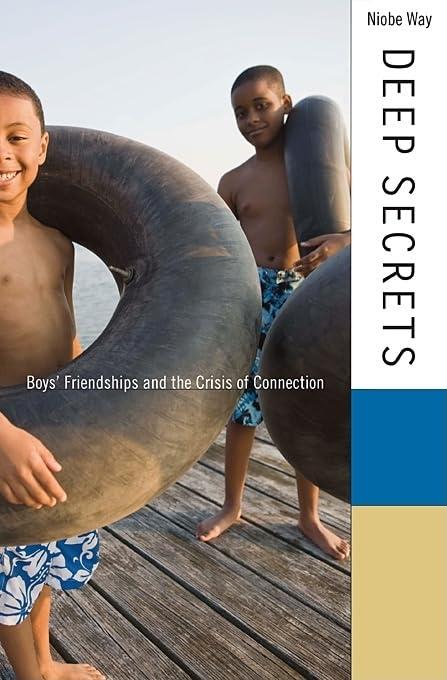

Deep Secrets: Boys’ Friendships and the Crisis of Connection Cover
Podcast Mentions

Deep Secrets Boys’ Friendships and the Crisis of Connection

Niobe Way

“Boys are emotionally illiterate and don’t want intimate friendships.” In this empirically grounded challenge to our stereotypes about boys and men, Niobe Way reveals the intense intimacy among teenage boys especially during early and middle adolescence. Boys not only share their deepest secrets and...

Podcasts 2
Quotes 7
The Daily Show: Ears Edition

Niobe Way's book, which details boys' friendships and the crisis of connection, was mentioned as the inspiration for the Oscar-nominated film, Close.

"

Also joining me is a professor of developmental psychology at NYU, an author of the book Deep Secrets, Boys' Friendships, And The Crisis Of Connection. Her book was also the inspiration for the Oscar-...

— Episode: Redefining Masculinity & Embracing Vulne...

Episode: Redefining Masculinity & Embracing Vulnerability |...

Niobe Way's book, which details boys' friendships and the crisis of connection, was mentioned as the inspiration for the Oscar-nominated film, Close.

"

Also joining me is a professor of developmental psychology at NYU, an author of the book Deep Secrets, Boys' Friendships, And The Crisis Of Connection. Her book was also the inspiration for the Oscar-nominated film Close.

I'll read a quote for 12-year-old boys that says something soft. I love him so much from my book, Deep Secrets.

Stay Tuned with Preet

It was discussed as a book that details the findings of the author's research on boys' friendships and the crisis of connection, highlighting the shift in language and behaviour as they age.

"

And then as they get older, you start to hear this sort of stereotypic man-up language.

— Episode: Indictment 2.0 & The Loneliness Crisis (...

Episode: Indictment 2.0 & The Loneliness Crisis (with Niobe...

It was discussed as a book that details the findings of the author's research on boys' friendships and the crisis of connection, highlighting the shift in language and behaviour as they age.

"

And then as they get older, you start to hear this sort of stereotypic man-up language.

So you start to hear things like, it's hard to find, you know, basically, it's hard to find friendships and I don't want them anymore.

You know, that basically I don't need them. It's okay, whatever.

And their language becomes much more, uh, both either sort of depressed, um, and you hear a sadness in their interviews.

Or it becomes this sort of, I don't care, whatever, it doesn't matter, it doesn't matter.

Note: The book recommendations on this page are discovered automatically from podcast transcripts, and may be incorrect or incomplete.