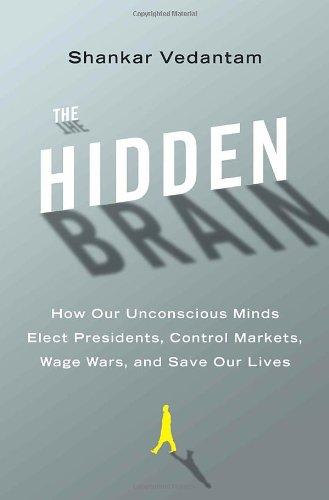
The Hidden Brain: How Our Unconscious Minds Elect Presidents, Control Markets, Wage Wars, and Save Our Lives Cover
Podcast Mentions

The Hidden Brain How Our Unconscious Minds Elect Presidents, Control Markets, Wage Wars, and Save Our Lives

Shankar Vedantam

Most of us would agree that there’s a clear—and even obvious—connection between the things we believe and the way we behave. But what if our actions are driven not by our conscious values and beliefs but by hidden motivations we’re not even aware of?

Podcasts 2
Quotes 6
The Joe Rogan Experience

Sam Harris's wife wrote this book about consciousness, which explores the concept that everything might have consciousness.

"

Sam Harris's wife just wrote a book about over one of the subjects of it's called conscious and conscious or consciousness sorry I don't remember which I haven't read it yet but I heard them talked ab...

— Episode: #1313 - Duncan Trussell

Episode: #1313 - Duncan Trussell

Sam Harris's wife wrote this book about consciousness, which explores the concept that everything might have consciousness.

"

Sam Harris's wife just wrote a book about over one of the subjects of it's called conscious and conscious or consciousness sorry I don't remember which I haven't read it yet but I heard them talked about it on his podcast and the concept that used to be like super woo woo was what if everything has consciousness yeah with everything had but it just it can't move it can express itself can't change its environment it's limited just like we can't fly and we can't swim underwater and breathe water like we we're limited in our physical abilities right but we assume that whatever limitations that we have like this is where it ends this is where the buck stops here yeah like everything that doesn't move it's gotta be stupid yeah but it might not be.
Hidden Brain

The host Shankar Vedantam referenced the title several times, noting that he had written about the Implicit Association Test and how subconscious biases shape behavior. He also described how the book examined patterns that influence life‑and‑death decisions during emergencies, such as the 9/11 attacks. These mentions highlighted the book as a key source for understanding unconscious influences on our actions.

Highly Recommended

Episode: Revealing Your Unconscious: Part 2

The podcast host mentioned that he wrote about the Implicit Association Test in his 2010 book, 'The Hidden Brain.'

"

I wrote about the test in my 2010 book, The Hidden Brain.

Episode: Revealing Your Unconscious: Part 2

It was mentioned as a book that the speaker had written about the implicit association test, suggesting it explored how people's subconscious biases can influence their actions.

"

I wrote about the test in my 2010 book, The Hidden Brain.

Episode: Persuasion: Part 2

The speaker mentioned his own book, 'The Hidden Brain', and how it described patterns of behavior that shape decisions involving life and death, referencing the events of September 11, 2001, specifically on the upper floors of the World Trade Center.

"

In my book, The Hidden Brain, I described how these patterns shape decisions involving life and death on the upper floors of the World Trade Center on September 11, 2001.

Episode: Persuasion: Part 2

The Hidden Brain was mentioned as a book that the host, Shankar Vedantam, wrote and it was explained how it helped him understand how people behave in emergencies. This was done by describing how people reacted on the upper floors of the World Trade Center during the 9/11 attacks.

"

In my book, The Hidden Brain, I described how these patterns shape decisions involving life and death on the upper floors of the World Trade Center on September 11, 2001.

Episode: Episode 1: Switchtracking

It was noted that Shankar Vedantam was the author of The Hidden Brain, a book about unconscious bias.

"

I'm Shankar Vedantam. You may know me as NPR social science correspondent or the author of The Hidden Brain, a book about unconscious bias.

Note: The book recommendations on this page are discovered automatically from podcast transcripts, and may be incorrect or incomplete.