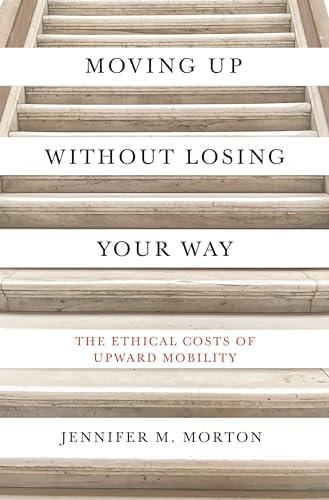

Moving Up without Losing Your Way: The Ethical Costs of Upward Mobility Cover
Podcast Mentions

Moving Up without Losing Your Way The Ethical Costs of Upward Mobility

Jennifer M. Morton

The ethical and emotional tolls paid by disadvantaged college students seeking upward mobility and what educators can do to help these students flourish Upward mobility through the path of higher education has been an article of faith for generations of working-class, low-income, and immigrant coll...

Podcasts 2
Quotes 14
Hidden Brain

Jennifer Morton argues that upward mobility often comes at an ethical cost, requiring individuals to make difficult choices that can strain their relationships with family and community. She explores the complexities of this dilemma through personal stories of strivers who navigate the challenges of leaving behind their origins and adapting to new social and economic environments.

"

In her book, Moving Up Without Losing Your Way, she explores the ethical costs that people often confront on the path to upward mobility.

— Episode: Between Two Worlds

Episode: Between Two Worlds

Jennifer Morton argues that upward mobility often comes at an ethical cost, requiring individuals to make difficult choices that can strain their relationships with family and community. She explores the complexities of this dilemma through personal stories of strivers who navigate the challenges of leaving behind their origins and adapting to new social and economic environments.

"

In her book, Moving Up Without Losing Your Way, she explores the ethical costs that people often confront on the path to upward mobility.

Jennifer Morton is a professor of philosophy at the University of Pennsylvania. She's the author of Moving Up Without Losing Your Way.

Episode: Between Two Worlds

It explored the ethical costs of upward mobility, especially in communities with concentrated social disadvantage, and how strivers can navigate the difficult ethical trade-offs inherent in seeking success.

"

In her book, Moving Up Without Losing Your Way, she explores the ethical costs that arise at the intersection of communities that face concentrated social disadvantage and the strivers from those communities who are on the path to upward mobility.

Jennifer Morton is a philosopher at the University of North Carolina at Chapel Hill. She's the author of Moving Up Without Losing Your Way.

Lovett or Leave It

It was described as an incredible book about climate change in the US and how corporate structures are trying to avoid facing the issue, both domestically and internationally. It was also said to explore the challenge of personal responsibility in a world where people are looking for fun movements that don't require individual perfection.

"

Mobility exists both as a story about climate in the U.S., but also a broader story about how how the world is facing climate change, how a kind of corporate structure that is international is trying...

— Episode: DeSantis on His Heels (Live from Portlan...

Episode: DeSantis on His Heels (Live from Portland!)

It was described as an incredible book about climate change in the US and how corporate structures are trying to avoid facing the issue, both domestically and internationally. It was also said to explore the challenge of personal responsibility in a world where people are looking for fun movements that don't require individual perfection.

"

Mobility exists both as a story about climate in the U.S., but also a broader story about how how the world is facing climate change, how a kind of corporate structure that is international is trying to avoid facing up to climate change.

And I think that like it is a book that grapples with personal responsibility to an enormous problem that we feel like the way in which people rationalize their connection to a broken system.

And I think that that's something that is like the left grapples with, I think more than the right does. But I think you see it in everything from fights about banning straws at Starbucks all the way up to, you know, what is all the way up to like what protests are happening like on college campuses.

Yeah, that's such a great point.

I think when people hear things like recently, like French people did a poll where they all agreed that people should have like four flights in their life. That doesn't like maybe make a lot of people think like, yes, I want to join onto this movement.

Episode: DeSantis on His Heels (Live from Portland!)

The book is described as a story about climate change in the US, and also a broader story about how the world is facing climate change, and how a kind of corporate structure is trying to avoid facing up to it.

"

Mobility exists both as a story about climate in the U.S., but also a broader story about how how the world is facing climate change, how a kind of corporate structure that is international is trying to avoid facing up to climate change.

And I think that like it is a book that grapples with personal responsibility to an enormous problem that we feel like the way in which people rationalize their connection to a broken system.

I think that that's something that is like the left grapples with, I think more than the right does. But I think you see it in everything from fights about banning straws at Starbucks all the way up to, you know, what is all the way up to like what protests are happening like on college campuses.

Mobility is an audio book. You can ear-read it.

You should get it as an audio book. Audio books are where you do your best ear-reading. Yes. But you mis-ear-read what I was saying. Yes.

Note: The book recommendations on this page are discovered automatically from podcast transcripts, and may be incorrect or incomplete.