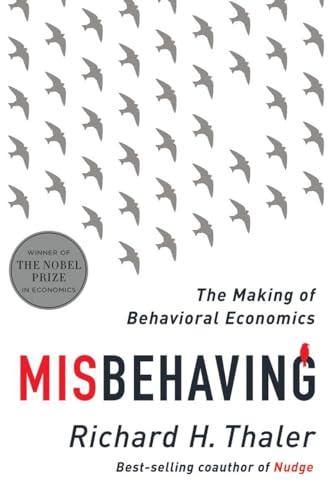
Misbehaving: The Making of Behavioral Economics Cover
Podcast Mentions

Misbehaving The Making of Behavioral Economics

Richard H. Thaler

Shortlisted for the Richard H. Thaler has spent his career studying the radical notion that the central agents in the economy are humans―predictable, error-prone individuals.

Podcasts 3
Quotes 25
Freakonomics Radio

It was mentioned in passing that Richard Thaler has written a book titled 'Misbehaving', which touches on the subject of behavioral economics.

"

there are books You know Thaler has published a book misbehaving on it

— Episode: 224. How To Win A Nobel Prize

Episode: 224. How To Win A Nobel Prize

It was mentioned in passing that Richard Thaler has written a book titled 'Misbehaving', which touches on the subject of behavioral economics.

"

there are books You know Thaler has published a book misbehaving on it

Episode: 207. Should We Really Behave Like Economists Say W...

It was described as an entertaining chronicle of how Thaler came to realize that the standard economist's model of human behaviour is inaccurate and unrealistic for most people. The book discusses behavioral economics.

"

So the book is called misbehaving the making of behavioral economics

Misbehaving is Thaler's very entertaining chronicle of how he came to recognize that the standard Economists model of human behavior is beyond the reach of most of us

...thus the title of my book

Hidden Brain

The host highlighted the title as a key resource for understanding the emergence of behavioral economics and how people often act contrary to rational economic models. He pointed out that the book uses anecdotes and research to illustrate concepts such as mental accounting and the empathy gap. The discussion emphasized its relevance for anyone interested in the psychological factors shaping economic decisions.

Highly Recommended

Episode: Follow the Anomalies

Richard Thaler's book, Misbehaving, explores the creation of the field of behavioral economics and how human behavior often deviates from traditional economic models. The book covers the development of the field through anecdotes and research, highlighting the importance of recognizing human psychology in economic decision-making.

"

Richard Thaler is the author of Misbehaving, the Making of Behavioral Economics.

You can read more about these ideas in his book, Misbehaving, the Making of Behavioral Economics.

Episode: Follow the Anomalies

This book tells the story of the creation of behavioral economics and provides insights into how human beings often fail to act like the rational economic actors in mathematical models.

"

Richard Thaler is the author of Misbehaving, the Making of Behavioral Economics.

You can read more about these ideas in his book, Misbehaving, the Making of Behavioral Economics.

Episode: Misbehaving with Richard Thaler

It was discussed as the latest book by Richard Thaler, outlining the development of behavioral economics, where it was explained that people often do not act as rationally as standard economic theory assumes.

"

Richard Thaler's latest book is Misbehaving, the Story of Behavioral Economics.

His latest book is called Misbehaving, The Making of Behavioral Economics.

Episode: Encore of Episode 16: Misbehaving

Richard Thaler's book, 'Misbehaving', was discussed at length, particularly the concepts of behavioral economics and mental accounting, explaining how people's decisions often deviate from the rational choices predicted by traditional economics.

"

Richard Thaler's latest book is Misbehaving, the Story of Behavioral Economics.

His latest book is called Misbehaving, the Making of Behavioral Economics.

LOL, this is just like one of the examples from your book.

Episode: Episode 16: Misbehaving

Richard Thaler's book "Misbehaving" explored the field of behavioral economics, highlighting how people deviate from the rational decision-making assumed by traditional economic models and how this impacts various aspects of our lives.

"

His latest book is called Misbehaving, The Making of Behavioral Economics.

That is the hot, cold empathy gap. Yeah. So when she was in the cold state, she didn't want any dessert. When she was staring the dessert in the face, you know, let me at it.

That was behavioral economist Richard Thaler. His latest book is called Misbehaving, the Making of Behavioral Economics.

No Stupid Questions

The biography of Richard Thaler was discussed, focusing on his path towards behavioural economics, a field for which he won a Nobel prize.

"

I have recently been slightly fascinated with the biography of Richard Taylor for a variety of reasons

— Episode: 147. Is Nudging Enough?

Episode: 147. Is Nudging Enough?

The biography of Richard Thaler was discussed, focusing on his path towards behavioural economics, a field for which he won a Nobel prize.

"

I have recently been slightly fascinated with the biography of Richard Taylor for a variety of reasons

So his story and how he became an economist and not a psychologist I think two paths diverged and yellow wood and there he the weary traveler stood and looked down one as far as he could To where it bent in the undergrowth and he took the economic path But I think he could have actually has easily become a psychologist

Honestly, that's why he did win the Nobel Prize for developing the discipline of behavioral economics, right?

So anyway, I've been on that rabbit hole and I think This is a good rabbit hole to be in now that we're coming out of a pandemic

But also I think there's another reason why all of this, you know nudging is a good is a bad What's beyond nudging?

Episode: 136. Is Sloth a Sin or a Virtue?

It was mentioned that Richard Thaler, a Nobel laureate in economics, is often described as lazy, but that his approach to laziness involves conserving energy for things he finds important and saying no to less important tasks.

"

I think of Richard Thaler the economist the University of Chicago are famously lazy Nobel laureate.

He loves I shouldn't say he loves to brag about being lazy but when other people talk about him being lazy he does kind of love it.

He does talk about himself as being lazy in the first person.

I would describe it as conserving attention and energy for things that you really care about and everything else you just say no to.

Note: The book recommendations on this page are discovered automatically from podcast transcripts, and may be incorrect or incomplete.