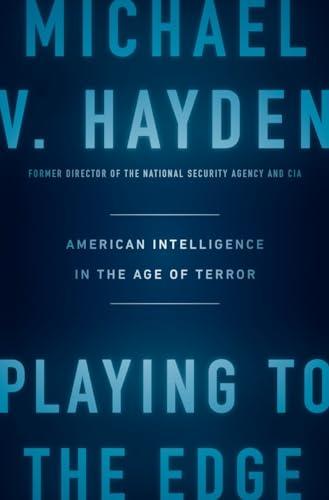
Playing to the Edge: American Intelligence in the Age of Terror Cover
Podcast Mentions

Playing to the Edge American Intelligence in the Age of Terror

Michael V. Hayden

An unprecedented high-level master narrative of America's intelligence wars, demonstrating in a time of new threats that espionage and the search for facts are essential to our democracy

Podcasts 2
Quotes 11
The President's Daily Brief

In the episode, Benham Ben‑Talablu referenced the title of the book while discussing how adversaries might gauge the limits of U.S. engagement in a region, noting that such insight could influence their actions. The mention was used as an illustrative point rather than a recommendation, highlighting the book's relevance to strategic analysis.

Episode: PDB Situation Report | August 3, 2024: Iran’s ‘Har...

The book's title was mentioned when discussing how adversaries may be able to assess the limits of US engagement in a region, suggesting the US was actively trying to distance itself.

"

And the ability of our adversaries to read that and to take the title of Michael Hayden's book Playing to the Edge, to play to the edge on that is what really got us in this scenario.

The Jordan Harbinger Show

It was discussed in detail throughout the podcast, and Hayden described the challenges of balancing security and liberty, especially after 9/11. He detailed how he'd had to adapt to the learning styles of different presidents and the challenges of dealing with difficult news.

"

I essentially say, look, the intel guy and the policy guy have got to come together in the room and that room could be a canvas covered tactic operation center in a desert somewhere or it could be the...

— Episode: 576: General Michael Hayden | American I...

Episode: 576: General Michael Hayden | American Intelligenc...

It was discussed in detail throughout the podcast, and Hayden described the challenges of balancing security and liberty, especially after 9/11. He detailed how he'd had to adapt to the learning styles of different presidents and the challenges of dealing with difficult news.

"

I essentially say, look, the intel guy and the policy guy have got to come together in the room and that room could be a canvas covered tactic operation center in a desert somewhere or it could be the over office.

The intel guy comes into the room through a different door than the policy guy.

The intel guy is fact based. The policy guy is vision based.

The intel guy is inherently pessimistic.

The policy maker though inherently optimistic if he or she didn't think they could make the world better, they wouldn't interview for the job.

Episode: 576: General Michael Hayden | American Intelligenc...

It was discussed in great detail throughout the episode, covering many controversial topics, including the tension between security and liberty, as well as the evolution of intelligence agencies in a post-9/11 world.

"

I point out that this is the greatest hemorrhaging of legitimate American secrets in the history of the Republic and Jordan. You are less safe today because of it.

In my book I try to weave this dynamic into a whole series of policy decisions that we supported the surgeon Iraq, the Elkabar nuclear reactor which was a nearly complete nuclear reactor in the Syrian desert in addition to the Iranian program.

The book is called playing to the edge what does that mean to you why did you name the book that yeah actually my wife named it the publisher said okay what's the title I go to title so my wife had read the manuscript and I said what do you think should be and she said playing to the edge I added the colon American intelligence in the age of terror but she recognized that one of the themes that permeates the book is that first of all I don't get to create the edge the edges the box that the American political process creates for security services legally you mean in terms of what you're allowed to do it's actually a creation of law and policy all right something to set down in law other things are set down in policy but we don't do either of those in the intel community that's done by elected officials and that's the box that we're allowed to operate in and the metaphor for the title is that when operational circumstances demand I've got to use the whole box I got to play all the way to the edge because if I don't play all the way to the edge if I don't use all the authorities the law and policy by the way Jordan if I play to the edge I know I'm going to have an unpleasant congressional airing newspapers are going to write some unhappy stories this is playing in the edge is going to be controversial but if I decide not to play back from the edge I've suddenly decided to protect myself or more nobly my agency from some unpleasant future but I'm not decided to protect you and that's my responsibility and so the theme of the book is that we did some really aggressive continue to be controversial things I was involved in practically all of them but in a very non-apologetic way I described what we did why we did it and why we thought it was a good idea.

Intelligence is essential to defend not just American security but American liberty it really has something so essential and so misunderstood or ununderstood by the population that it serves and so my purpose as you suggest Jordan in the book is to kind of do what I suggested to my Australian friend hey come with me I'm going to introduce you to some people and show you a bit of what it is they do on your behalf that you're probably not familiar with that was why I wrote

The Stoden Revolutions distorted but accelerated a necessary conversation and Jordan you already made reference to it, the NSA program and metadata and so on, all right? The other 98% of the stuff that he stole have nothing to do with your privacy or mind. They have everything to do with how your government collects legitimate foreign intelligence.

Note: The book recommendations on this page are discovered automatically from podcast transcripts, and may be incorrect or incomplete.