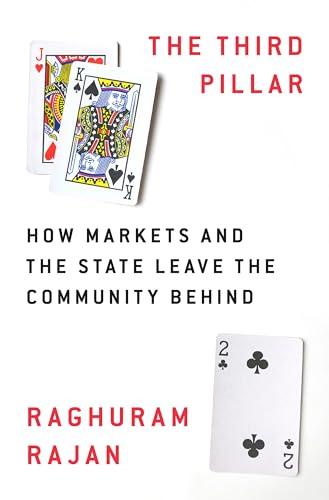
The Third Pillar: How Markets and the State Leave the Community Behind Cover
Podcast Mentions

The Third Pillar How Markets and the State Leave the Community Behind

Raghuram Rajan

Shortlisted for the Raghuram Rajan, distinguished University of Chicago professor, former IMF chief economist, head of India's central bank, and author of the 2010 FT-Goldman-Sachs Book of the Year

Podcasts 2
Quotes 6
Freakonomics Radio

It was published in the same month as the podcast, and focused on the importance of community alongside markets and the state, arguing that their scale has choked off community life and contributed to populism.

"

And this month, he's publishing a new book called The Third Pillar, how markets and the state leave the community behind.

— Episode: 366. This Economist Predicted the Last C...

Episode: 366. This Economist Predicted the Last Crisis. Wha...

It was published in the same month as the podcast, and focused on the importance of community alongside markets and the state, arguing that their scale has choked off community life and contributed to populism.

"

And this month, he's publishing a new book called The Third Pillar, how markets and the state leave the community behind.

The Third Pillar is an interesting book and an odd book. It's largely a work of economic history, even though Rajan isn't an economic historian.

His main argument is that the markets and the state have grown so big and powerful and institutional that they're choking off the lifeblood of actual communities, that we've gotten so good at scaling up that it's time for a concerted effort to scale down.

a populist movement believes that ruling elite are corrupt and undemocratic, that the masses have been treated poorly, and that the system ought to be changed because the general will of the people demands it.

The Jordan B. Peterson Podcast

The Third Pillar, by Raghuram Rajan, suggests that society thrives when three pillars, markets, the state, and community, are in balance. Keeley argues that having any one of these pillars out of kilter leads to problems, like environmental issues or crony capitalism.

"

I don't I'll talk about a couple different books today if I'm allowed to but one that's that that really did reach reach me, it was written by Rock Rogian who's a professor of finance at the Universit...

— Episode: 410. Discussing Impact Investment and ES...

Episode: 410. Discussing Impact Investment and ESG's with a...

The Third Pillar, by Raghuram Rajan, suggests that society thrives when three pillars, markets, the state, and community, are in balance. Keeley argues that having any one of these pillars out of kilter leads to problems, like environmental issues or crony capitalism.

"

I don't I'll talk about a couple different books today if I'm allowed to but one that's that that really did reach reach me, it was written by Rock Rogian who's a professor of finance at the University of Chicago and it's called the third pillar.

And what the thesis that that that Rock Rogian puts out, I think very effectively, is that if you have societies that he have either one of those out of kilter where where markets are too strong then then we run into environmental problems or we run into issues of distribution, we do have externalities negative externalities in markets that need to be corrected by proper but the role of community and the role of NGOs in the role of the volunteer sector the role of faith in a community the role is equally important if societies have any one of those missing they are not in optimal balance they tend towards crony capitalism.

Note: The book recommendations on this page are discovered automatically from podcast transcripts, and may be incorrect or incomplete.