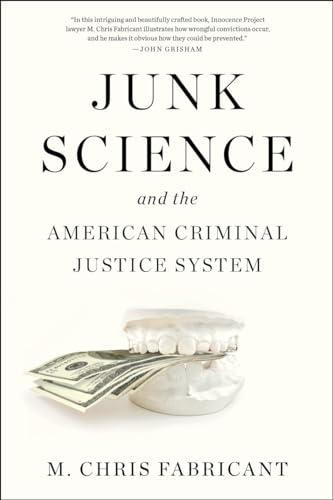
Junk Science and the American Criminal Justice System Cover
Podcast Mentions

Junk Science and the American Criminal Justice System

M. Chris Fabricant

Now in an expanded paperback edition, Innocence Project attorney M. Chris Fabricant presents an insider’s journey into the heart of a broken, racist system of justice and the role junk science plays in maintaining the status quo. "Fierce and absorbing . . . Fabricant chronicles the battles he and h...

Podcasts 3
Quotes 10
Behind the Bastards

The author of 'Junk Science' mentioned a story in his book about the use of hair microscopy in a rape conviction. The victim was a white woman who claimed her rapist was a black man, but DNA evidence later proved that the hair used as evidence was actually the pubic hair of the accuser.

"

Fabricant cites this infuriating story in his book, Junk Science.

— Episode: Part Two: The Bastards of Forensic Scien...

Episode: Part Two: The Bastards of Forensic Science

The author of 'Junk Science' mentioned a story in his book about the use of hair microscopy in a rape conviction. The victim was a white woman who claimed her rapist was a black man, but DNA evidence later proved that the hair used as evidence was actually the pubic hair of the accuser.

"

Fabricant cites this infuriating story in his book, Junk Science.

Quote, the Connecticut Supreme Court adopted the eyeball test and state v. Mark Reed, a rape conviction involving the use of hair microscopy, a technique that matches two hairs together through visual observation of the interior characteristics of human hair.

Hair matching evidence was admissible, not because it had been scientifically validated, but because jurors were free to make their own determinations as to the weight they would accord the expert's testimony in light of the photograph and their own powers of observation and comparison.

Ten years later, DNA proved that the jurors' powers of observation had led to Mark Reed's wrongful conviction.

He was innocent. The negroid hair, a racist anachronism still used in forensics today matched to Reed was in fact the pubic hair of his accuser, the white woman who had identified Reed a black man as her rapist.

Episode: Part One: The Bastards of Forensic Science

The conversation referenced the bookJunk Science, citing Chris Fabricant's commentary on how the FBI relied on flawed forensic evidence in the Mayfield case.

"

In the book Junk Science, Innocence Project lawyer Chris Fabricant writes, to the FBI Mayfield looked good for it.

book junk science to truly gain acceptance by his colleagues as a forensic scientist and recognition as an expert.

Criminal

Podcast

Criminal

The book was highlighted as a relevant resource for understanding the flaws in bite‑mark evidence, with the host directing listeners to a link on the podcast’s website. It was mentioned in the introduction and conclusion of the episode as a useful reference for the case discussed.

Episode: The Sailor's Teeth

Chris Fabricant's book, 'Junk Science and the American Criminal Justice System', was mentioned as relevant to the case discussed, specifically regarding the use of bite mark evidence and its flaws.

"

You can also find a link to Chris Fabricant's book, Junk Science and the American Criminal Justice System.

Stuff They Don't Want You To Know

It was recommended as a powerful read that illustrates how questionable scientific evidence is sometimes used in courtrooms to sway juries.

"

There's a great book out right now called Junk Science by Chris Fabricant that really shows you how the junk science is used in our courtrooms.

— Episode: Wrongful Conviction, with Jason Flom

Episode: Wrongful Conviction, with Jason Flom

It was recommended as a powerful read that illustrates how questionable scientific evidence is sometimes used in courtrooms to sway juries.

"

There's a great book out right now called Junk Science by Chris Fabricant that really shows you how the junk science is used in our courtrooms.

Episode: Wrongful Conviction, with Jason Flom

It was mentioned as a powerful book that reveals how junk science is often used in courtrooms to convict people.

"

There's a great book out right now called Junk Science by Chris Fabricant that really shows you how the junk science is used in our courtrooms.

Note: The book recommendations on this page are discovered automatically from podcast transcripts, and may be incorrect or incomplete.