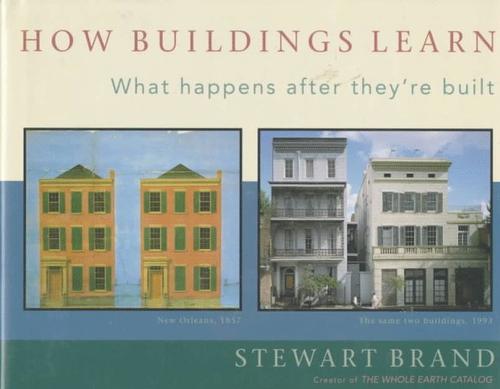

How Buildings Learn: What Happens After They're Built Cover
Podcast Mentions

How Buildings Learn What Happens After They're Built

Stewart Brand

Presents an innovative illustrated analysis of contemporary buildings and architecture, making a convincing argument for creating structures that are adaptable and allow redefinition of space and design and construction integration. 25,000 first printing. $25,000 ad/promo. Tour.

Podcasts 2
Quotes 13
The Ezra Klein Show

Brian cited Stewart Brand's How Buildings Learn, summarising its thesis that buildings never truly finish but are continuously reshaped, likening it to generative music.

"

One of Stuart Brand's books, it's called How Buildings Learn. In that he says you never finish a building, you only start it.

— Episode: A Breath of Fresh Air With Brian Eno

Episode: A Breath of Fresh Air With Brian Eno

Brian cited Stewart Brand's How Buildings Learn, summarising its thesis that buildings never truly finish but are continuously reshaped, likening it to generative music.

"

One of Stuart Brand's books, it's called How Buildings Learn. In that he says you never finish a building, you only start it.

Episode: Stewart Brand, Silicon Valley’s Favorite Prophet,...

It was praised as a beloved 1994 book that the host urged listeners to read.

"

Not just the whole Earth Catalog, but How Buildings Learn in 1994, which I love, and if you've not read, you really should.

99% Invisible

The podcast highlighted the book as a seminal work on adaptive reuse, emphasizing that buildings must be flexible and evolve with societal needs. Roman Mars repeatedly cited the author’s arguments that architecture is “allergic to time” and that structures serve as flawed predictions of the future, using examples from Victorian townhouses to manufactured homes. The discussion presented the book as a valuable framework for understanding how structures can grow and change over their lifespans.

Highly Recommended

Episode: Office Space

The book explores the concept of adaptive reuse, arguing that buildings should be flexible and able to change with the needs of society over time. The author, Stewart Brand, highlights how buildings are constantly evolving and that even the best buildings need to be refreshed and challenged from time to time.

"

What I'm really interested in is not architecture, it's buildings.

The problem with architecture is that it's allergic to time.

Because architects keep being asked to create lasting monuments frozen in time.

Buildings live in time the same way we do.

One of Brands big ideas is that all buildings are predictions for what the future will be like and those predictions are usually wrong.

Episode: Office Space

It was mentioned as a book and BBC miniseries that Stewart Brand wrote about buildings, particularly his ideas on adaptive reuse.

"

Proponents of adaptive reuse love to cite Stewart brand and his book and BBC miniseries how buildings learn

What I'm really interested in is not architecture its buildings The problem with architecture is that it's allergic to time Because architects keep being asked to create lasting monuments frozen in time. The buildings have no such presumption Buildings live in time the same way we do

One of brands big ideas is that all buildings are predictions for what the future will be like and those predictions are usually wrong The basic functions and uses of most buildings change in pretty radical ways over their lifespans a

In how buildings learn Stewart Brand talks about how for a building to be long-lasting It needs to be flexible a great example of this are old Victorian townhouses in San Francisco

Episode: Immobile Homes

The book 'How Buildings Learn' by Stuart Brand was mentioned in the context of the evolution and adaptability of buildings, particularly manufactured homes, and how they can change over time, even though they are initially pre-designed.

"

Stuart Brand's really excellent book, How Buildings Learn, was actually coined by a man named Elmer Frey.

But Brand points out that these initial modules are actually rich with potential too. As he puts it, a smaller unit can become the, quote, seed around which a larger home grows.

Note: The book recommendations on this page are discovered automatically from podcast transcripts, and may be incorrect or incomplete.