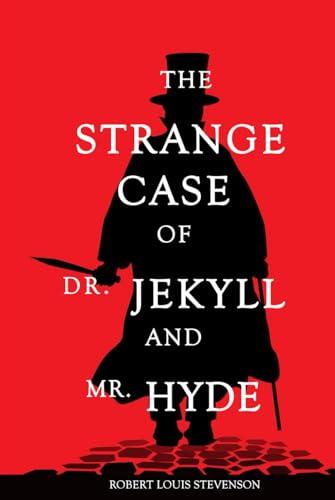
The Strange Case of Dr. Jekyll and Mr. Hyde Cover
Podcast Mentions

The Strange Case of Dr. Jekyll and Mr. Hyde

Robert Louis Stevenson

"The Strange Case of Dr. Jekyll and Mr. Hyde" is a classic novella written by Scottish author Robert Louis Stevenson and first published in 1886. This iconic work is a gripping exploration of the duality of human nature and the moral implications of unchecked desires.

Podcasts 3
Quotes 12
Fresh Air

Podcast

Fresh Air

The classic novella was cited as another Stevenson work the reviewer intended to revisit after being inspired by A Wilder Shore.

"

I want to reread Robert Louis Stevenson's three great works of fiction, Treasure Island, Kidnapped, and The Strange Case of Dr. Jekyll and Mr. Hyde.

— Episode: Actor Aunjanue Ellis-Taylor On The Compl...

Episode: Actor Aunjanue Ellis-Taylor On The Complexity & He...

The classic novella was cited as another Stevenson work the reviewer intended to revisit after being inspired by A Wilder Shore.

"

I want to reread Robert Louis Stevenson's three great works of fiction, Treasure Island, Kidnapped, and The Strange Case of Dr. Jekyll and Mr. Hyde.

American History Tellers

This novel was first published in 1886, the same year the Statue of Liberty was dedicated.

"

In 1886, the strange case of Dr. Jekyll and Mr. Hyde by Robert Louis Stevenson was first published.

— Episode: The Statue of Liberty | 6

Episode: The Statue of Liberty | 6

This novel was first published in 1886, the same year the Statue of Liberty was dedicated.

"

In 1886, the strange case of Dr. Jekyll and Mr. Hyde by Robert Louis Stevenson was first published.

Timothy Keller Sermons Podcast by Gospel in Life

Timothy Keller referenced the title as a springboard for discussing the biblical view of human nature, noting that its depiction of dual selves was both more pessimistic and more optimistic than Scripture. He described the story as a terrifying illustration of the inner battle between good and evil, emphasizing how the evil side can dominate when separated. The conversation highlighted the book’s usefulness for exploring the tension between sin and redemption, treating it as an insightful, if unsettling, example rather than a direct endorsement.

Episode: The War Between Your Selves (Part 2)

The book was used as a starting point to discuss the biblical view of human nature, which was argued to be both more pessimistic and more optimistic than the book's portrayal.

"

We began to talk about this last week in the famous story, novel by Robert Louis Stevenson, Dr. Jekyll and Mr. Hyde.

Because when Henry Jekyll for the first time takes the potion and he finds himself becoming Edward Hyde, he says, I knew myself at the first breath of this new life to be more wicked, one fold more wicked, sold a slave to my original sin.

And of course the first verse of the passage that we have pulled out for today in which he says, I know the law is spiritual but I am unspiritual, sold as a slave to sin.

You remember how the story goes that Henry Jekyll has come up with a magic potion, he calls it metaphysical chemistry, and that potion will enable his good and his evil self, the good in him and the evil in him to become two selves free from each other.

And he thinks that's really going to help because the problem with, he thinks, the human condition is that neither of those selves lets the other one ever enjoy life.

Episode: The War Between Your Selves (Part 1)

Dr. Jekyll and Mr. Hyde was a terrifying story about the duality of man, with good and evil battling within each individual. Jekyll ultimately discovered that his evil side was far worse than he imagined and he could not control it, ultimately losing the battle to his evil self.

"

I had a chance to read Dr. Jekyll and Mr. Hyde. No, I didn't see a movie, I didn't see a Broadway play, I haven't. I was just, I hadn't, you know, most of us think we know the story of Dr. Jekyll and Mr. Hyde, but we've actually seen productions of it. But when you actually go back and read the original little novella by Robert Louis Stevenson, it's not very long, 80 pages or so. It's a terrifying book.

He says, every day I drew steadily nearer to that truth that man is not truly one but truly two. I saw the primitive duality of man. I saw the two natures contending in the field of my consciousness. If I could rightly be said to be either, it was only because I was radically both.

He called himself, it's a great phrase, he called himself an incongruous compound. And he said, you see, nobody can be happy.

He says the unjust then might go his way, delivered from all the aspirations and remorse of his upright twin. And the just could walk on his upward path, doing good and no longer exposed to disgrace by the actions of his evil other.

He says, this being, Edward Hyde, was inherently maligned, his every act and every thought centered completely on himself. The book says that Edward Hyde is the only unmixed human being on the face of the earth. So that when you came up to him, you found no redeeming characteristics, so nothing but selfishness, nothing but a person who completely, as he said, every act and every thought centered totally on himself.
Note: The book recommendations on this page are discovered automatically from podcast transcripts, and may be incorrect or incomplete.