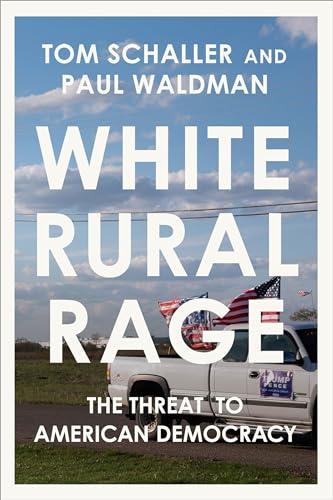
White Rural Rage: The Threat to American Democracy Cover
Podcast Mentions

White Rural Rage The Threat to American Democracy

Tom Schaller

NEW YORK TIMES White rural voters hold the greatest electoral sway of any demographic group in the United States, yet rural communities suffer from poor healthcare access, failing infrastructure, and severe manufacturing and farming job losses. Rural voters believe our nation has betrayed them, and...

Podcasts 4
Quotes 21
The Megyn Kelly Show

It was described as a book that promotes the idea that white, rural voters are a threat to the country due to their supposed racism, xenophobia, and anti-democratic beliefs.

"

A few weeks ago, they had on the authors of a new book they really want you to read called White Rural Rage.

— Episode: Predators Exposed at Nickelodeon, and De...

Episode: Predators Exposed at Nickelodeon, and Democrats Ab...

It was described as a book that promotes the idea that white, rural voters are a threat to the country due to their supposed racism, xenophobia, and anti-democratic beliefs.

"

A few weeks ago, they had on the authors of a new book they really want you to read called White Rural Rage.

They're the most racist xenophobic anti-immigrant anti gay geographic group in the country. Second, they're the most conspiracist group. Q and on support and subscribers, election denialism, COVID denialism, scientific skepticism, Obama, Berthorism.
The Charlie Kirk Show

The book was highlighted as a newly released work by two professors who argue that white rural voters who own farms, work with their hands, and attend church pose a threat to American democracy. Host Charlie Kirk discussed it in both episodes, describing its portrayal as a searing, damning takedown of these citizens and expressing disagreement with its premise. He critiqued the book’s characterization of rural Americans as an existential threat to the nation.

Critiqued

Episode: Whose Country Is It Anyway? My Speech at Texas Tec...

It was recently published and discussed as a book written by two professors who, while being welcomed on MSNBC, suggest that white rural voters who own farms, work with their hands, and go to church are a threat to democracy.

"

There's a book that was recently published and I can't help but just think of so many of you. The book's title is called 'White Rural Rage', the threat to democracy.

And so if you get in a car and go 30 miles west or 30 miles east from here you will find the people that this book is talking about.

These are two professors that wrote this book and they were beautifully welcomed on MSNBC.

And for those of you that own farms and you work with your hands and you go to church, you happen to be white they think you're the threat to democracy.

Episode: Squashing the Squatters

It was discussed as a book that portrays white rural voters as a threat to democracy, rejecting the core principles of the US and its constitution, a searing portrait of them, which Charlie Kirk disagreed with.

"

The book is called white rural rage. Remember we talked about this last week. I bought a copy of it. It's Blake's new homework assignment to read this thing.

A searing portrait and damning takedown of America's proudest citizens, were the least likely to defend its core principles.

They call anyone that lives in rural America and is white you are a threat to democracy.

They right here in white rural rage they've an entire chapter in this book, the greatest political hand ever dealt that US white rural voters have so you have a disproportionate amount of power in this country.

They call you an existential threat to the American project.

The Bulwark Podcast

The authors, Shaller and Wallach, were accused of misusing the academic research in their book by using the term "rage" when they were actually studying "resentment". The title was admittedly provocative but they pled guilty to the charge of overusing the term "rage" for the sake of readability. They were criticized for the potentially misleading title which may have cost them book sales.

"

We use the word rage, but we're really talking about the academic and scholarly construct resentment, but white world resentment is a lot of syllables and doesn't really fit neatly vertically, and as...

— Episode: Bill Kristol: Pure Oligarchic Greed

Episode: Bill Kristol: Pure Oligarchic Greed

The authors, Shaller and Wallach, were accused of misusing the academic research in their book by using the term "rage" when they were actually studying "resentment". The title was admittedly provocative but they pled guilty to the charge of overusing the term "rage" for the sake of readability. They were criticized for the potentially misleading title which may have cost them book sales.

"

We use the word rage, but we're really talking about the academic and scholarly construct resentment, but white world resentment is a lot of syllables and doesn't really fit neatly vertically, and as you know, publishers want, you know, one word blink Malcolm Gladwell kind of titles, we couldn't get it down to one or even two words, but we got it down to three words and four syllables, and so we're really talking about resentment.

We have pled guilty, this in public appearances already, the title is a bit provocative, we use the word rage, but we're really talking about the academic and scholarly construct resentment, but white world resentment is a lot of syllables and doesn't really fit neatly vertically and as you know publishers want, you know, one word, blink Malcolm Gladwell kind of titles. We couldn't get it down to one or even two words, but we got it down to three words and four syllables, and so we're really talking about resentment.

If you do a search on the galleys of the book as we've done, the word rage actually appears in the actual text a handful of times.

Episode: Tom Schaller and Paul Waldman: White Rural Rage

The authors explore the reasons behind the rise of resentment and anger among white rural voters in the United States, particularly during the Trump era, exploring the factors of economic decline, political disenfranchisement, and demographic change.

"

We use the word rage but we're really talking about the academic and scholarly construct resentment but white rural resentment is a lot of syllables and doesn't really fit neatly vertically and as you know publishers want you know one word blank Malcolm Gladwell kind of titles we couldn't get it down to one or even two words but we got it down to three words in four syllables and so we're really talking about resentment.

We believe that's the first time in American history that a majority of counties shrunk and 67% of rural counties lost population. There's a massive brain drain as young people are being told 60% of rural adults tell their own children to leave and not come back so these patterns are disemboweling rural America and some of it's you know not their fault. Its late-stage capitalism that replaces coal miners who used to be sent down holes with you know pickaxes and shovels to dig coal out a pound at a time now we have mountain top removal that blows the top off of a coal mine and removes it tons at a time with a shovel you can't go to Congress you could vote against globalization until China and other countries not to hire you know children for pennies on the hour and no environmental protections to outcompete us but they're not going to do that and Trump who said trade wars are easy to win found out the hard way when he posed tariffs on China that they would engage in retaliatory tariffs and had to pass a 23 billion dollar bailout for farmers and you know the suicide rates and dairy farmers in northern Wisconsin and other parts skyrocketed during the Trump administration because his policies backfire so there are some things that are beyond the control of rural America's white or otherwise to try to stand their communities back up because of just the natural movement away from rural farming and extractive economies into the technological age of education and health care and information age economies.

If it were just the disemboweling of rural communities that drove rage then we would see as Paul pointed out that rage would be uniform across both rural whites and non-whites but it is not. Why is it that rural non-whites rural minorities by the way with the exception of gun deaths and opioid deaths suffer economically worse than their white neighbors and experience worse health maladies than their neighbors? Why is it they're not as rageful and resentful? Why is it they're not storming state capitals? Why is it they're not justifying and excusing the people who attack the country and the capital in January 6th? This is a paradox that a lot of white rural scholars and many pundits do not want to engage it because what they're going to find at the end of that inquiry is that this rage is bifurcated between white rural Americans who have been as we call them the essential minority since the rise of Jacksonian democracy part of every governing coalition whether it was the Lincoln party era system from 1860 to 1896 to the McKinley system up until the New Deal in 1932 and certainly part of the rural southern New Deal coalition have now seen their power slip away. They don't like it and so we subscribe to the Ezra Klein belief that what really undergirds this is demographic change and that demographic change is to be fair new-erically moving away from them right the country is becoming less white it is becoming less rural and they feel their power slipping away and their their potency as the rural essential minority dissipating. That's true and so I think it's a revanchist sort of rear-guard action to defend territory and political power in a way that they see slipping away.

It's a fine young newly minted political scientist named Kristen Lundstruhi at the University of South Carolina. I read her dissertation when she wrote about rural white Americans at the University of Minnesota and she finds that there's higher anti-analyse realism among among rural white Americans and it's not a perfect direct through line to the kind of conspiracism in the disinformation that we see that is used by people like Pasoviaq who want to convince this that Hillary Clinton and John Podesta are kidnapping raping and then drinking the blood after killing children in a basement of a pizza shop that doesn't have a basement.

We don't want to talk about critical race theory, we don't want to talk about black lives matter. We want to talk about regulating the Arabian bees because people come from out of town and we want the money but we you know they trash the places and they're too loud and so far we want to keep the lake placid 24 hour emergency room that they want to close for eight hours overnight open so that people are in car accidents or have heart attacks don't have to go to Plattsburg or across the lake lake Champlain to Burlington because all the hospitals are owned by the Vermont system in Adirondex the Champlain Valley Regional Hospital that's what we're worried about. We don't want to talk about library book bans. This is the national ization of local politics and so when you remove the local media and you nationalize the politics and people are shouting at town meetings about critical race theory we've lost something and in the conversations become more course and the discourses become more devoid of real substance and facts and that's how with a peppy dollop of social media that's how you lose your democracy frankly and it's not a explicitly rural white phenomena it's a it's a broader cultural and media phenomena and I think it's very dangerous and I think you know even if rural whites as we argue are the tip of the spear of this movement of the magma movement they're not alone in that fact and we have serious problems with public discourse and a functional democracy that depends on voters being at least minimally informed and engaged.

The Clay Travis and Buck Sexton Show

The authors discussed the fourfold interconnected threat that white rural voters pose to the country, such as racism, xenophobia, conspiracy theories, and a willingness to excuse violence in place of discourse.

"

Their new book out tomorrow is entitled White Rural Rage, The Threat to American Democracy.

— Episode: Battleground LIVE: All Eyes on the Supre...

Episode: Battleground LIVE: All Eyes on the Supreme Court

The authors discussed the fourfold interconnected threat that white rural voters pose to the country, such as racism, xenophobia, conspiracy theories, and a willingness to excuse violence in place of discourse.

"

Their new book out tomorrow is entitled White Rural Rage, The Threat to American Democracy.

We lay out the fourfold interconnected threat that white rural voters pose to the country. First of all, and we show 30 polls in national studies to demonstrate this. We provide the receipts in chapter six. They're the most racist, xenophobic, anti-immigrant anti-gay, geodemographic group in the country.

Note: The book recommendations on this page are discovered automatically from podcast transcripts, and may be incorrect or incomplete.