
Podcast
On Being with Krista Tippett
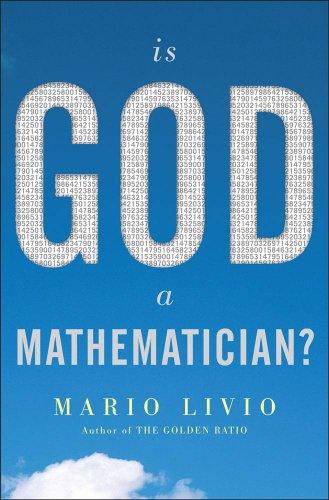
This question, the title of the book, is very intriguing to Mario Livio because it deals with the power of mathematics in explaining the universe and the question of whether mathematics is discovered or invented.
This question that is the title of your book, Is God a Mathematician? I want to honor the fact that the point you make that the question itself is what's most fascinating to you. And I'd like to dwell...
— Episode: Mario Livio — Mathematics, Mystery, and...
Episode: Mario Livio — Mathematics, Mystery, and the Univer...
This question, the title of the book, is very intriguing to Mario Livio because it deals with the power of mathematics in explaining the universe and the question of whether mathematics is discovered or invented.
This question that is the title of your book, Is God a Mathematician? I want to honor the fact that the point you make that the question itself is what's most fascinating to you. And I'd like to dwell on that. What is interesting? What does this question mean to you? And how do you find it arising? Kind of take us there.
So the question was phrased after there was a physicist called James Jeans in the last century and he once used phrases such as, you know, God is a mathematician and so on. And I phrased the question based on his words more or less. And the meaning of the question really is how come that mathematics is as powerful as it is in explaining almost everything in the universe? That's one part of the question. And the second part, which is equally intriguing, is, is mathematics discovered? Namely, you know, mathematics is out there and we are just discovering the truths of mathematics. Or is it an invention of the human mind? And it really has no existence outside the human mind. So these are the two main questions that I try to deal with in this book.
And, you know, my colleague, Roger Penrose, whom I don't know if you've ever interviewed him. I haven't, but I know his work. Yeah. So he's a very famous mathematical physicist. So he once said that there are these three worlds and three mysteries.
So the three worlds are, one is the physical world. You know, this is the world where we exist. There are chairs, tables, there are stars, there are galaxies, and so on. Then there is a second world, which is the world of our consciousness, if you like, our mental world, the world where this is where we love, where we hate, you know, and so on. All our thoughts are there and so on. And then there is the third world, which is this world of mathematical forms. This is the world where all of mathematics is there, you know, the theorem of Pythagoras and so on and so forth, all these imaginary numbers and all that.
And now come these three mysteries. One mystery is that somehow out of the physical world, our world of consciousness has emerged. That's one mystery. Right. A second mystery is that somehow our world of consciousness or mental world gained access to this world of mathematical forms, you know, that we were able to invent and discover all these mathematics. And third and maybe most amazing mystery is that we find that this world of mathematics provides the explanations for the physical world.
Episode: [Unedited] Mario Livio with Krista Tippett
The book explored the deep relationship between mathematics and the universe, questioning whether mathematics is discovered or invented and whether it points towards a divine order. The book's title is a question that the author posed, prompting readers to ponder the profound connections between mathematics, the universe, and possibly a higher power.
Mario Livio is the author of seven books, including ...Is God a Mathematician?
So the question, you know, was phrased after there was a physicist called James Jeans in the last century. And he once used phrases such as, you know, God is a mathematician and so on.
And I phrased the question, you know, based on his words more or less. And the meaning of the question really is how come that mathematics is as powerful as it is, you know, in explaining, you know, almost everything in the universe?
So let's talk first of all, about just the tease out the idea of the power of mathematics. I mean, you and other scientists use words to describe mathematics that are also words that are used to describe the divine, right? Omnipresence and omnipotence.
And you give some examples of that in your writing.
And you know, like the, the question is got a mathematician, the longer you think about this question of whether mathematics is invented or discovered, you find that just the act of asking the question itself is so rich, right? I mean, and you, and you, and you end up with all these puzzles or mysteries that, that feel to me that they're verging on the philosophical and the theological as well, right? By implication.
So, so you can say that our minds give rise to mathematics, but then, then mathematics are found to explain the physical world.
And that's the same sense of, you know, the question is God a mathematician? Nearly how come mathematics is as powerful as it is in explaining the universe?