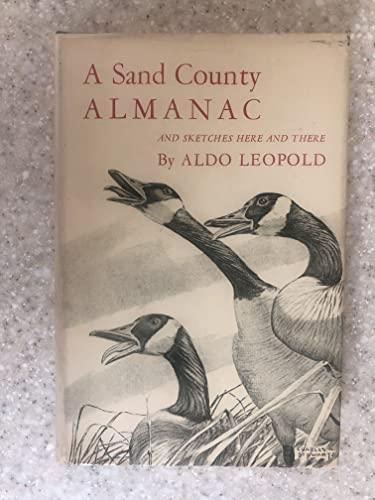
A Sand County almanac,
And Sketches here and there;
Aldo Leopold
Pp. 226, illustrated by Missouri conservationist and artist, Charles Schwartz. Teal cloth with silver lettering on the front board and spine, DJ, 8vo. Points: 1949 is on title page and copyright page, the dust jacket is the first state with the $3.50 price on the front flap but no mention of Round R...
This book was considered the most influential conservation and environmental text, written in a way that resonated with hunters and introduced the idea of the hunter-conservationist.
"
one of my peers that goes into wildlife management, like, introduced me, for instance, to Aldo Leopold's, a Sand County Almanac, which is probably... Not probably. Which is the most influential conser...
— Episode: Eating What You Kill This Thanksgiving
Episode: Eating What You Kill This Thanksgiving
This book was considered the most influential conservation and environmental text, written in a way that resonated with hunters and introduced the idea of the hunter-conservationist.
"
one of my peers that goes into wildlife management, like, introduced me, for instance, to Aldo Leopold's, a Sand County Almanac, which is probably... Not probably. Which is the most influential conservation environmental text.
Why it's the most influential is because it was written for rednecks like what we were.
The book was highlighted as a foundational conservation text whose elegant, poetic prose and timeless stewardship ethic resonated with hosts and listeners. Steven Rinella and other contributors praised its relevance, recommended it as essential reading for hunters, anglers, and conservationists, and referenced its influential concepts such as the five tools of wildlife management and the ethical relationship to nature. The overall sentiment was strongly positive, presenting the title as a must‑read classic.
Highly Recommended
Episode: Ep. 558: An Aldo Leopold Blowout Extravaganza
It was described as the most influential piece of conservation writing ever, and still maintains relevance today. It is a collection of Leopold's writings, and has been described as a beautiful book with powerful and emotive language. It was said to be more relevant today than Roosevelt's writings.
"
When you go read Roosevelt today, you're reading Roosevelt kind of like, like a hobby historian.
When you read a Sand County Almanac, you're, you're reading it and finding out you're reading it and being like, holy, this could have been written yesterday.
If you have a PhD, you run the risk of being like a mortician looking at a dead body.
There are those, there are some who can live without wild things and some who cannot.
These essays are the delights and dilemmas of one who cannot.
Episode: Ep. 443: Game On, Suckers! MeatEater Trivia LXI
It was mentioned in a trivia question regarding the five tools of wildlife management, which were discussed in the 1949 edition of this book. The question tested the players' knowledge of its contents.
"
Which of these is not one of the five tools of wildlife management listed in the 1949 book, a sand county almanac, axe, cow, water gun?
Episode: Ep. 443: Game On, Suckers! MeatEater Trivia LXI
It was mentioned in a trivia question regarding the five tools of wildlife management; the book was published in 1949. The question, about which of four options was not one of the five tools, proved particularly difficult, as no one answered correctly.
"
Which of these is not one of the five tools of wildlife management listed in the 1949 book A Sand County Almanac, axe, cow, water, gun?
Axe, cow, water, gun. What would be your guess, Steve?
Cow.
No, that's wrong. Water.
Water is right. Nobody got that right though the time we played.
Episode: Ep. 343: Game On, Suckers! MeatEater Trivia XIII
The book, published in 1949, details the five tools of wildlife management; the participants were asked which of four choices was not one of these tools. It was revealed that the correct answer was water, as the five tools are axe, plow, cow, fire, and gun.
"
Which of these is not one of the five tools of wildlife management listed in the 1949 book, a sand County almanac.
Which of these is not one of the five tools of wildlife management in a sand County almanac.
The central thesis of game management is this game can be restored by the creative use of the same tools, which have heretofore destroyed it. Axe, plow, cow, fire and gun.
What year was most of that book written?
it was written in the twenties
Episode: Ep. 177: Poison vs. Choppers
It was described as having elegant and compelling prose about the outdoors, resonating with the listener in college and remaining relevant even today, 70 years after its publication. The book's timeless stewardship ethic was noted as particularly relevant to Texas's private land conservation efforts.
"
I mean, his prose was so elegant. I mean, it was so compelling, and he just wrote about the outdoors in ways that really spoke to me. And in ways that no one had done.
I think the whole stewardship ethic, you know, and of course, in a private land state like Texas, that's very germane to what we do.
Episode: Ep. 149: Path of the Puma
The podcast mentioned Aldo Leopold's book, referencing his past experiences hunting predators and his later epiphanies about the role of predators in the ecosystem.
"
Aldo Leopold talks about it in Sand County Almanac, the mountain and the green, green fire, green fire dying in the wool side.
Episode: Ep. 140: Getting The Most Of It
The podcast discussed a quote, incorrectly attributed to Aldo Leopold, regarding ethical behavior. The hosts investigated its origin and found no evidence of Leopold ever writing or saying it.
"
ethical behavior is doing the right thing when no one else is watching, even when doing the wrong thing is legal
I contacted an old associate, Kurt Mein, the world's greatest Leopold authority, a trustee of the Leopold Foundation, a professor of ecology at University of Wisconsin, the author of the definitive Leopold biography.
He has read every quotable word Leopold ever wrote or said.
Aldo was a great man and a deep, deep thinker, but he never said what you keep saying he said, stop it.
Episode: Ep. 134: An Object and Its Shadow
The podcast mentioned a quote from Aldo Leopold's book, "Sand County Almanac", specifically a quote from his son Luna Leopold about rivers and the erosion of continents. It was discussed as a memorable and relevant quote about the landscape.
"
Rivers are the gutters down which flow the ruins of continents.
Episode: Ep. 119: Walking the Edge
Several Christian ethicists referenced this book, particularly the story of the wolf, when discussing the long-term implications of hunting and the concept of dominion.
"
And so he turns to Aldo Leopold. And so he turns to Aldo Leopold. And so he turns to Aldo Leopold. And so he turns to a you've got to think long term. So many Christian ethicists have turned to this.
Episode: Ep. 095: Inconvenient Critters
The podcast discussed Aldo Leopold's views on hunting technology and its impact on the environment, mentioning a quote about improving the pump without improving the well. His work was referenced as insightful regarding the balance of resource use and conservation.
"
Aldo Leopold's talking about technology he's talking specifically about hunting technology and he was saying that that you can't improve the well you can't improve the pump without improving the well yeah he's not talking about oil rigs he's talking about water water but meaning if you're going to make it easier and easier and easier to extract more and more and more water you're going to have to figure out a way to make the well better too deeper and better and pure because you will suck that some bitch dry
Episode: Ep. 072: American Wilderness
The podcast described "Sand County Almanac" as Aldo Leopold's seminal work, a poetic and ecologically insightful text resonating with hunters, anglers, and conservationists. It was recommended to be read before Curt Meine's biography.
"
San County Almanac. He wrote there and that was collected and published after his death.
Leopold's work in a Sand County Almanac is poetry and poetry with an ecological twist that every hunter angler conservationist can resonate with.
The author discusses his connection to Aldo Leopold's "A Sand County Almanac" which he first discovered in his brother's room. He was captivated by the writing and illustrations. It also resonated with his family's experience of living off the land.
"
I remember picking up his book, A Sand County Almanac in my brother's room and my brother's room was a place that that you ventured into at great peril.
— Episode: [Unedited] J. Drew Lanham with Krista Ti...
Episode: [Unedited] J. Drew Lanham with Krista Tippett
The author discusses his connection to Aldo Leopold's "A Sand County Almanac" which he first discovered in his brother's room. He was captivated by the writing and illustrations. It also resonated with his family's experience of living off the land.
"
I remember picking up his book, A Sand County Almanac in my brother's room and my brother's room was a place that that you ventured into at great peril.
Here's one way you just kind of summarize some of his admonitions that you kept with you to be to be one of those who cannot live without wild things. Keep all the parts, listen to the mountain and preserve the integrity, stability and beauty of the biotic community.
That says it all right. I mean, yeah, it's amazing. You know that if you can hoard if you can sort of hoard experiences, which I think is part of what I do along with books and other things. But if you can hoard experiences out there, then for me that that informs who I am.
So so seeing my father burn a piece of land to keep it productive or being out with him when he was cutting a tree and thinking about Leopold's good oak and thinking about the annual rings in that tree as history and not just how the tree grew, then then it it helps me understand and sort of re-find my place in the past, but also now.
The book, written by Aldo Leopold, was discussed in relation to the ethics of hunting and respecting wildlife. It was cited for its profound impact on the podcast host's understanding of ethical hunting practices.
"
there's uh you know one of the people we regard is sort of one of the fathers of modern wildlife conservation and also in some ways you know a person who was deeply influential to me though he you kno...
— Episode: Tony Gonzalez, Keita Bates-Diop, Courtne...
Episode: Tony Gonzalez, Keita Bates-Diop, Courtney Dauwalte...
The book, written by Aldo Leopold, was discussed in relation to the ethics of hunting and respecting wildlife. It was cited for its profound impact on the podcast host's understanding of ethical hunting practices.
"
there's uh you know one of the people we regard is sort of one of the fathers of modern wildlife conservation and also in some ways you know a person who was deeply influential to me though he you know we never cross paths uh is guy named Aldo Leopold who uh his most famous work is San County Almanac right which was which was basically a collection of things that he'd written during the sort of dark ages of American wildlife which was around the 1920s
The Book of Alma was mentioned as an example of the seed growing into a tree and producing fruit.
"
Alma later on is going to pick up in that same kind of language when he's talking about the seed and the seed growing into a tree and the tree producing fruit. He uses that same kind of language about...
— Episode: 1 Nephi 6-10 Part 1 • Dr. Gaye Strathear...
Episode: 1 Nephi 6-10 Part 1 • Dr. Gaye Strathearn • Jan 15...
The Book of Alma was mentioned as an example of the seed growing into a tree and producing fruit.
"
Alma later on is going to pick up in that same kind of language when he's talking about the seed and the seed growing into a tree and the tree producing fruit. He uses that same kind of language about the fruit thereof.
Episode: Hebrews 1-6 Part 2 • Dr. Matthew Grey • Oct 30 - N...
The Book of Alma was mentioned in passing, as Elder Bednar's talk seemingly related to the theology of Alma 7 and Hebrews 4:15.
"
Feels like Elder Bednar is very much tapping into not only that Book of Mormon theology of Alma 7, but the theology of the Book of Hebrews here.
Episode: Genesis 3-4, Moses 4-5 -- Part 2 : Dr. Shon D. Hop...
It was mentioned a few times during the podcast in relation to the Book of Mormon, specifically referencing Alma 12 and the idea that God gives people higher level agency and they learn to choose between two goods.
"
I think for me personally, I have seen, as I've learned more and more about this, the value of the Book of Mormon is just increasing in my eyes. 2 Nephi 2, 2 Nephi 9, Alma 12.
I've started reading Alma 12 the other day and I'm like, wow, we know so much about this story because of the Book of Mormon.
And I think, Oh, look at that. We could be covered by Christ or we'd be exposed.
Note: The book recommendations on this page are discovered automatically from podcast transcripts, and may be incorrect or incomplete.