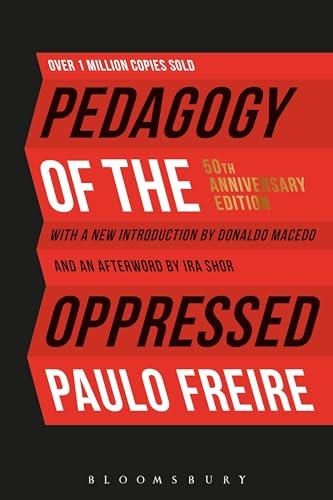
Pedagogy of the Oppressed: 50th Anniversary Edition Cover
Podcast Mentions

Pedagogy of the Oppressed 50th Anniversary Edition

Paulo Freire

First published in Portuguese in 1968,

Podcasts 6
Quotes 23
The Megyn Kelly Show

It was discussed that the book 'Pedagogy of the Oppressed' by Paulo Freire underpins teacher education programs, which are seen to be rooted in the notion of levelling privilege and indoctrination, rather than education.

"

And all those teacher ed programs, they're all predicated on this book, Paulo Freire's Pedagogy of the Oppressed, which is you teach to liberate, oppress, not to educate, not to, in fact, he calls it...

— Episode: Rebellion Against Wokeism, the Loss of P...

Episode: Rebellion Against Wokeism, the Loss of Patriotism,...

It was discussed that the book 'Pedagogy of the Oppressed' by Paulo Freire underpins teacher education programs, which are seen to be rooted in the notion of levelling privilege and indoctrination, rather than education.

"

And all those teacher ed programs, they're all predicated on this book, Paulo Freire's Pedagogy of the Oppressed, which is you teach to liberate, oppress, not to educate, not to, in fact, he calls it a banking factory, not to put things in your butt, but to, in modern terms, level privilege.


Behind the Bastards

It is Paulo Freire's greatest contribution to education, and explores Marxist class analysis in the relationship between colonizer and colonized, oppressor and oppressed.

"

But his greatest contribution, to me at least and to most people, is his book, The Pedagogy of the Oppressed.

— Episode: It Could Happen Here Weekly 40

Episode: It Could Happen Here Weekly 40

It is Paulo Freire's greatest contribution to education, and explores Marxist class analysis in the relationship between colonizer and colonized, oppressor and oppressed.

"

But his greatest contribution, to me at least and to most people, is his book, The Pedagogy of the Oppressed.

He says that humankind's central problem is how we affirm our identity as human beings.

Oppressors, they tend to treat people as objects to be possessed. They see freedom as threatening. And in turn, oppressed people end up becoming alienated from each other through oppression and begin to see the oppressors as something to strive towards.

He talks about the banking model of education that traditional pedagogy espouses because it treats the student as like this bank, this empty vessel to be filled with knowledge.

He, the teacher, talks about reality as if it were motionless, static, compartmentalized and predictable, or else he expounds upon a topic completely alien to the existential experience of the students.

Episode: It Could Happen Here Weekly 40

The book was written by Paulo Freire, a Brazilian educator. It explores Marxist class analysis in the context of colonization and oppression, arguing for a co-creative approach to education that challenges the traditional 'banking' model.

"

But his greatest contribution, to me at least and to most people, is his book, The Pedagogy of the Oppressed.

In the book, he sort of explores a detailed Marxist class analysis in the relationship between like the colonizer and colonized, the oppressor and the oppressed.

he, the teacher, talks about reality as if it were motionless, static, compartmentalized and predictable, or else he expounds upon a topic completely alien to the existential experience of the students.

His task is to fill the students with the contents of his narration, contents which are detached from reality, disconnected from the totality that engendered them and could give them significance.

Words are emptied of their concreteness and become a hollow, alienated and alienating verbosity.

Philosophize This!

It was discussed as the third most cited book in the humanities and social sciences, having significantly influenced education worldwide. It explores the concept of critical consciousness and problem-posing education, contrasting with the traditional 'banking' model.

"

So I want to tell you about a book today called The Pedagogy of the Oppressed by the philosopher Paulo Freire.

— Episode: Episode #210 ... The Pedagogy of the Opp...

Episode: Episode #210 ... The Pedagogy of the Oppressed (Pa...

It was discussed as the third most cited book in the humanities and social sciences, having significantly influenced education worldwide. It explores the concept of critical consciousness and problem-posing education, contrasting with the traditional 'banking' model.

"

So I want to tell you about a book today called The Pedagogy of the Oppressed by the philosopher Paulo Freire.

This book we're talking about, The Pedagogy of the Oppressed, is by one measurement that was taken, the third most cited book in all of the humanities and social sciences.

Meaning that when people in academia give citations for what works they took ideas from that inspired their new ideas and they cite it in the bibliography, The Pedagogy of the Oppressed by Paulo Freire comes in number three of all time.

Meaning at the very least this book that was written in 1968 in Brazil has gone on to change the way that people think about education across the entire world.

And here's where this is headed as we get deeper into the book of The Pedagogy of the Oppressed, to Paulo Freire.

The Rubin Report

This book was cited as the basis for teaching certificates in the United States, which Peter Boghossian argues teaches to liberate people from perceived oppression rather than focusing on truth.

"

It's predicated upon a book from a Brazilian educator, Paulo Freire, The Pedagogy of the Oppressed.

— Episode: Anti-Woke Liberal Reveals Whether He Is...

Episode: Anti-Woke Liberal Reveals Whether He Is Willing to...

This book was cited as the basis for teaching certificates in the United States, which Peter Boghossian argues teaches to liberate people from perceived oppression rather than focusing on truth.

"

It's predicated upon a book from a Brazilian educator, Paulo Freire, The Pedagogy of the Oppressed.

On Being with Krista Tippett

Clint Smith spoke about how reading this book by Paulo Freire helped him as a young high school English teacher. It helped his students understand that the world was a social construct that could be reconstructed.

"

Yeah I mean you know I think your spot on being a high school English teacher it helps shape everything for me I feel very lucky to read and write and think and for a living but man like sitting in a...

— Episode: Clint Smith — What We Know in the "Marro...

Episode: Clint Smith — What We Know in the "Marrow of Our B...

Clint Smith spoke about how reading this book by Paulo Freire helped him as a young high school English teacher. It helped his students understand that the world was a social construct that could be reconstructed.

"

Yeah I mean you know I think your spot on being a high school English teacher it helps shape everything for me I feel very lucky to read and write and think and for a living but man like sitting in a high school classroom with a bunch of teenagers and just talking about books was it was the best job I ever had it was so fulfilling it was so remarkable to sit with a group of 15 and 16 year olds talking about the way that a book is in conversation with the various facets of their own lives and to see that that could serve as an entry point for them to understand the way that their lives are in conversation with one another in ways that might have never been possible without that text in ways that might have never been possible without that one sentence and that one paragraph that one student pointed out in a way that illuminated something for everybody else in that classroom those specific moments of magic were so i mean that there's nothing like it and paul of fray you know he is a a Brazilian scholar an educator who as you say was incredibly formative for me I read his book perhaps his most popular text pedagogy of the oppressed and the essence of that book is thinking about how part of the role of education is to help people who have been subjected to violence who have been subjected to oppression who has been subjected to despair how how education can be a way to help them understand that the world is social construction that can be reconstructed and deconstructed and made into something new and that once you understand that you know part of what fray talks about is it helps disabuse you of the idea that your station in life is something that is sort of inevitably a facet of who you are and for me that idea is so freeing it's so profound because I remember I remember being a kid growing up in new orlands in the 80s and 90s and just being inundated with messages about all the things that were wrong with black people and that you know the reason new orlands had so much crime and so much poverty and so much violence and so many people in prison were because of things that were wrong with black people and things that black people had failed to do and I knew it was wrong but I didn't know how to say it was wrong I didn't have the language I didn't have the toolkit I didn't have the historical context with which to push back against it there was a sense of paralysis almost and I wanted to I knew the way that books had freed me in that way and I wanted to bring that to my students to the extent that I could I taught in printed churches county merlin you know a school that was predominantly black and latino school that was predominantly students on free and reduced lunch students who were undocumented students who were in and out of the criminal legal system and I wanted the conversations we had on our class to help them understand that the reason their communities looked the way that they did again we're not inevitable but we're the result of decisions that people had made and also I just I feel like what's coming through here is you know language has more than mere words right language as power right to have the language to to name something or not to have it is also about how one can move through the world and move the world you've written and spoken about an interesting kind of transition you made following on how you know that that approach you were taking to seeing the world that your students inhabited and how it constricted them and you've talked about how you for a while you know you wanted to go head on to the issues to these societal problems and these societal constructions and you started to find that that actually wasn't the way or the only way for them to do the work to actually step into that agency like you've talked about you found that you had to actually draw out their identities would you say some more about that?

Episode: [Extended] Clint Smith with Krista Tippett

This book by Paulo Freire, a Brazilian scholar and educator, was incredibly formative for Clint Smith. The essence of the book is about how education can be a tool for liberation, helping people understand that the world is a social construct and can be reshaped.

"

I read his book, perhaps his most popular text, Pedagogy of the Oppressed.

And the essence of that book is thinking about how part of the role of education is to help people who have been subjected to violence, who have been subjected to oppression, who has been subjected to despair or resource extraction at the hands of the state.

At the hands of their government, how education can be a way to help them understand that the world is social construction.

And thus can be reconstructed and deconstructed and made into something new and that the reality of the world around us is not an inevitability.

And I wanted to, I knew the way that books had freed me in that way. And I wanted to bring that to my students to the extent that I could.

Note: The book recommendations on this page are discovered automatically from podcast transcripts, and may be incorrect or incomplete.