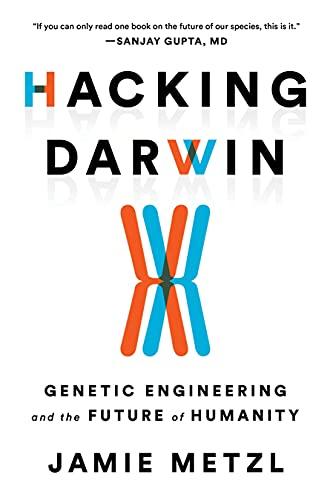
Hacking Darwin: Genetic Engineering and the Future of Humanity Cover
Podcast Mentions

Hacking Darwin Genetic Engineering and the Future of Humanity

Jamie Metzl

A groundbreaking exploration of genetic engineering and its impact on the future of our species from leading geopolitical expert and technology futurist, Jamie Metzl. "A gifted and thoughtful writer, Metzl brings us to the frontiers of biology and technology, and reveals a world full of promise and...

Podcasts 2
Quotes 24
The Joe Rogan Experience

The book discusses the ethical implications of genetically modified humans, comparing the current anxiety around the concept to the initial anxieties people had towards genetically modified food. The author urges an inclusive conversation on the future of genetics, emphasizing the need for responsible and ethical development.

"

The reason why I've written this book, Hacking Darwin, is that if we approach genetically modified humans in the same way, we approach genetically modified foods, which is the scientists say, hey, we'...

— Episode: #1294 - Jamie Metzl

Episode: #1294 - Jamie Metzl

The book discusses the ethical implications of genetically modified humans, comparing the current anxiety around the concept to the initial anxieties people had towards genetically modified food. The author urges an inclusive conversation on the future of genetics, emphasizing the need for responsible and ethical development.

"

The reason why I've written this book, Hacking Darwin, is that if we approach genetically modified humans in the same way, we approach genetically modified foods, which is the scientists say, hey, we've got this. We're going to manage them responsibly. And it just kind of happens to people. People are going to go nuts.

That's why I've written this book. That's why I'm out speaking every day about this topic because we need to recognize that if we have, if we approach these revolutionary technologies using the same values that we experience today where we're here and very comfortable. But just down the road, there are people who are just who are living without many opportunities.

The 21st story of the 21st century, one of the biggest stories of the 21st century will be how the US China rivalry plays out and the playing field will be with these revolutionary technologies.

When last year the book Hacking Dom was already in production in November when it was announced that these first genetically engineered babies had been born in China.

And so I called the publisher and said we need to pull this back out of productions. I need to reference this but it didn't require much of a change because I'd already written this is happening. We're going to see the world's first genetic humans. It's going to happen first in China and here's why.
The Jordan Harbinger Show

The book is mentioned as an example of Jamie's work in making complex scientific concepts accessible to a wider audience.

"

And frankly, that's why my last book, Hacking Darwin, before that I'd written my two science fiction novels, Genesis Code and Eternal Sonata.

— Episode: 1015: Jamie Metzl | AI Solutions for Hun...

Episode: 1015: Jamie Metzl | AI Solutions for Hunger, Healt...

The book is mentioned as an example of Jamie's work in making complex scientific concepts accessible to a wider audience.

"

And frankly, that's why my last book, Hacking Darwin, before that I'd written my two science fiction novels, Genesis Code and Eternal Sonata.

Episode: 1014: Jamie Metzl | AI Solutions for Hunger, Healt...

Jamie Metzl's book "Hacking Darwin" explores the future of human genetic engineering, focusing on human assisted reproduction. The author predicted the birth of the first CRISPR babies, which happened in China.

"

The first time you and I spoke was around the time, I think it was 2019 for the launch of my then book Hacking Darwin and that book was on the future of human genetic engineering when a big piece of that was human assisted reproduction.

And so for this which was the hardback version, all we need to do is I just need to add a couple of sentences saying and this thing that I've exactly predicted has happened.

In my last book hacking Darwin, I have a chapter called the end of sex which is exactly about this that nature has an error rate.

Episode: 253: Jamie Metzl | Genetic Engineering and the Fut...

It was discussed as an example of how genetic engineering is advancing at an unprecedented rate and how humans are developing the ability to alter and control genetic traits, including those related to intelligence, physical appearance, and disease resistance.

"

I mean we've been evolving for about four billion years since we started as a single cell organism and for four billion years we've evolved by the random mutation and natural selection to our winning evolution. And now we are amassing these incredibly powerful tools that are allowing us to shape life, shape life on earth and shape our own life.

But if we bring a baby from a thousand years in the future and I'm thinking probably more like a hundred or two hundred years in the future I don't know where you're thinking but from your book that's what it looks like if we bring that baby from the future back to now it's going to have a lot of outlier traits in terms of intelligence and athletic prowess genetic disease resistance things we have never seen in one human so what's going on here why is this the case?

I talk about this in the book you know I went to the fertility clinic to freeze my sperm and it's actually pretty easy they walk you in the back that you know there's no fancy science they got like a little thing it used to be a broom closet you know they got a video recorder and some radiot magazines and they give you a plastic cup and that's that and you got you know however somebody chooses to do it you get about a billion sperm cells in average so you don't need science we have old tried and true method

I talk a lot and write about in the book this concept of exponential change which I think is what Rob is also it also talks about is that anything that becomes digitized gets on this curve kind of like a Moore's Law curve but with the whole world networked nobody has to solve a problem that's already been solved by somebody else and so we have more people who are educated more people who are working on these incredible thorny problems and every time something gets solved I mean different parts of the world figured out copper and bronze thousands of years different from each other but imagine if you know the first civilization that discovered bronze was able just to send an email to everybody else and are the hey just discovered bronze here's the formula that means all right great we're two thousand years ahead developmentally and that's what's happening every day so that's why our imagination about the speed of change is often too conservative because we're looking in the rear of you mirror rather than imagining what exponential change is going to look like going forward

So is there a Moore's Law curve for biology you know is this yes I can't remember what it's called my friend Rob Reid mentioned this it's not a curve though it's more like it goes down and then it really drops crazily exponentially yes so basically certainly for genome sequencing so Moore's Law the computing power roughly doubles every two years for the same price is kind of the shorthand for it and so if you applied Moore's Law to genome sequencing and you started a billion dollars in 2003 we wouldn't be close to the six hundred dollars today and we wouldn't be close to the close to zero it's going to be well within a decade so the cost of sequencing is advancing matter rate far faster than Moore's Law would suggest

Episode: 253: Jamie Metzl | Genetic Engineering and the Fut...

It was discussed at length as it details the potential future of genetic engineering and its profound impact on humanity, including the ability to edit genes and select embryos with desired traits.

"

I illustrate this really well in hacking Darwin where you say if we brought a baby from a thousand years ago in a time machine and we brought him back today it would be pretty much the same organism right.

I talk about this in the book, you know I went to the fertility clinic to freeze my sperm and it's actually pretty easy.

I talk a lot and write about in the book this concept of exponential change.

I know we'll talk about so this CRISPR gene editing was invented in 2012 seven years ago the first CRISPR gene edited babies were born six years later in 2018.

Big thanks to Jamie Meetzel the book is called Hacking Darwin we'll throw that in the show notes.

Episode: 253: Jamie Metzl | Genetic Engineering and the Fut...

It was discussed as a book that illustrates the potential for genetic engineering to alter humanity's future, with outlier traits becoming commonplace. The book also delves into the ethical complexities of this technology, particularly in the context of embryo selection.

"

If we brought a baby from a thousand years ago in a time machine and we brought him back today it would be pretty much the same organism right. But if we bring a baby from a thousand years in the future and I'm thinking probably more like a hundred or two hundred years in the future I don't know where you're thinking but from your book that's what it looks like if we bring that baby from the future back to now it's going to have a lot of outlier traits in terms of intelligence and athletic prowess genetic disease resistance things we have never seen in one human so what's going on here why is this the case?

I talk about this in the book you know I went to the fertility clinic to freeze my sperm and it's actually pretty easy they walk you in the back that you know there's no fancy science they got like a little thing it used to be a broom closet you know they got a video recorder and some radiot magazines and they give you a plastic cup and that's that and you got you know however somebody chooses to do it you get about a billion sperm cells in average so you don't need science we have old tried and true method

I talk a lot and write about in the book this concept of exponential change which I think is what Rob is also it also talks about is that anything that becomes digitized gets on this curve kind of like a Moore's Law curve but with the whole world networked nobody has to solve a problem that's already been solved by somebody else and so we have more people who are educated more people who are working on these incredible thorny problems and every time something gets solved I mean different parts of the world figured out copper and bronze thousands of years different from each other but imagine if you know the first civilization that discovered bronze was able just to send an email to everybody else and are the hey just discovered bronze here's the formula that means all right great we're two thousand years ahead developmentally and that's what's happening every day so that's why our imagination about the speed of change is often too conservative because we're looking in the rear of you mirror rather than imagining what exponential change is going to look like going forward

I have a chapter in the book called the arms race of the human race and that's one of the possibilities and it's a scary one because what we're talking about is the future of life and you know if somebody changes humans in China or in Russia or in Kazakhstan or whatever eventually our kids are likely to procreate with their kids I mean it's not like they were going to be able to segregate out people who have been genetically altered and not so we are as humans we all are and should be stakeholders in how this story plays out

I write about that in the book so certainly let's just say we talked about having your own 10,000 fertilized eggs there will be a range so if you have let's say 10 of your your unimplanted embryos on average there's probably like a 10 or 15 IQ point differential it's hard to fully test this but between your potentially highest IQ embryo genetic component of IQ and your lowest if you have 10,000 that number becomes significantly bigger so you let's say that high genetic component of IQ is your number one priority in making those selections you can get a very high IQ relative to all of your other options and let's say somebody else has done the same thing you know so then you already are starting from this starting point that from an IQ perspective is beyond most other people and if you keep doing that and in the book I talk about a process of breeding embryos with other embryos which is that's kind of this mind blowing stuff is so you do that process you select from among your 10,000 you select your boy embryo and somebody else does the same thing to with two different parents so you're not genetically related and they select their girl female embryo and then you extract cells from each of those embryos so from the male embryo you do the same induced stem cell process so you go stem cell to sperm precursor cell to sperm and from the female embryo you go from the stem cell to the egg precursor cell to egg now my five day old embryo and your five day old embryo can themselves have a baby and then you do that same process with somebody else who's done that with a different two different genetic lines and so you see where this is going if we could push these chickens from one egg a month to one egg a day how far can we push some of these other traits and then there are huge unmassive unknowns with all this because all of our traits have evolved over millions or in some cases billions of years and so our bodies our beings are these balances if we had these super high IQs would there be other liabilities that we don't yet understand their very well could be but the basic point is that our biology is malleable and we understand that it's malleable in some abstract way because we know we used to be single cell organisms and we evolved into those single cell organisms involved into all of life on earth so we know that life can be expressed in many different ways but we don't know what it would mean for us and now we have the potential to find out which is exciting and everyone should feel exciting and it's scary and everyone should feel scared as well

Note: The book recommendations on this page are discovered automatically from podcast transcripts, and may be incorrect or incomplete.