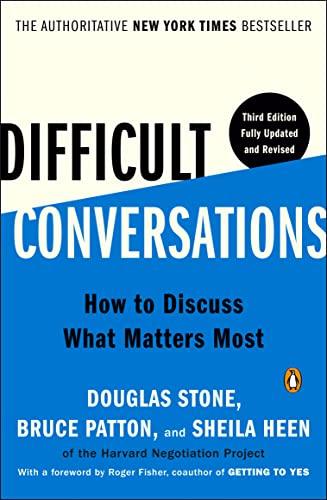

In the episode, the hosts highlighted the book's emphasis on uncovering underlying emotions and assumptions when conversations become difficult, noting that such talks often reveal deeper concerns about how each party feels treated. Sheila Heen explained the framework of three key components—preoccupation with being right, assigning fault, and questioning motives—while Matt Abrahams underscored its practical relevance for building trust. The discussion presented the title as a valuable resource for navigating tough conversations.
Episode: 204. Tough Talks: Turn Tension Into Trust
This book, co-authored by Sheila Heen, was mentioned as emphasizing the importance of understanding underlying emotions and assumptions in tough conversations. The discussion highlighted that when a conversation becomes difficult, there is often a deeper issue regarding how both parties feel treated in the interaction.
In your book, Difficult Conversations, you emphasize the importance of understanding the underlying emotions and assumptions in tough conversations.
One of the things that I found really interesting about Difficult Conversations is that by the time something becomes a difficult conversation, we've got at least two problems. We've got whatever we're disagreeing about on the surface. . . But if it's a difficult conversation, typically there's a deeper issue, which is how we each feel treated in how we're navigating this together.
In Difficult Conversations, we talk about that story itself having three key components. One is I'm preoccupied with what I'm pretty sure I'm right about. The second is whose fault is it that we're having this problem? And the third is why are you acting this way?