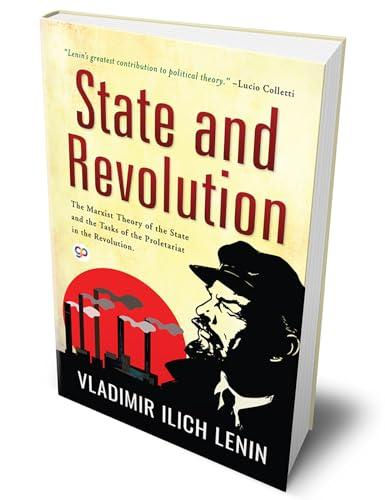
State and Revolution Cover
Podcast Mentions

State and Revolution

Vladimir Lenin Ilich

Lenin wrote 'State and Revolution' in 1917, while he was hiding from the Russian secret police. The book describes the inherent nature of the State as a tool for class oppression, a creation born of one social class's desire to control all other social classes. Drawing on detailed quotes from Karl M...

Podcasts 3
Quotes 7
Behind the Bastards

Lenin was obsessed with the German postal service and argued that socialism should be planned by a bureaucratic state, leading to a conflict with workers who wanted control of their work.

"

A witty German social Democrat of the 1870s called the postal service an example of the socialist economic system.

— Episode: It Could Happen Here Weekly 37

Episode: It Could Happen Here Weekly 37

Lenin was obsessed with the German postal service and argued that socialism should be planned by a bureaucratic state, leading to a conflict with workers who wanted control of their work.

"

A witty German social Democrat of the 1870s called the postal service an example of the socialist economic system.

To organize the whole national economy on the lines of the postal service, so that technicians, foremen, bookkeepers, as well as all officials that receive no salaries higher than a workman's wage, all under the control and leadership of the armed proletariat.

This is our immediate aim.

Episode: It Could Happen Here Weekly 37

Lenin's book about the future socialist state was said to be almost all lies, but it contained a passage about the postal service, which he described as an example of a socialist economic system.

"

A witty German social Democrat of the 1870s called the postal service an example of the socialist economic system. This is very true. At present, the postal service is a business organized along the lines of a state capital of monopoly, imperialism, this whole thing, but like imperialism is making everything also this. But so to organize the whole national economy on the lines of the postal service, so that technicians, foremen, bookkeepers, as well as all officials that receive no salaries higher than a workman's wage, all under the control and leadership of the armed proletariat. This is our immediate aim.

The Rubin Report

The book "State and Revolution" by Vladimir Lenin was discussed as a possible influence on President Biden's speech. The speakers pointed out similarities between Biden's rhetoric and Lenin's ideas on democracy and social equality. They suggest that Biden's speech reflects a focus on bringing down certain groups rather than lifting everyone up.

"

What he's actually riffing off of, again, a lot of people haven't read, is Vladimir Lenin wrote a book in 1917, the year he took over Russia and established the USSR. It's called State and Revolution....

— Episode: Joe Rogan Has a Brutal Message for Pro-P...

Episode: Joe Rogan Has a Brutal Message for Pro-Palestine P...

The book "State and Revolution" by Vladimir Lenin was discussed as a possible influence on President Biden's speech. The speakers pointed out similarities between Biden's rhetoric and Lenin's ideas on democracy and social equality. They suggest that Biden's speech reflects a focus on bringing down certain groups rather than lifting everyone up.

"

What he's actually riffing off of, again, a lot of people haven't read, is Vladimir Lenin wrote a book in 1917, the year he took over Russia and established the USSR. It's called State and Revolution. And chapter five is about democracy.

Real Dictators

This book was mentioned in the context of Lenin writing prodigiously while hiding out in a forest hut in Finland. The book explores his vision for the future of the government when workers take control, suggesting that the traditional concept of the state will cease to exist.

"

He envisages that when the workers take control, it will signal the death of the government as traditionally conceived. Where there's the state, there's no freedom, he writes. And where there's freedo...

— Episode: Lenin Part 3: First Russia, Then the Wor...

Episode: Lenin Part 3: First Russia, Then the World…

This book was mentioned in the context of Lenin writing prodigiously while hiding out in a forest hut in Finland. The book explores his vision for the future of the government when workers take control, suggesting that the traditional concept of the state will cease to exist.

"

He envisages that when the workers take control, it will signal the death of the government as traditionally conceived. Where there's the state, there's no freedom, he writes. And where there's freedom, there will be no state.

And by the summer of 1917, Lenin is increasingly saying, just give all power to the Soviets.

Note: The book recommendations on this page are discovered automatically from podcast transcripts, and may be incorrect or incomplete.