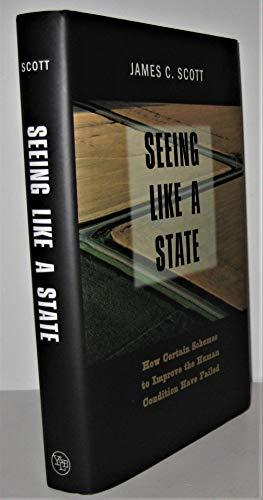

Seeing Like a State: How Certain Schemes to Improve the Human Condition Have Failed (The Institution for Social and Policy St) Cover
Podcast Mentions

Seeing Like a State How Certain Schemes to Improve the Human Condition Have Failed (The Institution for Social and Policy St)

Professor James C. Scott

Why have large-scale schemes to improve the human condition in the twentieth century so often gone awry? James C. Scott analyzes diverse failures in high-modernist, authoritarian state planning-collectivization in Russia, the building of Brasilia, compulsory ujamaa villages in Tanzania, and others-a...

Podcasts 4
Quotes 10
The Ezra Klein Show

During the discussion, the host recalled James C. Scott's book Seeing Like a State as a relevant reference.

"

I do think I'm sure you know the old James C. Scott book, seeing like a state.

— Episode: Ethereum’s Founder on What Crypto Can —...

Episode: Ethereum’s Founder on What Crypto Can — and Can’t...

During the discussion, the host recalled James C. Scott's book Seeing Like a State as a relevant reference.

"

I do think I'm sure you know the old James C. Scott book, seeing like a state.

Episode: Best of: A Life-Changing Philosophy of Games

Ezra Klein said the discussion reminded him of James C. Scott's Seeing Like a State and later exclaimed that his whole philosophical trajectory was now centered on that book.

"

This reminds me a lot of James C. Scott's Seeing Like a State.

Oh my god, my entire life arc right now is doing philosophy with Scott's Seeing Like a State.

Episode: A Philosophy of Games That Is Really a Philosophy...

Klein recalled James C. Scott's Seeing Like a State, linking its argument about largescale institutions seeing only standardized, quantified information to the discussion of point systems.

"

This reminds me a lot of James C Scott's Seeing Like a State.

Behind the Bastards

The podcast host recommended the book 'Seeing Like a State' by James Scott, which discusses land disclosure in France and how it impacted communities and led to the creation of property rights. The book highlights the need for a critical understanding of how capitalism structures space and how the state uses policing to enforce its property-based definition of life.

"

I keep going back to James Scott's Seeing Like a State, which is you know an amazing book and people haven't read it absolutely pick up a copy.

— Episode: It Could Happen Here Weekly 68

Episode: It Could Happen Here Weekly 68

The podcast host recommended the book 'Seeing Like a State' by James Scott, which discusses land disclosure in France and how it impacted communities and led to the creation of property rights. The book highlights the need for a critical understanding of how capitalism structures space and how the state uses policing to enforce its property-based definition of life.

"

I keep going back to James Scott's Seeing Like a State, which is you know an amazing book and people haven't read it absolutely pick up a copy.

In the first you know couple of chapters one of the things he talks about is land disclosure.

The question of exclusion from property or exclusion from space not only is it fragmenting public space but we start to look at the way that all of a sudden property has to exist right.

The Clay Travis and Buck Sexton Show

This book was recommended for going through government programs from the top down, specifically mentioning an example of German forestry from the late 19th century.

"

But if you've never read a book called Seeing Like a State, I would highly recommend it because it goes through government programs from the top down.

— Episode: Clay Travis and Buck Sexton Show H3 – Oc...

Episode: Clay Travis and Buck Sexton Show H3 – Oct 2 2021

This book was recommended for going through government programs from the top down, specifically mentioning an example of German forestry from the late 19th century.

"

But if you've never read a book called Seeing Like a State, I would highly recommend it because it goes through government programs from the top down.

Seeing like it's a little academic, but it's a really interesting book.

The Rubin Report

The book says that the state tries to make taxpayers legible so they can tax them as efficiently as possible, by knowing who people are, who they interact with, and their economic situation.

"

And I think it's ultimately another consequence of fiat currency and central banking though, because the reason there is so much national debt is because governments have figured out this way to borro...

— Episode: The Real Reason the US Gov’t Fears Bitco...

Episode: The Real Reason the US Gov’t Fears Bitcoin — It Is...

The book says that the state tries to make taxpayers legible so they can tax them as efficiently as possible, by knowing who people are, who they interact with, and their economic situation.

"

And I think it's ultimately another consequence of fiat currency and central banking though, because the reason there is so much national debt is because governments have figured out this way to borrow money into existence, right? It's literally what they're doing with the Fed is the US government issues this shit coin called US treasury bond. They can print as many of these as they want. They sell them to the Fed to borrow dollars, right? So the Fed now is already the creditor to the US government borrower at interest. The Fed's taking interest payments right off the top. The Fed can print dollars ad infinitum. So it's just total shell game. And then the government can spend those dollars as it sees fit. And that you end up with a situation where the government has extreme indebtedness, but will just keep printing more money to externalize the cost of that indebtedness onto the population via inflation. So you can think about it this way, the price inflation that you experience as a consumer, you are just paying for the slow motion default of your government on its debt.

Note: The book recommendations on this page are discovered automatically from podcast transcripts, and may be incorrect or incomplete.