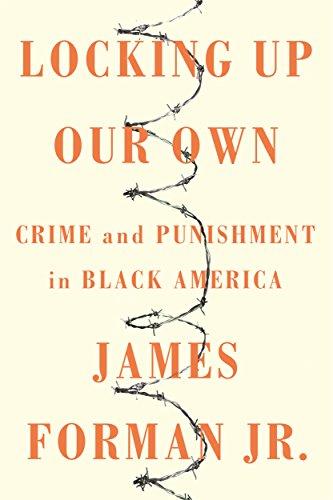
Locking Up Our Own: Crime and Punishment in Black America Cover
Podcast Mentions

Locking Up Our Own Crime and Punishment in Black America

James Forman Jr.

Winner of the Pulitzer Prize for General Non-Fiction Former public defender James Forman, Jr. is a leading critic of mass incarceration and its disproportionate impact on people of color. In

Podcasts 3
Quotes 9
The Ezra Klein Show

It was referenced as a central theme book about the black community's longstanding push for bothand solutions in criminaljustice reform.

"

One of the central themes of James Forman's Locking Up Our Own is the way that the Black community and Black politicians have for decades been asking for these kinds of bothand solutions. Not only mor...

— Episode: Why Is Murder Spiking? And Can Cities Ad...

Episode: Why Is Murder Spiking? And Can Cities Address It W...

It was referenced as a central theme book about the black community's longstanding push for bothand solutions in criminaljustice reform.

"

One of the central themes of James Forman's Locking Up Our Own is the way that the Black community and Black politicians have for decades been asking for these kinds of bothand solutions. Not only more police officers but also investments in jobs and poverty alleviation and mental health and addiction services.

Episode: Violent Crime Is Spiking. Do Liberals Have an Answ...

Ezra described it as an essential book for the moment, noting that Forman uses Washington, D.C. as a case study to examine the political dynamics of Black communities during the crime wave.

"

Pulitzer Prize winning author of Locking Up Our Own, Crime and Punishment in Black America. Just an essential book for this moment.

you write, quote, For residents of the city's poorest neighborhoods, especially young people, this treatment became part of a social contract, a tax paid in exchange for the right to move.

the book was essential reading and it was utterly essential for this moment.
Strict Scrutiny

This Pulitzer Prize-winning book was cited by Justice Thomas to suggest that some Black leaders in D.C. favored mandatory minimum penalties for crack cocaine, a point Justice Sotomayor contended was largely incomplete history.

"

Justice Thomas is citing to James Foreman's Pulitzer Prize winning book locking up our own and noting that it is true that DC council members and even the mayor of DC at the time they were in favor of...

— Episode: State Courts Are Where It's At

Episode: State Courts Are Where It's At

This Pulitzer Prize-winning book was cited by Justice Thomas to suggest that some Black leaders in D.C. favored mandatory minimum penalties for crack cocaine, a point Justice Sotomayor contended was largely incomplete history.

"

Justice Thomas is citing to James Foreman's Pulitzer Prize winning book locking up our own and noting that it is true that DC council members and even the mayor of DC at the time they were in favor of these increased sentences because they were worried about public safety DC is a majority minority city and was at the time and they were concerned about the black community more broadly but.

And the history that he acknowledged and surfaced in his box concurrence was partly true but largely incomplete so this is kind of like a weird sort of rehashing of that whole move and you know I don't know why he's engaged in this kind of law office history but it would be great if he would continue reading the books and add more of that in.

And just to note this is another example I think of the sniping in the footnotes that we've really seen over the last couple of weeks with these opinions like you know last week it was Kagan and Kavanaugh mixing it up you know here.

The lack of coverage of the redistributive part of that history is really appalling because it's a big part of both the Hinton book both both the Hinton and Foreman books and the Sophead that you've cited.

The NPR Politics Podcast

The host referenced the book while discussing public safety, noting that Forman Jr.'s work examined how Black communities and leaders contributed to mass incarceration. It highlighted the nuanced role of Black elites, church members, and elected officials in shaping punitive policies, suggesting the title provided useful context for the episode’s theme.

Episode: How To Make The Public Safer? It's A Lot Harder Th...

The host mentioned the book while noting Forman Jr.'s work on the role of Black communities in mass incarceration.

"

we talked to James Forman Jr., who wrote a book called Locking Up Our Own, which is about the role that Black people, Black elites, but not always Black people in Black neighborhoods, invest in parties in Black neighborhoods, you know, whether it's the old church ladies or Black elected officials played in mass incarceration.

Note: The book recommendations on this page are discovered automatically from podcast transcripts, and may be incorrect or incomplete.