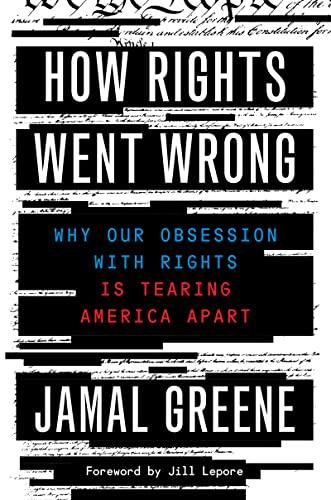

How Rights Went Wrong: Why Our Obsession with Rights Is Tearing America Apart Cover
Podcast Mentions

How Rights Went Wrong Why Our Obsession with Rights Is Tearing America Apart

Jamal Greene

AMERICAN ASSOCIATION OF PUBLISHERS PROSE AWARD FINALIST | “Essential and fresh and vital . . . It is the argument of this important book that until Americans can reimagine rights, there is no path forward, and there is, especially, no way to get race right. No peace, no justice.”—from the foreword b...

Podcasts 2
Quotes 8
The Ezra Klein Show

It was described as a great book that argued America's constitutional approach went awry, critiquing the anticanon and the strong recognition of few rights.

"

He's the author of the great book, How Rights Went Wrong, and he believes that America's approach to constitutional law went awry a long time ago.

— Episode: The Supreme Court Went Off the Rails Lon...

Episode: The Supreme Court Went Off the Rails Long Before D...

It was described as a great book that argued America's constitutional approach went awry, critiquing the anticanon and the strong recognition of few rights.

"

He's the author of the great book, How Rights Went Wrong, and he believes that America's approach to constitutional law went awry a long time ago.

you argue in the book that there's something more fundamental separating American courts from international peers and it's how we treat rights.

Episode: Let’s Talk About How Truly Bizarre Our Supreme Cou...

Greene's book argued that America's constitutional law is misguided, stressing that courts recognize few rights strongly instead of many rights weakly, and it catalogued the resulting bizarre Supreme Court outcomes.

"

He's the author of a book called How Rights Went Wrong, and in it, he argued that America does constitutional law all wrong, that we do it in a way that other countries don't, in a way that is tearing our country apart.

You argue in the book that there's something more fundamental separating American courts from international peers, and it's how we treat rights.

This is what I spent the most time wrestling with in your book, which is whether or not there is value to the American effort, the effort we have in the way we treat the courts in this country to create a fig leaf of separate authority for the other, less democratic institution.
Strict Scrutiny

The book outlined a basic thesis on handling rights adjudication and thinking about rights conflict in a context of radical pluralism and conflict. It suggested moving away from deciding who has or doesn't have rights toward a more granular approach that reconciles different rights people possess.

"

And so before he entered law teaching, he served as a law clerk to Justice Stevens and to Judge Guido Calabresi. In addition to his teaching and writing, he serves as co-chair of the Facebook Oversigh...

— Episode: How Rights Went Wrong

Episode: How Rights Went Wrong

The book outlined a basic thesis on handling rights adjudication and thinking about rights conflict in a context of radical pluralism and conflict. It suggested moving away from deciding who has or doesn't have rights toward a more granular approach that reconciles different rights people possess.

"

And so before he entered law teaching, he served as a law clerk to Justice Stevens and to Judge Guido Calabresi. In addition to his teaching and writing, he serves as co-chair of the Facebook Oversight Board.

So just for our listeners, what is the basic argument of the book? The book is basically about how to handle rights adjudication and thinking about rights conflict in a context of radical pluralism and radical conflict.

So I use that case as an example of a different model and one that we've kind of lost in some ways because we have fetishized the approach that Justice Holmes takes in the Lochner case.

Note: The book recommendations on this page are discovered automatically from podcast transcripts, and may be incorrect or incomplete.