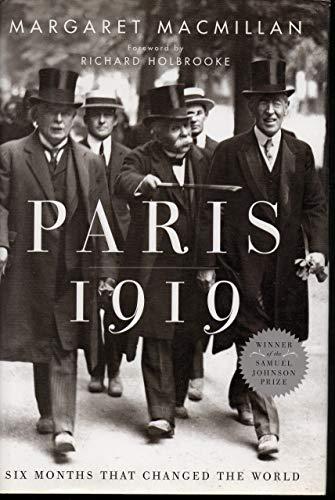
Margaret Macmillan's book Paris 1919 was cited to emphasize that the leaders of the nations at the time made choices, and therefore the domino effect of the Versailles Treaty was not inevitable, but the treaty was a major factor in shaping the hyper-nationalism that contributed to the rise of Nazism.
"
I really did like Margaret Macmillan's point in her book Paris 1919 that their successors, they made choices. So yes, we shouldn't just look at the Versailles Treaty and blame everything as though the dominoes had to fall, but the domino was not. Yeah. It was a big part of that. It set up the hyper...
And it's these sorts of instances where I contrast this to the Congress of Vienna and the words of Abraham Lincoln actually come to mind for me, with malice toward none, with charity for all. When you go tooth for tooth, you do that in... It doesn't end well. It never does. You have to go into it saying, I get that I'm really angry at you because of all this, but we have to find a way to work together. How do we build a better future? Yeah. Yeah. Otherwise, I'll go with another analogy. It's like a fishtail in a car, right? Yeah. That just keeps swinging and swinging. It takes enormous strength to do what the leaders of Europe did in Vienna in 1815. To not pile all the blame. Yeah. To not pile the blame, to not say, well, we're going to make them pay. We're just going to crush you. And again, I totally get the strategic thought, the idea that we will neuter Germany so that they can't. Yeah. In doing so. Yeah. Really, Woodrow had it right on that whole self-determination point, allowing nations to be themselves. Yeah. And of course, to bring this full circle, we should discuss Woodrow, the idealist who in so many ways wouldn't compromise, yet he would readily compromise on that and many other points. Again, trying to get into his head, right? It's easy to point out where Woodrow became a hypocrite. Where he fell short. Yeah, and fell short. We can do that all day long with- Of course, but we could do that with everyone. Yes. Yes, we could do that with any villain, hero, doesn't matter, right? It's easy to do. To understand whether or not we agree or condone is to grasp how deeply he believed in the idea of the League of Nations. Yeah. And in his mind, if he could just get that across the finish line, we're golden because the League of Nations is going to fix everything. It's going to solve all the problems. Yes. Will be fixed. We'll all hold hands and sing Kumbaya. So it's okay, I can compromise on these other issues, but I can't do is compromise on the League, which he then, as we saw stubbornly, would not. He compromised in Paris to get the League, but he wouldn't compromise in the United States to get the Senate to approve the treaty, which as I just had this discussion with my students this last week, as I'm teaching my Middle East class and we were talking through covering the Iran nuclear agreement under the Obama administration and discuss the difference between binding treaties versus executive orders and so forth. Woodrow Wilson's looking for a binding treaty. The president, yes, oversees our foreign policy and secretary of state assists with that. But per the constitution, it's the Senate that approves the treaty. Yeah. So if you can't get- If you can't get them on board with it, it doesn't matter. Yep. It's toast. And as we know, he didn't. The agony. It's so ironic. It's super ironic. It's the only thing he wouldn't compromise on. Yep. So he gets his Nobel Peace Prize for the idea and we get the League of Nations. It's not like it doesn't exist. The United States is not a part of it. It is not. It super, super is not a part of it.