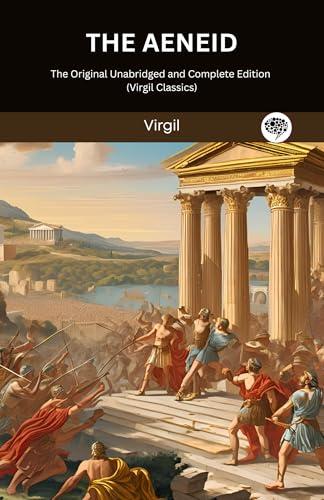

The Aeneid: The Original Unabridged and Complete Edition (Virgil Classics) Cover
Podcast Mentions

The Aeneid The Original Unabridged and Complete Edition (Virgil Classics)

Virgil

"The Aeneid" by Virgil is a cornerstone of classical literature, presenting the epic journey of Aeneas, a Trojan hero destined to found Rome. This unabridged edition preserves the full narrative, exploring themes of duty, fate, and the struggles of war and peace. As Aeneas flees the ruins of Troy, h...

Podcasts 4
Quotes 20
The Tucker Carlson Show

Michael Knowles referenced the book as an analogy for a grand, heroic narrative, specifically citing its sixth book. He used the comparison to illustrate the epic scope of the topic being discussed. The mention was brief and served mainly as a literary illustration.

Episode: Michael Knowles: Attacks on Christians, Norm McDon...

The epic was referenced as an analogy for a grand, heroic narrative, specifically mentioning its sixth book.

"

It's like the Aeneid, in book six of the Aeneid.
The Rest Is History

The hosts repeatedly highlighted the work as Virgil's epic that underpinned Roman myth and European literature, noting its use in recounting the legendary origins of Carthage, Dido, and the founding of Rome. They emphasized its adaptation of Homeric material, its Augustan propaganda elements, and its enduring presence, with scholars such as Mary Beard remarking that it had been read every day since Virgil’s death.

Highly Recommended

Episode: 605. Greek Myths: Jason & The Quest for the Golden...

The podcast explained that Virgil adapted Homeric material into the Aeneid, describing it as a mythic work that shaped Roman cultural memory.

"

Virgil, when he adapts Homer to tell this great epic drawing on stories of the Trojan War and the Odyssey, that explains the beginning, the origins of Rome, the Aeneid is a work of mythology.

Episode: 262: Tunisia: Dido of Carthage

The hosts described the work as Virgil's epic that founded Roman myth, noting its status as the foundational text of European literature and that it has been continuously read since its composition.

"

And the Aeneid, it's an epic that tells the story of the founding of Rome, how Rome comes to be founded by a band of exiles from Troy.

Since Virgil wrote it, there probably hasn't been a day when people haven't been reading it. It is absolutely the foundational text of European literature.

It's written by Virgil and it is written in where it's the reign is Augustus emperor.

The Aeneid is a great poem. It's a powerful poem, it's a moving poem, it's a complex poem because Virgil is not just writing Augustan propaganda.

It has been a celebration of Augustus and his regime and Rome's destiny and I guess Roman imperialism, you could say.

Episode: 198. Cleopatra's Downfall (Part 4)

They referenced Virgil's epic as the most famous example of how Roman poetry reshaped the AntonyCleopatra story.

"

the most famous example of this would be in the Aeneid, the great epic of Roman beginnings that Virgil writes.

Episode: 105. Classics

Mary Beard claimed that since Virgil's death there has never been a day when someone hadn't read The Aeneid, emphasizing its enduring presence.

"

there wasn't a day when someone hadn't read The Aeneid.

they weren't thinking about the literary merit of the Aeneid.

Episode: 643. Rome’s Greatest Enemy: Carthage Destroyed (Pa...

The hosts explained that the poem, translated by Robert Fagles, was being used to recount the legendary beginnings of Carthage and Dido's story.

"

So that was the greatest of all Roman poets, Virgil. ... In that poem, The Aeneid, which is translated there by Robert Fagles, Virgil is taking us back, isn't he, to the legendary beginnings of Carthage.

Episode: 688. The Odyssey: Return of the King (Part 2)

The Aeneid was cited as an example of a later work that borrowed elements from the Odyssey.

"

There are elements of it in Virgil's poem, The Aeneid.

The Moth

Podcast

The Moth

Romy Negron's Latin teacher, Adam, referenced Virgil's Aeneid to support a student's answer during a Latin competition. The specific line cited was Book 1, line 324.

"

excuse me but actually in Virgil's Aeneid book one line 324 he uses the alternative the alternative poetic form of the word which is the form that Keegan answered with

— Episode: The Moth Radio Hour: The Games We Play

Episode: The Moth Radio Hour: The Games We Play

Romy Negron's Latin teacher, Adam, referenced Virgil's Aeneid to support a student's answer during a Latin competition. The specific line cited was Book 1, line 324.

"

excuse me but actually in Virgil's Aeneid book one line 324 he uses the alternative the alternative poetic form of the word which is the form that Keegan answered with

The Daily Stoic

A passage from the Aeneid was recalled, highlighting its timeless relevance and the message of the fleeting nature of empires.

"

I'll never forget there's a passage where you know virtual's writing and there's a lot of different backgrounds of what's going on but in the epic poem we know in some day Rome won't exist anywhere ei...

— Episode: Timothy Denevi on the Power of Reading a...

Episode: Timothy Denevi on the Power of Reading and Learnin...

A passage from the Aeneid was recalled, highlighting its timeless relevance and the message of the fleeting nature of empires.

"

I'll never forget there's a passage where you know virtual's writing and there's a lot of different backgrounds of what's going on but in the epic poem we know in some day Rome won't exist anywhere either it's stepping back it's it's a fact there really a day America does not exist but being an 18 year old boy with my boy brain and sitting back and looking around and being like this country's not going to exist someday too you know and having that realization the presentness yeah of our lives the instantaneousness of our lives it doesn't just make us you know focused on our phones or screens or who said something it makes us blind and the way humans want to be to very clear facts that this country these people were all gonna die someday anyways as the stoics will tell you they already did but you know better than anybody but this country itself personally we're almost as going to be on and whatever an 18 year old boy's brain is it is malleable you can give it good writing and good perspectives and those magnets they're not gonna hurt you know and so i i've always remembered that moment of looking up stepping back from the book one to think why is virtual putting it in there he's writing to Augustus right and he's trying to get that to him and so like the just even the it's heightened by the sense of like what's the author trying to do here what's the message that they're delivering right

Episode: Dr. Shadi Bartsch on Eastern vs. Western Philosoph...

Dr. Bartsch's translation of Virgil's The Aeneid was discussed; it was described as beautiful, readable, and riveting.

"

Previously she was on discussing her beautiful readable riveting translation of the Ineid.

And you can check out her new book Plato Goes to China, the Greek classics in Chinese nationalism and do read her translation of Virgil's The Ineid.

I found that absolutely fascinating and I think you're really going to enjoy this interview.

Episode: Classics Scholar Shadi Bartsch on What Ancient Tex...

Shadi Bartsch's translation of Virgil's "The Aeneid" was discussed extensively. Her unique perspective, informed by her background, was praised for offering fresh insights into the ancient poem.

"

And I'm just finishing her translation of Virgil's The Anteid.

And you can get her new book, the translation of the Ineid, anywhere books are sold, including my bookstore, The Painted Porch here in Bastrop, Texas

I think it's interesting that there is a pragmatic streak to the Stoics that perhaps Seneca embodies most of all, but Athenodorus and Arias do, which is like, governance is a complicated thing.

Note: The book recommendations on this page are discovered automatically from podcast transcripts, and may be incorrect or incomplete.