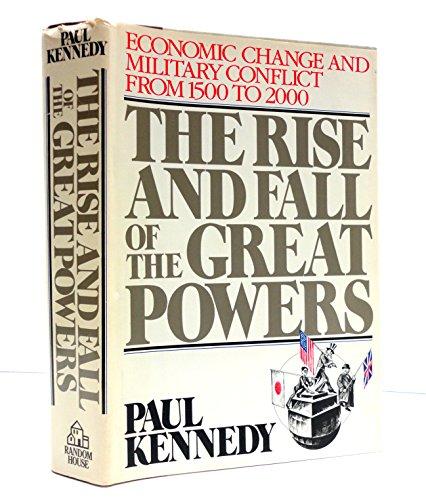
The Rise and Fall of the Great Powers: Economic Change and Military Conflict from 1500 to 2000 Cover
Podcast Mentions

The Rise and Fall of the Great Powers Economic Change and Military Conflict from 1500 to 2000

Paul Kennedy

About national and international power in the "modern" or Post Renaissance period. Explains how the various powers have risen and fallen over the 5 centuries since the formation of the "new monarchies" in W. Europe.

Podcasts 3
Quotes 7
The Ezra Klein Show

Tim mentioned Kennedy's historical analysis to illustrate that empires have predictable cycles, which can inform our view of today's technological empires.

"

The last book I guess this is where I got some ideas about tech platforms and the big picture is from Paul Kennedy rise and fall of the great powers I feel everything is on a cycle.

— Episode: Everything Wrong With the Internet and H...

Episode: Everything Wrong With the Internet and How to Fix...

Tim mentioned Kennedy's historical analysis to illustrate that empires have predictable cycles, which can inform our view of today's technological empires.

"

The last book I guess this is where I got some ideas about tech platforms and the big picture is from Paul Kennedy rise and fall of the great powers I feel everything is on a cycle.

Morning Joe

The book was repeatedly cited by the hosts as a seminal work for understanding how economic strength and military capability drive the rise and decline of nations, with one former president even noting he read it while president‑elect. Joe Scarborough called it a favorite and landmark text, using its historical GDP analysis to frame discussions about Russia, the Soviet Union, and U.S. power. The references highlighted its relevance to contemporary geopolitical debates and underscored its lasting influence on the show’s analysis.

Highly Recommended

Episode: Morning Joe 6/19/24

George H.W. Bush mentioned reading this book in December 1988 while he was president-elect. It was considered a significant book for its time, and Bush sacrificed his presidency to some extent when he abandoned his 'no new taxes' pledge, which helped set the conditions for the budget surplus discussed in the episode.

"

And he talks about how he'd read, read at that book, The Rise and Fall of the Great Powers. Remember Paul Kennedy?

Paul Kennedy was an essential was an essential part of that and how existential that was and for which he in some ways sacrificed his presidency when he abandoned his no new taxes pledge, which helped set the conditions for the surplus you're talking about.

Episode: Morning Joe 1/9/24

It was discussed in the context of Russia's current economic situation and compared to the decline of the Soviet Union, referencing a past overextension of power.

"

It's one of my favorite books. So I don't mean to be critical, but The Rise and Fall of the Great Empires. Paul, Paul Kennedy talking at Kennedy talking about the rise and fall of the United States.

Episode: Morning Joe 10/7/22

It was mentioned in the context of comparing the relative strength of countries globally, specifically the United States's economy and military in comparison to other nations throughout history.

"

And as I've said, we may have our problems, but if you go back and you look at the classic, The Rise and Fall of the Great Powers by Paul Kennedy, it was always how strong is a country relative to everybody else on the globe?

Episode: Morning Joe 8/1/22

It was mentioned as a book the host had read in 1987 and was brought up during a discussion on parallels between the USSR and Russia's current geopolitical standing.

"

I mean, reading through Paul Kennedy's old book, The Rise and Fall of the Great Powers, written in 1987, and he was writing as if the United States and USSR were sort of on parity economically because that's what a lot of people thought at the time.

Episode: Morning Joe 6/28/22

It was mentioned in the context of using historical analysis of GDP to predict the outcome of wars, and how Russia's declining GDP could affect the war in Ukraine.

"

And we remember Paul Kennedy's landmark work and I think it was 1987, The Rise and Fall of the Great Powers and each race from 1500 through the late 1980s, how you would have countries rise and fall and you could predict the outcome of a war based on their GDP.

Note: The book recommendations on this page are discovered automatically from podcast transcripts, and may be incorrect or incomplete.