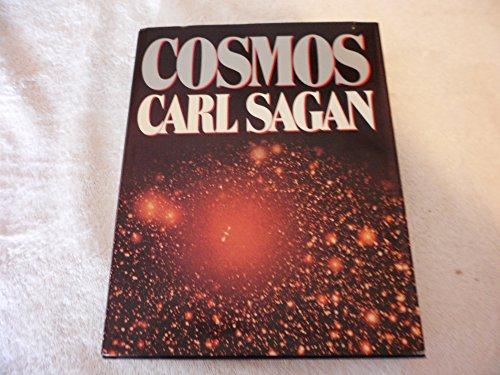

Cosmos Cover
Podcast Mentions

Cosmos

Carl Sagan

Cosmos This visually stunning book with over 250 full-color illustrations, many of them never before published, is based on Carl Sagan’s thirteen-part television series. Told with Sagan’s remarkable ability to make scientific ideas both comprehensible and exciting,

Podcasts 5
Quotes 29
Monday Morning Podcast

Bill Burr shared a story from a Carl Sagan book about the origin of chess, where a vizier asks for a single grain of wheat for the first square, and then doubles it for each subsequent square. The story highlights the power of exponential growth, as the amount of wheat on the 64th square was 18 quintillion grains.

"

I recently read something kind of insane in a Carl Sagan book and thought I'd share

— Episode: Monday Morning Podcast 1-15-24

Episode: Monday Morning Podcast 1-15-24

Bill Burr shared a story from a Carl Sagan book about the origin of chess, where a vizier asks for a single grain of wheat for the first square, and then doubles it for each subsequent square. The story highlights the power of exponential growth, as the amount of wheat on the 64th square was 18 quintillion grains.

"

I recently read something kind of insane in a Carl Sagan book and thought I'd share

a vizier for an ancient I don't even know what that is for an ancient Persian king invented chess.

The king was so blown away by the game that he says to the vizier you can have anything you want as a reward. A palace or two treasures, dancing girls, you name it. You name it.

The vizier comes back to the king and says all I want is one single grain of wheat for the first square then two grains for the second square then double it for each square after.

The king laughs at the request and tells the head of his granary to grant the vizier's request and when he started everybody did it. So the vizier gets one grain in the first square then two in the second four in the third eight and the fourth and so on. Here's the thing though by the time he gets to the 64th square the vizier had his own 18 quintillion 446 quadrillion 744 trillion 73 billion 709 million 551 thousand 615 bits of grain.
StarTalk Radio

Neil deGrasse Tyson compared the USS Enterprise to the Ship of Imagination featured in Cosmos, a ship that allows for exploration through the cosmos and time, with an emphasis on peace and love.

"

I am so biased here. Of course you are. What are the odds? Well I mean if anyone who is listening doesn't know the ship of the imagination it's what I got around in.

— Episode: Season 6 Time Capsule (Part 2)

Episode: Season 6 Time Capsule (Part 2)

Neil deGrasse Tyson compared the USS Enterprise to the Ship of Imagination featured in Cosmos, a ship that allows for exploration through the cosmos and time, with an emphasis on peace and love.

"

I am so biased here. Of course you are. What are the odds? Well I mean if anyone who is listening doesn't know the ship of the imagination it's what I got around in.

And that's the spaceship of the imagination version two. The original one Carl Sagan wrote around the universe back in 1980.

No, spaceship of the imagination does not have photon torpedoes or phasers or anything like that because it doesn't need it.

Episode: The Value of Science, with Brian Cox

It was mentioned as a significant influence on Brian Cox's early interest in astronomy, inspiring him at the age of 12.

"

Confirmed really actually by watching Cosmos, the first Cosmos, which was 1980 I think.

You get 13 hours of Carl Sagan on television and that was it for me.

Episode: A Conversation with Edward Norton

Edward Norton mentioned the book series as being on his grandparents' shelf, and that he was fascinated by them in his youth. They sparked his interest in astronomy.

"

His books with Android were in my grandparents shelf I remember going through those books like fascinated and I went to Yale and thought that I was gonna be an astronomy major

Episode: Cosmic Queries about Cosmic Phenomena

Godfrey mentioned watching Cosmos with his father when he was a kid, and that Carl Sagan was a genuinely caring person.

"

Oh yeah. He took over the reins.

He was very polite and very, it was almost, he cared. I mean that's really, he cared about the trajectory of others who would come behind him.

Man, he could have at least given you his turtleneck and his jacket too. That would have been sweet.

Episode: Season 6 Time Capsule (Part 2)

Neil deGrasse Tyson mentioned it was the original spaceship of the imagination, and its concept was introduced by Carl Sagan.

"

And that's the spaceship of the imagination version two. The original one Carl Sagan wrote around the universe back in 1980.

it seems a little bit more democratic and universal not everybody gets to be on the Enterprise but anybody can be on the ship of the imagination.

Episode: The Value of Science, with Brian Cox

Brian Cox recalled watching the original Cosmos series in 1980 at age 12, which sparked his interest in astronomy and significantly influenced his career path.

"

Confirmed really actually by watching Cosmos, the first Cosmos, which was 1980 I think.

You get 13 hours of Carl Sagan on television and that was it for me.

The Rubin Report

It was mentioned as Carl Sagan's most famous book, which was later redone into a series and then again with Neil deGrasse Tyson as the host.

"

Even Carl Sagan's most famous book which then became a series I think in the late 70s, Cosmos, they redid that. Seth MacFarlane redid it on Fox with Neil deGrasse Tyson.

— Episode: Neil deGrasse Tyson Gets Pissed After Ho...

Episode: Neil deGrasse Tyson Gets Pissed After Hosts Ask Hi...

It was mentioned as Carl Sagan's most famous book, which was later redone into a series and then again with Neil deGrasse Tyson as the host.

"

Even Carl Sagan's most famous book which then became a series I think in the late 70s, Cosmos, they redid that. Seth MacFarlane redid it on Fox with Neil deGrasse Tyson.

Episode: Tucker Carlson Is Furious Over This Part of Hunter...

It was mentioned as Carl Sagan's most ubiquitous book, which was later adapted into a popular science series and described as one of the speaker's top three favorite movies of all time.

"

He wrote the book Cosmos, was really his most ubiquitous book that then became the incredible science series that was on American television, I think late 70s, early 80s.

Las Culturistas with Matt Rogers and Bowen Yang

Joel compared the belief in astrology to Carl Sagan's book Cosmos, saying that it's pseudoscience and comes from the same place as Donald Trump's "fake news" statement.

"

Rita Carl Sagan book because the alignment of stars hundreds of light years away and their relative positioning to the Sun and Moon has no bearing on your personality traits or that your 28th year is...

— Episode: “Why Did You Do That... TO ME?!” (w/ Joe...

Episode: “Why Did You Do That... TO ME?!” (w/ Joel Kim Boos...

Joel compared the belief in astrology to Carl Sagan's book Cosmos, saying that it's pseudoscience and comes from the same place as Donald Trump's "fake news" statement.

"

Rita Carl Sagan book because the alignment of stars hundreds of light years away and their relative positioning to the Sun and Moon has no bearing on your personality traits or that your 28th year is a hard one okay sometimes it so happens that we have hard years and Matt I'm sorry that that it coincided with this pseudo science

On Being with Krista Tippett

It was mentioned in relation to a chapter called "reflections on a grain of salt", which discussed the limitations of human knowledge and the order of the universe. The book's ideas resonated with Batalha's perspective on the universe's order and our capacity for discovery.

"

The diversity of the phenomena of nature is so vast. And the treasures hidden in the heavens so rich, precisely in order that the human mind shall never be lacking in fresh nourishment.

— Episode: Natalie Batalha — Exoplanets and Love: S...

Episode: Natalie Batalha — Exoplanets and Love: Science Tha...

It was mentioned in relation to a chapter called "reflections on a grain of salt", which discussed the limitations of human knowledge and the order of the universe. The book's ideas resonated with Batalha's perspective on the universe's order and our capacity for discovery.

"

The diversity of the phenomena of nature is so vast. And the treasures hidden in the heavens so rich, precisely in order that the human mind shall never be lacking in fresh nourishment.

understanding is a form of ecstasy

for small creatures such as we the vastness is bearable only through love

Episode: [Unedited] Natalie Batalha with Krista Tippett

It focused on the wonder of the universe and the glory of it, inspiring deep feelings of reverence for the mysteries of the universe and a sense of intense beauty. It was seen as a book that presented things in a new way, particularly at the beginning of college.

"

That was a book written by Carl Sagan and called Cosmos. I think the subtitle is like the romance of science, something like that.

Episode: Natalie Batalha — Exoplanets and Love: Science Tha...

The book was referenced in relation to the idea that the universe is ordered, allowing humans to understand it, and a quote about understanding being a form of ecstasy was mentioned.

"

understanding is a form of ecstasy

the diversity of the phenomena of nature is so vast. And the treasures hidden in the heavens so rich, precisely in order that the human mind shall never be lacking in fresh nourishment

Episode: [Unedited] Natalie Batalha with Krista Tippett

This book, read around the age of 18, focused on the wonder and glory of the universe and inspired deep feelings of reverence and a sense of intense beauty. It's described as being the right book at the right time, presenting things in a new way.

"

The second book came along when I was about 18 and that was a book written by Carl Sagan and called Cosmos. I think the subtitle is like the romance of science, something like that.

So, no but it was very much along those themes as well. You know, the wonder of the universe and the glory of it and I had experienced very deep feelings of reverence for the mysteries of the universe and feeling that sense of beauty. You know, just very intense beauty.

Note: The book recommendations on this page are discovered automatically from podcast transcripts, and may be incorrect or incomplete.