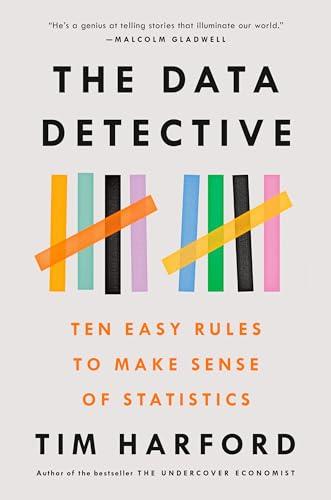
The Data Detective
Ten Easy Rules to Make Sense of Statistics
Tim Harford
From “one of the great (greatest?) contemporary popular writers on economics” (Tyler Cowen) comes a smart, lively, and encouraging rethinking of how to use statistics
Today we think statistics are the enemy, numbers used to mislead and confuse us. That’s a mistake, Tim Harford says in
Harford said his most recent book, The Data Detective, examined how to think clearly with numbers and warned against reflexive skepticism toward statistics, focusing on using data to understand the world.
"
So my that is a point I made in my most recent book, which is called the Data Detective in the US, and it's called how to make the world that up in the UK.
— Episode: #548 - Tim Harford - Why Is Thinking Cle...
Episode: #548 - Tim Harford - Why Is Thinking Clearly So Di...
Harford said his most recent book, The Data Detective, examined how to think clearly with numbers and warned against reflexive skepticism toward statistics, focusing on using data to understand the world.
"
So my that is a point I made in my most recent book, which is called the Data Detective in the US, and it's called how to make the world that up in the UK.
There was a reflexive skepticism, like lies, damn lies and statistics, or you can prove anything with statistics, or this famous book, how to lie with statistics.
Tim Harford's book, 'The Data Detective', was recommended as a guide to understanding statistics and presented a three-part framework of calm, context, and curiosity to analyze data.
"
So I wrote an entire book about this and I'm going to give you the secret to that book so you don't need to buy it. Although I do recommend that you do buy it. It's called The Data Detective.
— Episode: Cautionary Tales, with Tim Harford
Episode: Cautionary Tales, with Tim Harford
Tim Harford's book, 'The Data Detective', was recommended as a guide to understanding statistics and presented a three-part framework of calm, context, and curiosity to analyze data.
"
So I wrote an entire book about this and I'm going to give you the secret to that book so you don't need to buy it. Although I do recommend that you do buy it. It's called The Data Detective.
And and yeah, I recommend the book.
And now you don't have to buy the data as a detective, but maybe you should.
Episode: Cautionary Tales, with Tim Harford
Tim Harford's 'The Data Detective' was promoted on the podcast and offers a three-part approach to understanding statistics, emphasizing calm, context, and curiosity to combat the emotional and manipulative uses of data.
"
So I wrote an entire book about this and I'm going to give you the secret to that book so you don't need to buy it. Although I do recommend that you do buy it. It's called 'The Data Detective'.
I wish that Sir Arthur Conan Doyle could have purchased the data detective while he was still around.
And I would also add, death is the great commonality. Right? So that's something everyone can identify with, unfortunately at some point.
Take a page from Matt's book and join me as a fan of the data detective, along with the undercover economist and Messi and how to make the world add up.
Episode: Cautionary Tales, with Tim Harford
It was recommended by Tim Harford, as it covers making sense of statistics presented in the media. It utilizes the three C's - calm, context, and curiosity.
"
So I wrote an entire book about this and I'm going to give you the secret to that book so you don't need to buy it. Although I do recommend that you do buy it. It's called The Data Detective.
But but then I wouldn't I. But let me try and give you the OK, so the three part approach to making sense of a number that you see. It's the three C's calm context curiosity.
Yeah, I'm going to, for sure. I wish that Sir Arthur Conan Doyle could have purchased the data detective while he was still around.
Note: The book recommendations on this page are discovered automatically from podcast transcripts, and may be incorrect or incomplete.