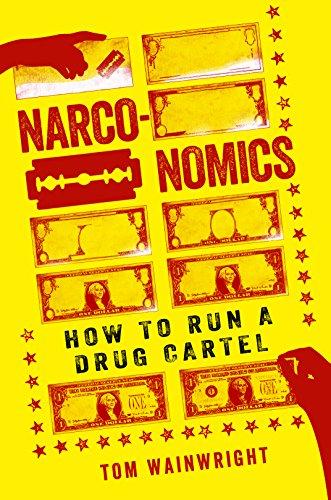
Narconomics: How to Run a Drug Cartel Cover
Podcast Mentions

Narconomics How to Run a Drug Cartel

Tom Wainwright

What drug lords learned from big business How does a budding cartel boss succeed (and survive) in the 300 billion illegal drug business? By learning from the best, of course. From creating brand value to fine-tuning customer service, the folks running cartels have been attentive students of the str...

Podcasts 2
Quotes 24
Stuff They Don't Want You To Know

It was discussed as a book written by a journalist who reported on business and economics in Mexico, and how the drug trade and cartels use business models similar to large corporations. It was described as being like a textbook.

"

I found that one week I'd be writing about the car business. The next week I'd be writing about the drugs business. I gradually came to see that the two actually were perhaps more similar than people...

— Episode: Cartels as Corporations -- and Governmen...

Episode: Cartels as Corporations -- and Governments

It was discussed as a book written by a journalist who reported on business and economics in Mexico, and how the drug trade and cartels use business models similar to large corporations. It was described as being like a textbook.

"

I found that one week I'd be writing about the car business. The next week I'd be writing about the drugs business. I gradually came to see that the two actually were perhaps more similar than people normally recognize.

Narconomics How to Run a Drug Cartel

Episode: Cartels as Corporations -- and Governments

It was described as a textbook for how to run a drug cartel. The hosts praised its clarity and the insights into the business models of drug cartels.

"

I found that one week I'd be writing about the car business. The next week I'd be writing about the drugs business. I gradually came to see that the two actually were perhaps more similar than people normally recognize.

Narconomics: How to Run a Drug Cartel

Episode: Cartels as Corporations -- and Governments

It was described as a textbook on how to run a drug cartel, with insights into how cartels use business models similar to big box stores and fast-food franchises. The author found that cartels control their supply chains, allowing them to manipulate variables and keep prices stable.

"

I found that one week I'd be writing about the car business. The next week I'd be writing about the drugs business. I gradually came to see that the two actually were perhaps more similar than people normally recognize.

Narconomics How to Run a Drug Cartel

To make, for instance, a kilo of cocaine. You need about a ton of coca leaf and that ton once it's all dried out in a country like Columbia will fetch perhaps $400.

Now the kilo in the United States will fetch about $100,000.

If there is a disruption to some sort of supply and Walmart runs that supply chain...Tom uses the example of like a bad harvest year for apples. Apple growers in that case, they can't increase their prices because Walmart is the only buyer.
The Jordan Harbinger Show

It was discussed how drug cartels operate like businesses, with tactics like branding and PR, and that focusing on demand reduction is more effective than supply interdiction.

"

I just found the concepts so interesting and compelling that I wanted to do a show on this.

— Episode: 387: Tom Wainwright | How to Run a Drug...

Episode: 387: Tom Wainwright | How to Run a Drug Cartel

It was discussed how drug cartels operate like businesses, with tactics like branding and PR, and that focusing on demand reduction is more effective than supply interdiction.

"

I just found the concepts so interesting and compelling that I wanted to do a show on this.

You wore a GPS device to meeting with a drug cartel leader and it didn't work.

It's not worth very much at all to make a kilo of pure cocaine powder you need about a turn of fresh coca leaf and in Colombia for instance that turn is worth probably about $500 or thereabouts which is nothing and of course by the time that kilo of cocaine makes it to the United States it's worth probably more than a hundred thousand dollars.

If you try to interrupt supply you're going to find that if you do it early in the chain you have very little effect and if you do it late in the chain you'll have more of an impact but by that stage it's very very difficult because by the time the product makes its way to the states it's dispersed into tiny quantities of just a few grams here and there and you can lock up those dealers but by then you know if you try and lock up every dealer who's shifting a gram or two of cocaine you're going to end up locking up you know a very very large number of people which indeed is exactly what has happened in the US.

If the trucks business were a country it's a pretty serious economy they really use that economic power and if you look at some of the countries where they operate particularly ones in central america where in many cases the state the government is very very weak the cartels just have the upper hand.

Episode: 387: Tom Wainwright | How to Run a Drug Cartel

It explored the parallels between drug cartels and regular businesses, arguing that understanding them as profit-driven enterprises is key to combating them. The author discussed how cartels use branding, PR, and even corporate social responsibility tactics.

"

I just found the concepts so interesting and compelling that I wanted to do a show on this.

You wore a GPS device to meeting with a drug cartel leader and it didn't work.

It's a pretty serious economy they really use that economic power.

It's just really really interesting to see how the problems have to be handled in the same way.

The book is called Narconomics, links to that stuff is always on the website in the show notes.

Episode: 387: Tom Wainwright | How to Run a Drug Cartel

It explored the parallels between drug cartels and regular businesses, revealing how drug cartels operate like profit-motivated businesses rather than purely criminal organizations.

"

I just found the concepts so interesting and compelling that I wanted to do a show on this.

You wore a GPS device to meeting with a drug cartel leader and it didn't work. So that was kind of what hooked me into this and I thought this guy, this guy's crazy.

I think the kind of height of this PR activity is a form of what really looks like corporate social responsibility and it sounds crazy but again if you watch that show Narcos or if you read about Pablo Escobar one of the interesting things about him is that despite the fact that he brought stunning levels of violence to Columbia he remained in many areas a popular figure.

If you don't have to intimidate a certain wrong of people on the ladder here you can end up with a base right you end up with a base and those people can protect you.

This has been absolutely fascinating thank you so much Tom narco nomics will be linked of course in the show notes as well it's a great read and it goes by quick and there's just so many interesting parallels here between the cartels and quote unquote regular business here in the good old USA and the rest of the world.

Note: The book recommendations on this page are discovered automatically from podcast transcripts, and may be incorrect or incomplete.