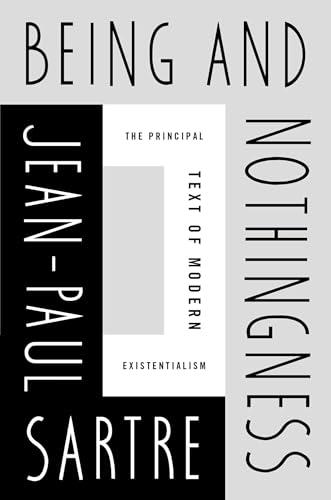

Being and Nothingness Cover
Podcast Mentions

Being and Nothingness

Jean-Paul Sartre

Revisit one of the most important pillars in modern philosophy with this new English translation—the first in more than 60 years—of Jean-Paul Sartre’s seminal treatise on existentialism. “This is a philosophy to be reckoned with, both for its own intrinsic power and as a profound symptom of our time...

Podcasts 4
Quotes 11
The BOB & TOM Show Free Podcast

Sartre's "Being and Nothingness" was considered banal and annoying by the speaker, who found it far less interesting than Kierkegaard's work.

"

Well I found Sarrte's Being and Nothingness quite a banal piece of work.

— Episode: Full Show Podcast for April 29, 2024

Episode: Full Show Podcast for April 29, 2024

Sartre's "Being and Nothingness" was considered banal and annoying by the speaker, who found it far less interesting than Kierkegaard's work.

"

Well I found Sarrte's Being and Nothingness quite a banal piece of work.

Well as I learned that Sarrte makes Kierkegaard looked like niches pretty annoying huh.
Philosophize This!

The podcast repeatedly highlighted the book as a cornerstone of Sartrean philosophy, using its notion that "man is condemned to be free" to explore ethical implications of human freedom. Hosts referenced it while discussing consciousness as an active freedom rather than a passive receptacle, and critiqued the reduction of complex personalities to universal essences. Throughout the episodes, the discussion framed the work as essential for understanding Sartre's ideas on nothingness and the inseparability of consciousness and the world.

Highly Recommended

Episode: Episode #104 ... Sartre and Camus pt. 5 - Consciou...

It was described as Sartre's seminal work, exploring his concept of consciousness as freedom and nothingness. The podcast host discussed the book's complex ideas about the relationship between consciousness and the world, emphasizing the concept of consciousness as an activity rather than a passive receptacle.

"

transition, becoming anything that permits us to say that being is not yet what it will be and that it is already what it is not. All that is forbidden on principle. It is full positivity. It's important. It knows no otherness. It never posits itself as other than another being. It is not subject to temporality

that man back there in the past is me. It's not someone else after all. I recognize myself in that past man. And yet in the sense that matters right now, that man is not me. That man has good resolutions that speak to him and are persuasive. But those resolutions do not affect me one bit unless I make those resolutions anew now. I don't find his resolutions affecting me.

Episode: Episode #104 ... Sartre and Camus pt. 5 - Consciou...

The podcast extensively discussed Sartre's seminal work, focusing on his concepts of consciousness as freedom and nothingness. The episode explored Sartre's ideas about consciousness as an activity of pure directedness towards being-in-itself and his rejection of the unconscious mind as a scapegoat for actions.

"

transition, becoming anything that permits us to say that being is not yet what it will be and that it is already what it is not. All that is forbidden on principle. It is full positivity. It's important. It knows no otherness. It never posits itself as other than another being. It is not subject to temporality

that man back there in the past is me. It's not someone else after all. I recognize myself in that past man. And yet in the sense that matters right now, that man is not me. That man has good resolutions that speak to him and are persuasive. But those resolutions do not affect me one bit unless I make those resolutions anew now. I don't find his resolutions affecting me.

Episode: Episode #103 ... Sartre and Camus pt. 4 - The Ques...

The podcast mentioned Sartre's critique of using universal essences to understand individuals, illustrated by his analysis of a biography of Gustave Flaubert. His work challenged traditional philosophical approaches and emphasized the inseparability of consciousness and the world.

"

a critic for example wishing to explain the psychology of Flaubert will write that he quote appeared in his early youth to know as his normal state a continual exaltation resulting from the twofold feeling of his grandiose ambition and his invincible power. The effervescence of his young blood was then turned into literary passion as happens about the 18th year and precocious souls who find the energy of style or the intensities of fiction some way of escaping the need of violent action or of intense feeling which torments them end quote.

in this passage there's an effort to reduce the complex personality of an adolescent to a few basic desires as the chemist reduces compound bodies to merely a combination of simple bodies. The primitive givens will be grandiose ambition the need of violent action and of intense feeling these elements when they enter into combination produce a permanent exaltation end quote.

at each state in the description just quoted we meet with a hiatus why did ambition and the feeling of his power produce in Flaubert exaltation rather than tranquil waiting or gloomy impatience why did this exaltation express itself specifically in the need to act violently and feel intensely or rather why does this need make a sudden appearance by spontaneous generation at the end of the paragraph and why does this need instead of seeking to appease itself in acts of violence by amorous adventures or in debauch choose precisely to satisfy itself symbolically and why does Flaubert turn to writing rather than to painting or music for the symbolic satisfaction he could just as well not resort to the artistic field at all quote I could have been a great actor wrote Flaubert somewhere why did he not try to be one in a word we have understood nothing we have seen a succession of accidental happenings of desires springing forth fully armed one from the other with no possibility for us to grasp their genesis end quote

The Daily Stoic

The speaker mentioned having read this book in high school, although they did not fully understand the content at the time. They enjoyed the image of being the type of person who reads such books.

"

I remember when I was in high school my dad was a philosophy major in college and he had all his old philosophy books lying around and I started reading them and I didn't understand them but I loved t...

— Episode: Michael Schur on the Virtuous Life and H...

Episode: Michael Schur on the Virtuous Life and Humor in Ph...

The speaker mentioned having read this book in high school, although they did not fully understand the content at the time. They enjoyed the image of being the type of person who reads such books.

"

I remember when I was in high school my dad was a philosophy major in college and he had all his old philosophy books lying around and I started reading them and I didn't understand them but I loved the idea of being a high school kid who read philosophy so I would walk around with Nietzsche or or hide a girl or something in my bag and like or Kierkegaard and I had being in nothingness and I would like leave through it and I didn't understand a word I was saying or reading but I love the idea of being the kind of person who did that and I think that's a lot of what I and Rand appeals to is like this is a big idea I'm filling your head with big ideas and you get so swelled up with pride because you understand them and they and they're like yes of course I am powerful I am I can do this I'm on my own I am an adult now and then when you are 23 and you read it again hopefully you say like well this is absurd like the world can't function this way this is ridiculous

Real Dictators

Enver Hoxha's personal library contained a variety of books, including "Being and Nothingness" by Jean-Paul Sartre.

"

It included books by Sartre and Kamu and the one thing it didn't include was anything written by either Marx or Lenin which one might find surprising.

— Episode: Enver Hoxha Part 2: Stalin’s Shadow, Eur...

Episode: Enver Hoxha Part 2: Stalin’s Shadow, Europe’s Nort...

Enver Hoxha's personal library contained a variety of books, including "Being and Nothingness" by Jean-Paul Sartre.

"

It included books by Sartre and Kamu and the one thing it didn't include was anything written by either Marx or Lenin which one might find surprising.

Note: The book recommendations on this page are discovered automatically from podcast transcripts, and may be incorrect or incomplete.