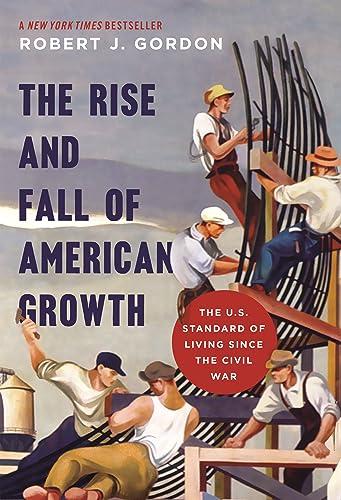

The Rise and Fall of American Growth: The U.S. Standard of Living since the Civil War (The Princeton Economic History of the Western World) Cover
Podcast Mentions

The Rise and Fall of American Growth The U.S. Standard of Living since the Civil War (The Princeton Economic History of the Western World)

Robert J. Gordon

How America's high standard of living came to be and why future growth is under threat In the century after the Civil War, an economic revolution improved the American standard of living in ways previously unimaginable. Electric lighting, indoor plumbing, motor vehicles, air travel, and television...

Podcasts 2
Quotes 10
The Ezra Klein Show

The book was highlighted as a key argument that the rapid growth of the early industrial era is unlikely to return, tracing the transformation between the late 19th and mid‑20th centuries. Ethan Mollick introduced it in a discussion about AI, and the host Roger cited it as a seminal, though pessimistic, analysis of the historic wave of innovation and its recent decline. Both episodes presented it as essential reading for understanding future productivity challenges.

Highly Recommended

Episode: How Should I Be Using A.I. Right Now?

Mollick described the book as an argument that the rapid growth of the early industrial era will not recur and explained how the world changed between the late1800s and mid1900s.

"

One of them is The Rise and Fall of American Growth, which is an argument about why we will never have the kind of growth that we did in the first part of the Industrial Revolution again. It describes how the world changed between 1870 or 1890 and 1940 versus 1940 and 1990 or 2000, showing the transformation of the world during that period.

Episode: How Martin Wolf Understands This Global Economic M...

The guest called it a seminal, somewhat pessimistic work that examines the historic wave of innovation and its recent decline.

"

The last is to me a seminal book which is sort of in a way an anti-Acemoglu and Robinson was by Robert Gordon, it's called The Rise and Fall of American Growth and it really explores why there was this huge wave of innovation between 1880 and 1940 roughly, 1950, 1960 actually into the 60s and then the decline and it's much more pessimistic and that is very disturbing for the future because if productivity growth slows, I think it becomes much more difficult to sustain our sort of society.
Freakonomics Radio

The author was interviewed and expressed his opposition to a guaranteed minimum income due to potential disincentives to work and a decrease in labor force participation.

"

As far as a guaranteed minimum income, I'm not in favor of that. I'm in favor of a modest increase in the minimum wage and a substantial increase in the earned income tax credit, which encourages low...

— Episode: 242. Is the World Ready for a Guaranteed...

Episode: 242. Is the World Ready for a Guaranteed Basic Inc...

The author was interviewed and expressed his opposition to a guaranteed minimum income due to potential disincentives to work and a decrease in labor force participation.

"

As far as a guaranteed minimum income, I'm not in favor of that. I'm in favor of a modest increase in the minimum wage and a substantial increase in the earned income tax credit, which encourages low income people to work.

There's too much of an incentive if you guarantee income to replace work.

And if you provide a guaranteed minimum income to everybody, then those with low skills will drop out of the labor force and will no longer work.

Episode: 240. Yes, the American Economy Is in a Funk -- But...

It was discussed that the book suggests the American economy's growth has peaked and likely won't return to previous rates due to the nature of recent inventions compared to earlier ones, particularly those of the Second Industrial Revolution.

"

The Northwestern economist Robert Gordon has written a book called The Rise and Fall of American Growth.

And that's where we get into some of the controversy that's been caused by my book.

So this brings us really I guess to part of the controversy of your book, which is also brings us to the title of your book, The Rise and Fall of American Growth.

Gordon believes that as bright and shiny and wonderful as the many manifestations of this Third Industrial Revolution may be, well, they can't compare to the more essential inventions of the Second Industrial Revolution when it comes to increasing the average person's standard of living.

Gordon's economic conversation tells a different story, that our runaway growth of the past was essentially a golden age.

Note: The book recommendations on this page are discovered automatically from podcast transcripts, and may be incorrect or incomplete.