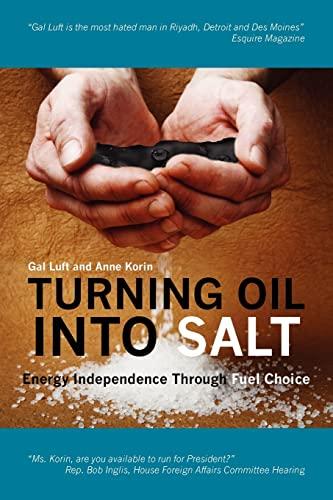

Turning Oil Into Salt: Energy Independence Through Fuel Choice Cover
Podcast Mentions

Turning Oil Into Salt Energy Independence Through Fuel Choice

Anne Korin

Throughout history the pursuit of strategic commodities has governed world affairs. Centuries ago salt enjoyed a monopoly over food preservation, and securing access to the white mineral shaped the great empires' international behavior. Today, it is oil that monopolizes our transportation system giv...

Podcasts 3
Quotes 7
StarTalk Radio

The authors argued that if cars were no longer dependent on gasoline, oil would become less of a strategic commodity. They suggested that electric cars, which can be powered by various energy sources, would make oil less valuable as it would have to compete with numerous other commodities.

"

So the thesis of the book was if you have a car that does not depend on gasoline, that could run on 30 different types of fuel, then the gasoline is no longer a strategic commodity.

— Episode: Our Electrified Future with David Reichm...

Episode: Our Electrified Future with David Reichmuth

The authors argued that if cars were no longer dependent on gasoline, oil would become less of a strategic commodity. They suggested that electric cars, which can be powered by various energy sources, would make oil less valuable as it would have to compete with numerous other commodities.

"

So the thesis of the book was if you have a car that does not depend on gasoline, that could run on 30 different types of fuel, then the gasoline is no longer a strategic commodity.

So the two authors there, I've got Anne Koren and Gail Luft. So they're the two authors of that book, Turning Oil Into Salt.

So the book I read called Turning Oil Into Salt, and I forgot the two authors, co-authors of that, made a fascinating point, which was you have a car that requires oil products, so gasoline, it'll only run on gasoline.


Odd Lots

Podcast

Odd Lots

This book, written by the same author as the book about cod, was brought up as another example of a single-commodity study.

"

And then the same author wrote a book called salt.

— Episode: What 300 Years of Firewood Prices Say Ab...

Episode: What 300 Years of Firewood Prices Say About the Ec...

This book, written by the same author as the book about cod, was brought up as another example of a single-commodity study.

"

And then the same author wrote a book called salt.

Untraditionally Lala

Michael mentioned reading a book about the history of salt, specifically its use as currency and its value compared to gold, which Lauryn found intriguing.

"

He's a huge reader, which is a huge turn on for me. They like that and he said I'm reading a book on salt and I was like what and he's like salt I'm reading about the history of salt and he starts tel...

— Episode: The Skinny Confidential's Lauryn & Micha...

Episode: The Skinny Confidential's Lauryn & Michael Bosstic...

Michael mentioned reading a book about the history of salt, specifically its use as currency and its value compared to gold, which Lauryn found intriguing.

"

He's a huge reader, which is a huge turn on for me. They like that and he said I'm reading a book on salt and I was like what and he's like salt I'm reading about the history of salt and he starts telling me all the history of salt how salt used to be used as a currency and like it used to be his money and I was like salt was worth more than gold

You ever heard the term like worth his weight in salt, yeah, so it comes from because it was a currency

Episode: The Skinny Confidential's Lauryn & Michael Bosstic...

They talked about a book on the history of salt that explained how salt was once used as currency, even worth more than gold.

"

He said, "I'm reading a book on salt." I asked what it was called and he replied, "Salt." He then told me how salt was used as a currency and at one point was worth more than gold.

Note: The book recommendations on this page are discovered automatically from podcast transcripts, and may be incorrect or incomplete.