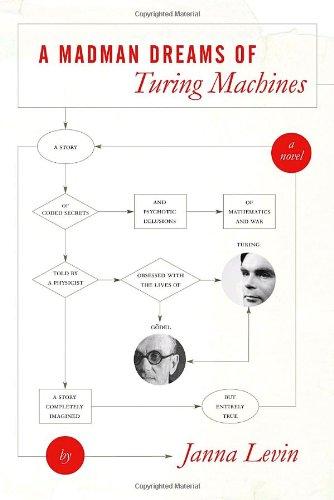
This novel centers on the lives and ideas of Kurt Gdel and Alan Turing, exploring the intersection of philosophical questions and scientific inquiry. The podcast extensively discussed the book's themes and explored the author's intentions in writing it.
"
Her novel, a mad band dreams of cheering machines, centers on the lives and ideas of two pivotal 20th century mathematicians, Kurt Gerdel, and Alan Turing.
Episode: Janna Levin — Mathematics, Purpose, and Truth
This novel centers on the lives and ideas of Kurt Gdel and Alan Turing, exploring the intersection of philosophical questions and scientific inquiry. The podcast extensively discussed the book's themes and explored the author's intentions in writing it.
"
Her novel, a mad band dreams of cheering machines, centers on the lives and ideas of two pivotal 20th century mathematicians, Kurt Gerdel, and Alan Turing.
In our novel Jan 11 writes, one plus one will always be too. Churring and Gerdel's broken lives are mere anecdotes in the margins of their discoveries. But then their discoveries are evidence of our purpose. And their lives are parables on free will. And they are not the most advanced in difference. I want to tell their stories.
I think that the answers that we're going to get at the discoveries that we're going to make are going to be in mathematics. But they're going to be meaningless to us unless they're integrated into a sort of human perspective where we understand why we ask the questions. What the significance of the answer is for us and how the world is going to change as a result of having made those discoveries.
I definitely think it's the reason the book was structured as a novel. I try to stick as close to fact as possible. It's not the facts that I'm changing it's the approach to the facts and it's a sort of confession that no matter how I list these facts I am somehow not able to get at the truth that truth doesn't just drop out like a theorem if I follow certain logical steps and I think maybe it's saying something also about maybe my own approach to science no matter how much I follow these logical steps no matter how much I make real discoveries that will be on ambiguous I hope.
Episode: [Unedited] Janna Levin with Krista Tippett
The book, which won the PEN/Bingham prize, explores the lives of Kurt Gdel and Alan Turing, weaving together their stories and scientific contributions with philosophical questions about truth and reality. The author aimed to create a reading experience that was almost overwhelming and unnerving, using vivid and surreal language.
"
I love the book. I think it's fantastic and, uh, and there's a lot in there to talk about.
I really hoped that the reader would have that experience because ultimately I think that's where the book nudges you know that any of this is real that the book isn't a figment of your imagination in the book itself.
I really wanted the book to be as much about language as anything else as much about of visceral experiences anything else
It's not so much about the specifics of the science the fact that science it's my subject is just the way it is for me
I did want the reader to have this sense that there are no true things really out except for things as crisp as one plus one equals to that are unambiguously true and and yet we we know we're getting closer to the truth even though we can't always prove it
Episode: Janna Levin — Mathematics, Purpose, and Truth
This novel centers on the lives and ideas of Kurt Gdel and Alan Turing, exploring their contributions to mathematics and their impact on our understanding of meaning and purpose. The podcast extensively discusses themes and ideas from the book.
"
Her novel, a mad band dreams of cheering machines, centers on the lives and ideas of two pivotal 20th century mathematicians, Kurt Gerdel, and Alan Turing.
In our novel Jan 11 writes, one plus one will always be too. Churring and Gerdel's broken lives are mere anecdotes in the margins of their discoveries. But then their discoveries are evidence of our purpose. And their lives are parables on free will. And they are not the most advanced in difference. I want to tell their stories.
I really hoped that the reader would have that experience because ultimately I think that's where the book nudges. Do you know that any of this is real that the book isn't a figment of your imagination even though it's self-rebook itself, but somehow you aren't the author of the book itself.
Episode: [Unedited] Janna Levin with Krista Tippett
The book, which won the PEN/Bingham prize, explores the intersection of philosophical questions and scientific inquiry, particularly focusing on the lives and work of Kurt Gdel and Alan Turing. The narrative weaves together their stories, highlighting their struggles with truth, reality, and the limits of human knowledge.
"
I love the book. I think it's fantastic and, uh, and there's a lot in there to talk about
I really hoped that the reader would have that experience because ultimately I think that's where the book nudges do you know that any of this is real that the book isn't a figment of your imagination in the book itself.
It was definitely pushing on that limit of what do we know and what don't we know, what do we take to be faith, what's rational to believe, what's not rational to believe.
I really wanted the book to be as much about language as anything else as much about of visceral experiences anything else
I did want the reader to have this sense that there are no true things really out except for things as crisp as one plus one equals to that are unambiguously true and and yet we we know we're getting closer to the truth even though we can't always prove it
Note: The book recommendations on this page are discovered automatically from podcast transcripts, and may be incorrect or incomplete.