
Podcast
Huberman Lab
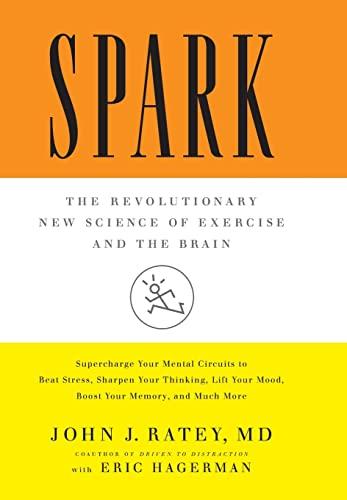
Andrew Huberman highlighted the title as an early academic work that linked exercise and movement to brain plasticity, noting its discussion of animal studies where inactivity led to brain tissue loss. He also pointed out that the book emphasized the role of play, novelty, and varied environments as key drivers of neuroplasticity, and described it as still relevant and quite good. Overall, the discussion presented the book as a valuable resource for understanding how physical activity shapes the brain.
Episode: Understand & Improve Memory Using Science-Based To...
John Ratey, a professor at Harvard Medical School, wrote "Spark", one of the early books about brain plasticity and the relationship between exercise and movement in plasticity. He discussed the observations of ocean dwelling animals that have a robust and complicated nervous system early in life but then become stationary in the late portion of their life and actually digest their own brain.
John Rady who's a professor in Harvard Medical School. He wrote a book called Spark which is one of the early books, at least from an academic about brain plasticity and the relationship between exercise and movement in plasticity.
And John who I have the good fortune to know has described to me experiments or I should say observations of species of ocean dwelling animals that have at least for the early part of their life a very robust and complicated nervous system.
But then these particular animals are in the habit of plopping down onto a rock they find a kind of a safe comfy space and they actually stick to that rock.
And they don't move anymore for a certain portion I should say the late portion of their life and it is at the transition between moving a lot and being stationary that those animals actually digest their own brain.
They literally metabolize a good portion of their nervous system because they decide don't need this anymore and gobble it up use it for its nutritional value and then sit there like a moron version of themselves with a limited amount of brain tissue because they don't need to move anymore.
Episode: Using Play to Rewire & Improve Your Brain
John Ratey, a psychiatrist at Harvard Medical School, wrote this book about the important role that play exerts in the neuroplasticity process. He also points to the importance of navigating new environments.
one of the more popular books that I think is quite good is from my friend and colleague John Raidi who's a psychiatrist at Harvard Medical School ...he wrote the book Spark a few years back and I think it's still very relevant and John talks about the important role that play exerts in the neuroplasticity process and points to a number of different protocols that one can engage in he also points to the importance of navigating new environments to not just go on the same hike every week or take the same walk but actually get into new novel environments so you're starting to sense a theme here there's novelty exploring contingencies keeping the stakes relatively low etc etc but these really are the gates to this holy grail that we call neuroplasticity