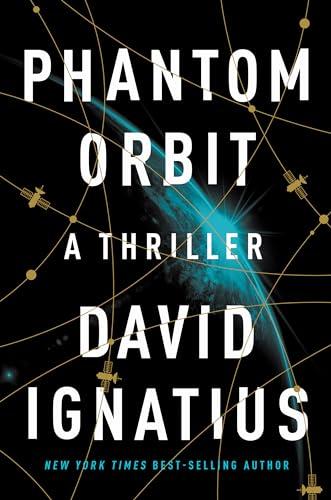
Phantom Orbit: A Thriller Cover
Podcast Mentions

Phantom Orbit A Thriller

David Ignatius

A subtle and masterful novel from a prescient voice on the cutting edge of spy literature. David Ignatius is known for his uncanny ability, in novel after novel, to predict the next great national security headline. In

Podcasts 4
Quotes 20
The Prof G Pod with Scott Galloway

It was a thriller about an invisible enemy that could disrupt a satellite signal central to our daily lives. The author used the book to illustrate the growing dominance of space weapons in warfare, and believed that Ukraine was the first space war. It was about a Russian astrophysicist who came to believe that Russia and China developed a kill switch that could disable the American GPS system and tried to communicate that to the US. The author felt that the future of warfare would be dominated by systems in space and that private sector companies had more leverage over our national security policy.

"

So this is a novel about the way in which space weapons, space warfare are coming to dominate warfare more broadly.

— Episode: Vulnerabilities in Space + Updates on th...

Episode: Vulnerabilities in Space + Updates on the Wars in...

It was a thriller about an invisible enemy that could disrupt a satellite signal central to our daily lives. The author used the book to illustrate the growing dominance of space weapons in warfare, and believed that Ukraine was the first space war. It was about a Russian astrophysicist who came to believe that Russia and China developed a kill switch that could disable the American GPS system and tried to communicate that to the US. The author felt that the future of warfare would be dominated by systems in space and that private sector companies had more leverage over our national security policy.

"

So this is a novel about the way in which space weapons, space warfare are coming to dominate warfare more broadly.

I've become convinced in four visits to Ukraine that Ukraine is really the first space war.

I can explain that in a minute but the book opens with a Russian astrophysicist, not a defector, not a traitor, but somebody who's come to believe that Russia and China developed the ability to essentially have a kill switch that can disable the GPS system on which American communications everywhere, our cell phone calls, our air travel, our travel of every sort depend.

And he tries to communicate that to the United States thinking he has a responsibility to do so and the CIA doesn't want to respond, doesn't get back to him.

But more broadly it's a book about what I think is the future of warfare, maybe the future of commerce as well, which is systems in space.


Morning Joe

It was a new thriller about space warfare, which was described as the future of warfare. Ukraine was described as the first space war and the book was said to be about the truth of what is coming in space warfare.

"

So, Joe, I have a friend from Syria who said to me once, David, you tell the truth more in your fiction than in your journalism.

— Episode: Morning Joe 5/6/24

Episode: Morning Joe 5/6/24

It was a new thriller about space warfare, which was described as the future of warfare. Ukraine was described as the first space war and the book was said to be about the truth of what is coming in space warfare.

"

So, Joe, I have a friend from Syria who said to me once, David, you tell the truth more in your fiction than in your journalism.

The Washington Post David Ignatius, thank you.

So, John Meacham, Phantom Orbit is about the world of warfare that has really arrived.

The next war will begin in space, it may end in space, and these are systems that people haven't really begun to think about.

I get to think in this broader way about what's coming and the characters who are driving it.

On with Kara Swisher

This is David's latest novel. It is a spy thriller that delves into the world of satellite warfare. It opens with a Russian scientist who discovers a Russian-Chinese technique to disable GPS satellites. He decides to share this secret with the CIA, as he believes it is too dangerous for the world. The book also explores the Chinese efforts to penetrate the supply chain for satellite systems, as they see satellites as the future of weapons and the economy.

"

So I tried to teach myself, got rejected by everybody but it ended up getting published in 1987. And because it told this amazing true story it became almost like a text.

— Episode: War in Gaza, Ukraine & Space, plus Biden...

Episode: War in Gaza, Ukraine & Space, plus Biden vs. Trump...

This is David's latest novel. It is a spy thriller that delves into the world of satellite warfare. It opens with a Russian scientist who discovers a Russian-Chinese technique to disable GPS satellites. He decides to share this secret with the CIA, as he believes it is too dangerous for the world. The book also explores the Chinese efforts to penetrate the supply chain for satellite systems, as they see satellites as the future of weapons and the economy.

"

So I tried to teach myself, got rejected by everybody but it ended up getting published in 1987. And because it told this amazing true story it became almost like a text.

So I've written 12 novels. Things that I find interesting in my journalism and want to unpack and tell in a rich way that they really happen I put into my fiction.

So sometimes I do make them columns in the Washington Post and then there's a dimension that is, I don't know enough to write it as fact but I know enough to make it plausible fiction.

So this book opens with a Russian who thinks that he has discovered a Russian-Chinese technique for, as he calls it, a kill switch for turning off GPS satellites which would, as all your listeners understand, would have a crippling effect. You couldn't use your cell phone, you couldn't travel, commerce wouldn't work. And so he feels he has to share this secret with the CIA.

But why is this so critical? Why was this the thing you wanted to put in? That they had put in essentially a sleeper cell, not a person, but a sleeper software that would disable.

Stay Tuned with Preet

The book is about a Russian space scientist who discovers that Russia and China have created a system that can shut down the GPS, which would cripple American communications and transportation, and he tries to inform the CIA. The book follows the scientist, his mentor, and an American CIA agent as their stories intertwine, leading them to the present day and the shadow of the war in Ukraine.

"

So this is a book that's about space weapons which are taking over the world of warfare.

— Episode: Stormy Testimony & Space Wars (with Davi...

Episode: Stormy Testimony & Space Wars (with David Ignatius...

The book is about a Russian space scientist who discovers that Russia and China have created a system that can shut down the GPS, which would cripple American communications and transportation, and he tries to inform the CIA. The book follows the scientist, his mentor, and an American CIA agent as their stories intertwine, leading them to the present day and the shadow of the war in Ukraine.

"

So this is a book that's about space weapons which are taking over the world of warfare.

The book is about a Russian space scientist named Ivan Volkov who finds evidence that makes him believe that Russia and China have developed a system, kill switch is what he thinks of it as, that can turn off the GPS global positioning system on which every aspect of U.S. communications, transportation and really our economic lifeline depends and feels that he has a responsibility to share that information with the CIA.

The book pulls back to look at how his obsession with space shared with two other main characters began in the mid 1990s in Beijing and how the stories of this Russian, a Chinese who's his mentor and an American woman who works for the CIA become entangled in ways that take them right to today to the shadow of the Ukraine war which is happening as the concluding action of the book takes place.

And I wanted to go there because I wanted to see what people who had been crushed after the fall of the Soviet Union looked and felt like. I wanted my character to be of that world. People were recovering from this catastrophe.

So I was all set to go, was thinking about what hotel to stay in and this Magnitogorsk faraway place when boom, Russia invaded. And I was, I think, in the first big chunk of people who were banned. I was, I think, the only or one of the few journalists to this day. I don't know quite why I was on the list, but it meant that my visa was gone, obviously, and my chance of going to Magnitogorsk and Moscow had vanished.

Note: The book recommendations on this page are discovered automatically from podcast transcripts, and may be incorrect or incomplete.