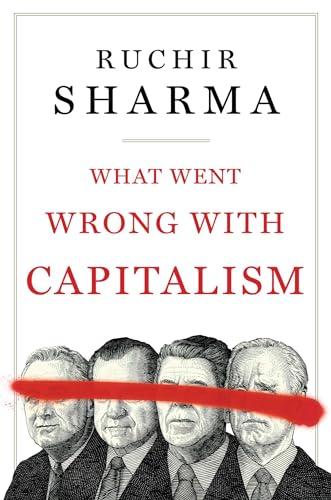
This book argues that excessive government intervention in the economy, including regulations and bailouts, has undermined the creativity and productivity of capitalism, leading to declining productivity, rising inequality and disillusionment among Americans. Sharma highlights the impact of excessive regulations on small businesses and the increasing reliance on government spending, leading to a decline in productivity and economic growth. He criticizes the overregulation of certain industries and the implicit assumption of government bailouts, arguing for a more balanced approach that prioritizes economic freedom and allows for natural economic churn.
"
Yeah, I think as I'm showing the book here, Scott, which is the fact that if you look at what's been happening in America, pretty much a lot of the Western world over the last few decades, is that we have progressively seen greater and greater government intervention in the economy.
And those consequences include declining productivity, rising inequality, and also this feeling amongst most Americans that the system they have in place is not working.
As I say in the book, that the surveys show that most young Americans, particularly Democrats, say they would rather have socialism than capitalism.
In fact, I begin this book, like in the prologue, by speaking about my journey from India because as you say, I was born there and India was a truly socialist economy when I was born in the mid-1970s.
And in the Anglo-Saxon world, of course, the country that has been doing the worst, which I think is a bit of a surprise and I wrote about that is Canada.