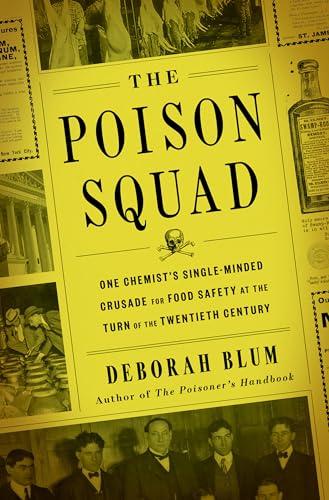

The Poison Squad: One Chemist's Single-Minded Crusade for Food Safety at the Turn of the Twentieth Century Cover
Podcast Mentions

The Poison Squad One Chemist's Single-Minded Crusade for Food Safety at the Turn of the Twentieth Century

Deborah Blum

A By the end of nineteenth century, food was dangerous. Lethal, even. "Milk" might contain formaldehyde, most often used to embalm corpses. Decaying meat was preserved with both salicylic acid, a pharmaceutical chemical, and borax, a compound first identified as a cleaning product. This was not by...

Podcasts 3
Quotes 11
The Ezra Klein Show

She highlighted The Poison Squad as an excellent biography of a USDA chemist who helped establish the FDA and foodsafety regulations.

"

Another one is Deb Blum's Poison Squad. And this is like an excellent look through a biography of one of the former chemists at the USDA who did research that helped lead to the establishment of the F...

— Episode: GLP-1s and the ‘Wild West’ of Wellness

Episode: GLP-1s and the ‘Wild West’ of Wellness

She highlighted The Poison Squad as an excellent biography of a USDA chemist who helped establish the FDA and foodsafety regulations.

"

Another one is Deb Blum's Poison Squad. And this is like an excellent look through a biography of one of the former chemists at the USDA who did research that helped lead to the establishment of the FDA and a lot of the food regulations and other types of consumer protection laws that we have.
Behind the Bastards

It was quoted several times throughout the episode, specifically regarding the use of formaldehyde in milk and other food adulteration practices in the late 19th century.

"

So dairymen began increasing the dose of formaldehyde, seeking to keep their product fresh for as long as possible. Chemical companies came up with new formaldehyde mixtures with innocuous names such...

— Episode: Part One: The Food And Drug Administrati...

Episode: Part One: The Food And Drug Administration

It was quoted several times throughout the episode, specifically regarding the use of formaldehyde in milk and other food adulteration practices in the late 19th century.

"

So dairymen began increasing the dose of formaldehyde, seeking to keep their product fresh for as long as possible. Chemical companies came up with new formaldehyde mixtures with innocuous names such as ice lean or preserva lean. The latter was said to keep a pint of milk fresh for up to 10 days.

Fakery and adulteration ran rampant in other American products as well. Honey often proved to be thickened colored corn syrup and vanilla extract, a mixture of alcohol and brown food coloring.

Strawberry jam could be sweetened paste made from mashed apple peelings laced with grass seeds and dyed red. Coffee might be largely sawdust or wheat, beans, beets, peas and dandelion seeds. Scorched black and ground to resemble the genuine article.

Containers of pepper, cinnamon or nutmeg were frequently laced with a cheaper filler material such as pulverized coconut shells, charred rope or occasionally floor sweepings. Flour routinely contained crushed stone or gypsum as a cheap extender. Ground insects could be mixed into brown sugar, often without detection.

Episode: Part One: The Food And Drug Administration

The Poison Squad was referenced multiple times throughout the episode, highlighting the rampant food adulteration of the late 1800s and early 1900s, using examples such as milk, honey, and jams.

"

So dairymen began increasing the dose of formaldehyde, seeking to keep their product fresh for as long as possible. Chemical companies came up with new formaldehyde mixtures with innocuous names such as ice lean or preserva lean. The latter was said to keep a pint of milk fresh for up to 10 days.

Fakery and adulteration ran rampant in other American products as well. Honey often proved to be thickened colored corn syrup and vanilla extract, a mixture of alcohol and brown food coloring.

Strawberry jam could be sweetened paste made from mashed apple peelings laced with grass seeds and dyed red. Coffee might be largely sawdust or wheat, beans, beets, peas and dandelion seeds. Scorched black and ground to resemble the genuine article.

Containers of pepper, cinnamon or nutmeg were frequently laced with a cheaper filler material such as pulverized coconut shells, charred rope or occasionally floor sweepings. Flour routinely contained crushed stone or gypsum as a cheap extender.

Ground insects could be mixed into brown sugar, often without detection. Their use linked to an unpleasant condition known as grocer's itch.

The Dollop with Dave Anthony and Gareth Reynolds

It was mentioned as the main source for this particular episode, providing information about Harvey Wiley's hygienic table and the experiments he conducted.

"

the main source of this episode is pure food the press and the poison squad evaluating the coverage of Harvey Wiley's hygienic table by Kevin Murphy Columbia University.

— Episode: 394 - The Poison Squad

Episode: 394 - The Poison Squad

It was mentioned as the main source for this particular episode, providing information about Harvey Wiley's hygienic table and the experiments he conducted.

"

the main source of this episode is pure food the press and the poison squad evaluating the coverage of Harvey Wiley's hygienic table by Kevin Murphy Columbia University.

Note: The book recommendations on this page are discovered automatically from podcast transcripts, and may be incorrect or incomplete.