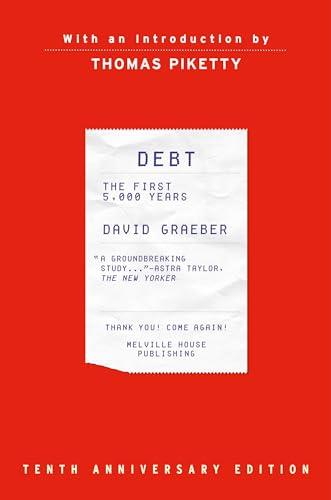
Debt: The First 5,000 Years,Updated and Expanded Cover
Podcast Mentions

Debt The First 5,000 Years,Updated and Expanded

David Graeber

The classic work on debt, now is a special tenth anniversary edition

Podcasts 4
Quotes 20
The Ezra Klein Show

He described it as a longterm view of debt systems, arguing that debt always concerns power.

"

And I'd recommend another book, David Graeber's Debt the First 5,000 Years, which looks at what you do with debt systems from a very long term perspective, and makes a point about the fact that debt i...

— Episode: Is Trump ‘Detoxing’ the Economy or Poiso...

Episode: Is Trump ‘Detoxing’ the Economy or Poisoning It?

He described it as a longterm view of debt systems, arguing that debt always concerns power.

"

And I'd recommend another book, David Graeber's Debt the First 5,000 Years, which looks at what you do with debt systems from a very long term perspective, and makes a point about the fact that debt is always about power.

Matt and Shane's Secret Podcast

It was discussed in detail, exploring the historical and moral implications of debt across various cultures and societies, including its connection to sin and the concept of Jubilee.

"

I started reading this book on debt I think he was just very islamophobic so shout out to him

— Episode: Ep 324- Drenched

Episode: Ep 324- Drenched

It was discussed in detail, exploring the historical and moral implications of debt across various cultures and societies, including its connection to sin and the concept of Jubilee.

"

I started reading this book on debt I think he was just very islamophobic so shout out to him

the guy who wrote it David Graber he's an anarchist but he's like this guy was about to get tenure at fucking Yale he's smart as fuck he's like a dunce but he wrote this book about debt and how the idea of debt

the question he was at a little cocktail party thing with this priest which is really this guy has the funniest group of friends he's like I was with this priest hanging out it was really annoying because this guy would introduce me as an anarchist which would like I'm in polite society and everyone's already judging me a little

he's like I was in Madagascar for two years trying to negotiate with the IMF to be like stop fucking just forgive these guys loans

his whole idea the book's looking into like where does the moral obligation from like debt come from and how far does it go back and he goes all the way you know all the way back to like the Sanskrit word for debt is also the same for sin and the Aramaic word for debt is also the same as sin

Behind the Bastards

It was recommended for its discussion of chartelism, a school of economic thought that pre-dates MMT, and for its exploration of the history of money, which dates back 5,000 years.

"

And he kind of introduced me to ideas from a school of economic thought called chartelism.

— Episode: It Could Happen Here Weekly 29

Episode: It Could Happen Here Weekly 29

It was recommended for its discussion of chartelism, a school of economic thought that pre-dates MMT, and for its exploration of the history of money, which dates back 5,000 years.

"

And he kind of introduced me to ideas from a school of economic thought called chartelism.

And chartelism is kind of the theoretical forebear of MMT.

And chartelism over 100 years before this is putting out very similar ideas around money that is created by states in order to marshal physical resources. They call it biophysical resources.

And Graeber goes through these wonderful examples of silver and other metals being used as international means of payment.

But he says, in order to get from the domestic money into the international money, you need to have these linkages of experts in the temple and the trade networks to get together and make credit instruments, which knit them together into this trade network.

Episode: It Could Happen Here Weekly 14

Anthropologist David Graeber, in his book *Debt: The First 5,000 Years*, described the consequences of an IMF austerity program in Madagascar in which a malaria outbreak killed 10,000 people because the government had to cut mosquito eradication programs due to IMF-imposed austerity.

"

The anthropologist David Graeber described the consequence of one such IMF austerity program in debt the first 5,000 years quote For almost two years. I had lived in the highlands of Madagascar Shortly before I arrived there had been an outbreak of malaria It was a particularly virulent outbreak because malaria had been wiped out in Highland, Madagascar many years before So that after a couple of generations most people had lost their immunity The problem was it took money to maintain those mosquito eradication programs since there had to be periodic tests to make sure mosquitoes weren't starting to breed again and Spraying campaigns if it was discovered that they were not a lot of money But owing to IMF imposed austerity programs the government had to cut the monitoring program 10,000 people died. I met young mothers grieving for lost children One might think it would be hard to make a case that the loss of 10,000 human lives is really justified in order to ensure That Citibank wouldn't have to cut its losses on one irresponsible loan. That wasn't particularly important to its balance sheet anyways

Episode: It Could Happen Here Weekly 3

David Graeber's book, "Debt: The First 5,000 Years", was mentioned as being a better, more important read than "The Heart of Empire."

"

But I think like, you know, and there was like a lot of like people saying things about like the Agora, you know Democracy the sort of political the political and count space of encounter and that stuff wasn't all wrong Like I mean, I'm sort of being a little sarcastic with a lot of it but I think like like there there was a lot of You know Part of how we I think we should understand the over discussed under and under you know Like over analyzed word neoliberalism that like has largely become meaningless one of the things I should I think I think it's valuable for understanding is a process by which capitalism responded to the long 60s by Disorganizing its production process such that the long 60s could never happen again, right? so like like the for the control the like the concentration of workers within within production in such a way that they could be agitated by students and then like sort of radically unionized Wildcat and sort of like almost overthrow government, right? Like the neoliberalism is like, you know, it smashes the unions Yes, but it also it also like Distributes out the active production right so that so that that's not so easily done. And I think one of the real Problems of you know that was facing social movement, you know in the period, you know the long period like, you know You had stuff like in the US again This is where I know the best but like, you know, you have the LA uprising which is huge And you have you know, the the glow the summit hopping movement and anti globalization which you know It could attack a target but there wasn't really a sense of like how it felt hard to do a local struggle beyond like literally like a Revolutionary riot like LA which you know, you can't really precipitate I mean, you can't really precipitate a movement either obviously, but I think like but like but like a A political a political movement a form of political organizing that didn't require something on the level of George Floyd Which is what the LA rebellion was, right? but that also didn't require like an action from capital that you were like striking against right like the the the You know the summits or whatever and that again and like all of these areas are very important This is not to like, you know, obviously like this is with with respect for those movements But yeah, we felt I think it felt like we were in a political wilderness and I think that that like Occupy really and the movement of the squares globally, I think Really like demonstrated that it was possible to practice a kind of street politics even without You know a shop floor where you can organize even without you know a Capital P party to organize within and I think that was really important I think it also scared a lot of people who and continues to who are committed to those politics. Yeah, and To the 20th century workers movement or the 19th and 20th century labor movement Which they somehow fantasize will come back if they just wish hard enough and write books or whatever and I think like So I think that was powerful. I also think like like Yeah, sorry, we can move on to legacy later but yes, I think that was like I think that was very much like an important thing was was just like and you know, I Graduated college in 2009 So I was like part of that millennial generation that like, you know had gone into incredibly deep debt Yeah, like we'd have a college degree and then like the bottom fell out of the economy. There were no jobs And like I think there were a lot of you know, like people who like had anticipated a middle-class life Of some kind not that I really had at that point But whatever like but a lot of people like in my economic cohort like had Suddenly facing you know proletarianization right and I think that was one of the strengths of the movement I think that was that you know, like I mentioned the statistics in great in Spain and Greece Like I think that was a global aspect of this kind of movement Arab Spring to like there was there was a lot of like that was really a response to the economic crisis Obviously those folks were already more proletarian than the people who the young people in the squares movements But they they innovated they created the tactics in Arab Spring right, um, Tahrir Square most famously in Cairo and I think like those creating a meeting place where you didn't require a Pre-constructed like political community in order to engage was a strength and a weakness And I think it also, you know as a result of the dynamics of the General Assembly It led to a lot of people who were already confident who are already feeling good being able to like take more power, right like And I think it also was a very white movement certainly in New York But but I think I think across the country. It was largely it was largely, you know, it was it was majority white in a way that You know by higher percentages than any movement that we've really been part of since was And that was obviously a limit for reasons that will be obvious to everyone Including the idea that like a lot of people pushed that like the police are part of the 99% Yeah, right
Episode: It Could Happen Here Weekly 29

The book introduced the speaker to the idea of chartelism, which is a school of economic thought that pre-dates modern monetary theory, or MMT, and puts out similar ideas on money being created by states in order to marshal resources.

"

And a book that really shaped my initial understanding was David Graeber's Debt, The First 5,000 Years.

And it's excellent. It's very long and it's a bit scattered, but I love what he put together with it.

So it's about the origins of money. And origins of money, it turns out, are at least 5,000 years ago, as the title says.

Episode: It Could Happen Here Weekly 3

The book was mentioned as a good book, in comparison to "Heart of Darkness", a book that was said to be "embarrassingly" important. The book was described as "important."

"

But I think like, you know, and there was like a lot of like people saying things about like the Agora, you know Democracy the sort of political the political and count space of encounter and that stuff wasn't all wrong Like I mean, I'm sort of being a little sarcastic with a lot of it but I think like like there there was a lot of You know Part of how we I think we should understand the over discussed under and under you know Like over analyzed word neoliberalism that like has largely become meaningless one of the things I should I think I think it's valuable for understanding is a process by which capitalism responded to the long 60s by Disorganizing its production process such that the long 60s could never happen again, right? so like like the for the control the like the concentration of workers within within production in such a way that they could be agitated by students and then like sort of radically unionized Wildcat and sort of like almost overthrow government, right? Like the neoliberalism is like, you know, it smashes the unions Yes, but it also it also like Distributes out the active production right so that so that that's not so easily done. And I think one of the real Problems of you know that was facing social movement, you know in the period, you know the long period like, you know You had stuff like in the US again This is where I know the best but like, you know, you have the LA uprising which is huge And you have you know, the the glow the summit hopping movement and anti globalization which you know It could attack a target but there wasn't really a sense of like how it felt hard to do a local struggle beyond like literally like a Revolutionary riot like LA which you know, you can't really precipitate I mean, you can't really precipitate a movement either obviously, but I think like but like but like a A political a political movement a form of political organizing that didn't require something on the level of George Floyd Which is what the LA rebellion was, right? but that also didn't require like an action from capital that you were like striking against right like the the the You know the summits or whatever and that again and like all of these areas are very important This is not to like, you know, obviously like this is with with respect for those movements But yeah, we felt I think it felt like we were in a political wilderness and I think that that like Occupy really and the movement of the squares globally, I think Really like demonstrated that it was possible to practice a kind of street politics even without You know a shop floor where you can organize even without you know a Capital P party to organize within and I think that was really important I think it also scared a lot of people who and continues to who are committed to those politics. Yeah, and To the 20th century workers movement or the 19th and 20th century labor movement Which they somehow fantasize will come back if they just wish hard enough and write books or whatever and I think like So I think that was powerful. I also think like like Yeah, sorry, we can move on to legacy later but yes, I think that was like I think that was very much like an important thing was was just like and you know, I Graduated college in 2009 So I was like part of that millennial generation that like, you know had gone into incredibly deep debt Yeah, like we'd have a college degree and then like the bottom fell out of the economy. There were no jobs And like I think there were a lot of you know, like people who like had anticipated a middle-class life Of some kind not that I really had at that point But whatever like but a lot of people like in my economic cohort like had Suddenly facing you know proletarianization right and I think that was one of the strengths of the movement I think that was that you know, like I mentioned the statistics in great in Spain and Greece Like I think that was a global aspect of this kind of movement Arab Spring to like there was there was a lot of like that was really a response to the economic crisis Obviously those folks were already more proletarian than the people who the young people in the squares movements But they they innovated they created the tactics in Arab Spring right, um, Tahrir Square most famously in Cairo and I think like those creating a meeting place where you didn't require a Pre-constructed like political community in order to engage was a strength and a weakness And I think it also, you know as a result of the dynamics of the General Assembly It led to a lot of people who were already confident who are already feeling good being able to like take more power, right like And I think it also was a very white movement certainly in New York But but I think I think across the country. It was largely it was largely, you know, it was it was majority white in a way that You know by higher percentages than any movement that we've really been part of since was And that was obviously a limit for reasons that will be obvious to everyone Including the idea that like a lot of people pushed that like the police are part of the 99% Yeah, right

Episode: It Could Happen Here Weekly 3

David Graeber, who was involved in the early days of Occupy, had claimed that the police were hesitant to clear the encampment because of the fear of being hacked. This was due to an earlier hacking campaign called Anti-SEC.

"

David Graeber rest in peace who is there in the early days organizing claimed and That he had he had heard and talked to the some of the like Overheard the police talking about the reason they didn't sweep at the occupy encampment the first day when we were pretty weak frankly Or the first week was because there were a bunch of guy Fox masks and they were scared They were scared They were gonna get hacked They were scared we were gonna hack them and steal their yeah, so so it was a weird time indeed Yeah Yeah

Episode: It Could Happen Here Weekly 3

The book was mentioned as a better book than Heart of Empire.

"

There was a lot of people talking about embarrassingly about heart and neck Riz, sort of like really a really a much better book that was important was also David Graeber's debt.

Breaking Points with Krystal and Saagar

It was described as a different take on the evolution of money and finance, arguing that it was initially focused on debt-related purposes, even including Sumerian texts.

"

The book recommendation I read years ago, it's called a debt. I just looked up the title, The First 5,000 Years by a guy named David Graeber. It's kind of a modern, it's a different take on the way th...

— Episode: 11/6/23: US Sends Nuclear Sub To Middle...

Episode: 11/6/23: US Sends Nuclear Sub To Middle East, Isra...

It was described as a different take on the evolution of money and finance, arguing that it was initially focused on debt-related purposes, even including Sumerian texts.

"

The book recommendation I read years ago, it's called a debt. I just looked up the title, The First 5,000 Years by a guy named David Graeber. It's kind of a modern, it's a different take on the way the evolution of money and finance, how it actually wasn't, you know, for commerce, it was actually debt related purposes.

Note: The book recommendations on this page are discovered automatically from podcast transcripts, and may be incorrect or incomplete.