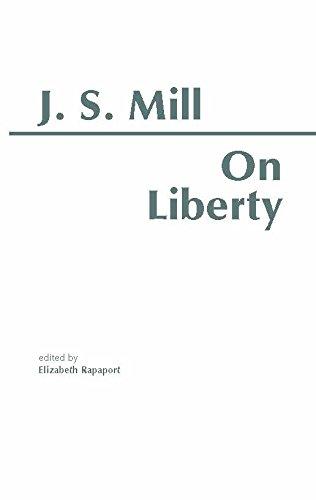
On Liberty (Hackett Classics) Cover
Podcast Mentions

On Liberty (Hackett Classics)

John Stuart Mill

Contents include a selected bibliography and an editor's Introduction broken into two sections. The first section provides a brief sketch of the historical, social, and biographical context in which Mill wrote and the second traces the central line of argument in the text to aid in the comprehension...

Podcasts 5
Quotes 19
The Joe Rogan Experience

Shermer referenced Mill's 1859 classic as a foundation for freespeech arguments, emphasizing that hearing opposing views strengthens one's own arguments.

"

John Stewart Mill ... his book on liberty where he said, okay look you might be completely right but by listening to somebody else it strengthens your own arguments.
— Episode: #1456 - Michael Shermer

Episode: #1456 - Michael Shermer

Shermer referenced Mill's 1859 classic as a foundation for freespeech arguments, emphasizing that hearing opposing views strengthens one's own arguments.

"

John Stewart Mill ... his book on liberty where he said, okay look you might be completely right but by listening to somebody else it strengthens your own arguments.
The Rest Is History

The hosts noted that Mill referenced the Chinese examination system in his work On Liberty.

"

So John Stuart Mill, he talks about it in UnLiberty.

— Episode: 84. Exams

Episode: 84. Exams

The hosts noted that Mill referenced the Chinese examination system in his work On Liberty.

"

So John Stuart Mill, he talks about it in UnLiberty.

Behind the Bastards

It was discussed as a foundational text for classical liberalism, but also highlighted that Mill himself would likely disagree with modern free speech absolutism, particularly due to his 'harm principle'.

"

They're ought to exist the fullest liberty of professing and discussing as a matter of ethical conviction, any doctrine, however immoral it may be considered.

— Episode: The Fake Crusade for Free Speech

Episode: The Fake Crusade for Free Speech

It was discussed as a foundational text for classical liberalism, but also highlighted that Mill himself would likely disagree with modern free speech absolutism, particularly due to his 'harm principle'.

"

They're ought to exist the fullest liberty of professing and discussing as a matter of ethical conviction, any doctrine, however immoral it may be considered.

If all mankind minus one were of one opinion and only one person were of the contrary opinion mankind would be no more justified in silencing that one person than he if he had the power would be justified in silencing mankind.

In truth, thinkers such as Mill were far from being libertarians and what's more would never have embraced the borderline absolutist position of today's free speech warriors.

Based in what is called the harm principle Mill argued for a big government approach to situations in which the exercise of liberty might result in the harm to others or even to the individual practicing it.

In On Liberty he argues that parents of poor moral fiber may have their children removed from the home and calls for similar state and intervention to stop the harms caused by gamblers, prostitutes, and the drug addicts.

Episode: The Fake Crusade for Free Speech

It was discussed in the context of classical liberalism and free speech, as a counterpoint to the more absolutist views of some modern free speech advocates.

"

They're ought to exist the fullest liberty of professing and discussing as a matter of ethical conviction, any doctrine, however immoral it may be considered.

If all mankind minus one were of one opinion and only one person were of the contrary opinion mankind would be no more justified in silencing that one person than he if he had the power would be justified in silencing mankind.

Episode: The Fake Crusade for Free Speech

It was discussed as a key text in the classical liberal tradition, whose principles were referenced when people spoke of free speech. However, it was also pointed out that Mill advocated for a strong state when it came to the harm principle, and would likely not have agreed with modern-day free speech absolutism.

"

They're ought to exist the fullest liberty of professing and discussing as a matter of ethical conviction, any doctrine, however immoral it may be considered.

If all mankind minus one were of one opinion and only one person were of the contrary opinion mankind would be no more justified in silencing that one person than he if he had the power would be justified in silencing mankind.

Episode: The Fake Crusade for Free Speech

It was discussed in the context of classical liberalism and free speech, and how its principles may have been misinterpreted by modern free speech advocates.

"

They're ought to exist the fullest liberty of professing and discussing as a matter of ethical conviction, any doctrine, however immoral it may be considered.

If all mankind minus one were of one opinion and only one person were of the contrary opinion mankind would be no more justified in silencing that one person than he if he had the power would be justified in silencing mankind.

Episode: The Fake Crusade for Free Speech

It was discussed in the context of classical liberals' views on free speech, and how Mill's ideas, particularly the harm principle, differed from modern "free speech warriors."

"

They're ought to exist the fullest liberty of professing and discussing as a matter of ethical conviction, any doctrine, however immoral it may be considered.

If all mankind minus one were of one opinion and only one person were of the contrary opinion mankind would be no more justified in silencing that one person than he if he had the power would be justified in silencing mankind.

The Ben Shapiro Show

The book was cited as an example of a philosophical argument where liberty is believed to have inherent value, suggesting the ability to choose is what makes people human.

"

John Stuart Mill in On Liberty would probably argue that liberty has inherent value, that the ability to choose is what makes us human, and that is the thing that has actual real value.

— Episode: Ep. 1590 - The West Literally Goes Suici...

Episode: Ep. 1590 - The West Literally Goes Suicidal

The book was cited as an example of a philosophical argument where liberty is believed to have inherent value, suggesting the ability to choose is what makes people human.

"

John Stuart Mill in On Liberty would probably argue that liberty has inherent value, that the ability to choose is what makes us human, and that is the thing that has actual real value.

Bill O’Reilly’s No Spin News and Analysis

The podcast mentioned John Stuart Mill's writing from the mid-1800s, where he argued against the idea that truth inevitably prevails, stating that its acceptance is a 'pleasant falsehood' refuted by history. He posited that truth's triumph depends on the right circumstances and the efforts of dedicated individuals.

"

That idea is one of the pleasant falsehoods which men repeat one after another until it becomes commonplace. But all of history refutes.

— Episode: The O'Reilly Update, April 11, 2024

Episode: The O'Reilly Update, April 11, 2024

The podcast mentioned John Stuart Mill's writing from the mid-1800s, where he argued against the idea that truth inevitably prevails, stating that its acceptance is a 'pleasant falsehood' refuted by history. He posited that truth's triumph depends on the right circumstances and the efforts of dedicated individuals.

"

That idea is one of the pleasant falsehoods which men repeat one after another until it becomes commonplace. But all of history refutes.

History teams with instances of truth being put down by persecution.

But the goodness is, even if the truth is tamped down once, twice, even a hundred times, John Stuart Mill said eventually there will be a group of people in the perfect circumstance where the truth will be able to be set free.

Note: The book recommendations on this page are discovered automatically from podcast transcripts, and may be incorrect or incomplete.