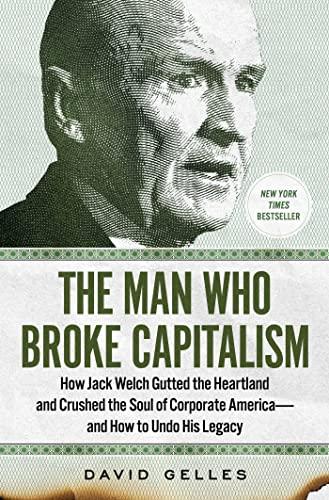
The Man Who Broke Capitalism: How Jack Welch Gutted the Heartland and Crushed the Soul of Corporate America―and How to Undo His Legacy Cover
Podcast Mentions

The Man Who Broke Capitalism How Jack Welch Gutted the Heartland and Crushed the Soul of Corporate America―and How to Undo His Legacy

David Gelles

New York Times

Podcasts 3
Quotes 20
Behind the Bastards

It was mentioned and quoted several times throughout the podcast, particularly in relation to Jack Welch's leadership style and its impact on GE and the broader business world.

"

One analyst asked how the price for copper would impact earnings in the next quarter. "What the hell difference will that make?" Welch shot back. "You should be asking me where I want to take the comp...

— Episode: Part Two: Jack Welch Is Why You Got Laid...

Episode: Part Two: Jack Welch Is Why You Got Laid Off

It was mentioned and quoted several times throughout the podcast, particularly in relation to Jack Welch's leadership style and its impact on GE and the broader business world.

"

One analyst asked how the price for copper would impact earnings in the next quarter. "What the hell difference will that make?" Welch shot back. "You should be asking me where I want to take the company."

Some people think it's cruel or brutal to remove the bottom 10% of our people. It isn't. It's just the opposite. What I think is brutal is false kindness. False kindness is keeping people around who aren't going to grow and prosper.

Within months of his departure, it became clear that GE was deeply troubled. And in a matter of years, the corporation was falling apart.

Had so much of the wealth created by corporations not been reverse distributed back to investors in the form of buybacks and dividends over the past 45 years and had pay kept pace with productivity, the average full-time American worker would be making about $102,000 annually, roughly double what he or she is today.

He's full of shit, Jack said. "He's a bullshitter." But Jack, I asked, "Didn't you choose Jeff?" "Yes," he conceded he had. "That's my burden and that I have to live with," he continued. "But people have been hurt. Employees, people's pensions, shareholders. It's bad." There were tears in his eyes. "I fucked up," he said again. "I fucked up."

Episode: Part One: Jack Welch Is Why You Got Laid Off

It was used as a primary source for the episode, providing a critical assessment of Jack Welch's career and his impact on American capitalism, while also acknowledging a possible bias towards a romanticized view of the past.

"

An annual report from 1953 described how GE worked in the balanced best interests of all. The report trumpeted how much the company had paid in taxes, the virtues of paying its suppliers well and how critical it was to take care of its employees.

That year, GE proudly stated that it spent some 37 percent of its sales on pay and benefits for its workers, resulting in the biggest payroll in the company's history, with more people at work than ever before.

Next to the statistic was an illustration of a grinning factory worker walking away from the assembly line holding bags of money only after enumerating all the ways in which it was helping the government suppliers and employees.

layoff spread to other divisions as Welch amassed more responsibility. And as he toured GE's facilities around the country, he took the opportunity to remind the rank and file who was now in charge.

In Cleveland at the light bulb factory, he berated a manager for the relative high costs of GE's bulbs, screaming that competitors in communist Europe made similar products for half the price.
Pivot

Podcast

Pivot

The book discusses Jack Welch's legacy as CEO of GE, contrasting the positive myths surrounding his management style with the negative realities of his aggressive tactics, including downsizing and questionable financial practices. The authors explores the lasting impact of Welch's approach on corporate America.

"

The myth of Jack Welch was maybe best summarized by Fortune magazine, which at the end of his career crowned him manager of the century

— Episode: Will Netflix Buy Roku? Are You Ready for...

Episode: Will Netflix Buy Roku? Are You Ready for Antitrust...

The book discusses Jack Welch's legacy as CEO of GE, contrasting the positive myths surrounding his management style with the negative realities of his aggressive tactics, including downsizing and questionable financial practices. The authors explores the lasting impact of Welch's approach on corporate America.

"

The myth of Jack Welch was maybe best summarized by Fortune magazine, which at the end of his career crowned him manager of the century

Overriding all of that was this alpha male, I would argue toxic, fear based, top down hierarchical leadership, which of course is still familiar to so many of us today who have worked at any company because it became the norm.

He was merciless. He was the downsizer in chief and he set the precedent for the rest of corporate America to do the same sort of thing.

All of this absolutely relentless earnings management, which has delivered meet or beat quarters for something like 80 quarters in a row. Like that's not possible. It's not possible. It's impossible.

It was so seductive. Those were his terms, right? It was impossible not to just keep going one more quarter, one more meat or beet. And you do whatever you could to make those numbers work.

The Daily Stoic

The podcast discussed David Gelles' book, which examines Jack Welch's leadership at GE, focusing on his impact on corporate America and the ethical considerations of his decisions. It was described as offering a critical look at Welch's legacy, prompting discussion on ethics and obligations beyond profit maximization.

"

And in today's episode we're talking about David's latest book, The Man Who Broke Capitalism, How Jack Welch gutted the heartland and crushed the soul of corporate America and how to undo his legacy.

— Episode: David Gelles on Jack Welch’s Legacy and...

Episode: David Gelles on Jack Welch’s Legacy and the Future...

The podcast discussed David Gelles' book, which examines Jack Welch's leadership at GE, focusing on his impact on corporate America and the ethical considerations of his decisions. It was described as offering a critical look at Welch's legacy, prompting discussion on ethics and obligations beyond profit maximization.

"

And in today's episode we're talking about David's latest book, The Man Who Broke Capitalism, How Jack Welch gutted the heartland and crushed the soul of corporate America and how to undo his legacy.

I'll leave that to you and I encourage you to read the book.

a CEO's primary social responsibility is to assure the financial success of the company

it was a bag of shit

the manager of the century the greatest CEO of all time

Note: The book recommendations on this page are discovered automatically from podcast transcripts, and may be incorrect or incomplete.