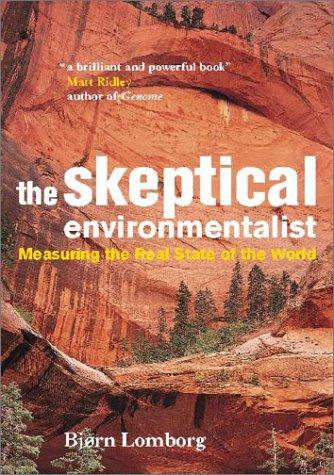
The Skeptical Environmentalist: Measuring the Real State of the World Cover
Podcast Mentions

The Skeptical Environmentalist Measuring the Real State of the World

Bjørn Lomborg

Bjørn Lomborg, a former member of Greenpeace, challenges widely held beliefs that the world environmental situation is getting worse and worse in his new book, The Skeptical Environmentalist. Using statistical information from internationally recognized research institutes, Lomborg systematically ex...

Podcasts 4
Quotes 29
Freakonomics Radio

It was a result of the author's personal journey, initially attempting to disprove Julian Simon's claims, but then found that many environmental factors had improved over time, prompting a more nuanced discussion about global priorities.

"

Fundamentally my book The Skeptical Environmentalist was really a result of my own personal journey.

— Episode: 181. Fixing the World, Bang-for-the-Buck...

Episode: 181. Fixing the World, Bang-for-the-Buck Edition

It was a result of the author's personal journey, initially attempting to disprove Julian Simon's claims, but then found that many environmental factors had improved over time, prompting a more nuanced discussion about global priorities.

"

Fundamentally my book The Skeptical Environmentalist was really a result of my own personal journey.

I read an interview with an American economist called Julian Simon back in Wired Magazine in 1997 and he said, listen you think everything's getting worse with the environment but actually most things are getting better.

But he said one thing that really stuck with me, he said go check the data.

So I decided yeah okay I'm gonna check his data, I'm gonna you know get some of my smartest students together, we're gonna have a fun half year and prove him wrong.

That was the start of my point of saying well we should compare different priorities and of course I thought somebody else must have made this prioritization list, somebody else must have looked at that and nobody had.

The Jordan B. Peterson Podcast

The title was brought up several times as the work that launched Lomborg’s controversial stance on environmental priorities, suggesting that other actions might outweigh drastic fossil fuel cuts. Jordan Peterson referenced it as a notable early work that established Lomborg’s reputation and called it a fascinating read, while Lomborg himself highlighted its challenge to common climate alarm narratives. The podcast’s discussion framed the book as a significant, thought‑provoking contribution rather than endorsing it outright.

Episode: 315. The World is Not Ending | Bjørn Lomborg

The 'Skeptical Environmentalist' by Bjrn Lomborg was mentioned as one of his works, touching on themes related to environmentalism and the need to challenge assumptions about environmental catastrophes.

"

His books include False Alarm, How Climate Change Panic Costs As Trillions Hurts the Poor and Fails to Fix the Planet. The skeptical environmentalist, cool it.

Episode: 285. How to Make the World a Better Place | Bjørn...

This book was mentioned as another book written by Bjorn Lomborg.

"

He's also written The Skeptical Environmentalist, Cool It How to Spend $75 billion to make the world a better place, which is a fascinating read.

Episode: 163. Is Everything Better Than We Think? | Bjorn L...

This book was mentioned as one of Bjorn Lomborg's early works that helped establish his reputation and notoriety. It is likely that this book addressed concerns about climate change in a more skeptical way than typical environmentalism.

"

the skeptical environmentalist which I think really established your reputation and your notoriety for that matter

Behind the Bastards

It was initially seen as a compelling counter-argument to the scientific consensus on climate change, with many citations, but was later shown to have misinterpreted or misrepresented many studies and used unreliable sources.

"

The primary targets of the book, a substantial work of analysis with almost 3,000 footnotes are statements made by environmental organizations like the World Watch Institute, the World Wildlife Fund a...

— Episode: Bjorn Lomborg: Patient Zero of Climate D...

Episode: Bjorn Lomborg: Patient Zero of Climate Denial

It was initially seen as a compelling counter-argument to the scientific consensus on climate change, with many citations, but was later shown to have misinterpreted or misrepresented many studies and used unreliable sources.

"

The primary targets of the book, a substantial work of analysis with almost 3,000 footnotes are statements made by environmental organizations like the World Watch Institute, the World Wildlife Fund and Greenpeace.

Using bad data and lies Lumborg estimated a species loss worldwide of just 0.7% over the next 50 years.

He uncritically and selectively cites literature much of it non peer reviewed and misinterprets or misunderstands the previously published scientific research

most of Lomborg's 3,000 citations are to media articles and secondary sources.

This is a hastily prepared book on complex scientific issues which disagrees with broad scientific consensus using arguments too often supported by news sources rather than by peer reviewed publications.

Episode: Bjorn Lomborg: Patient Zero of Climate Denial

It was presented as a scholarly work with many footnotes, but was later shown to have misinterpreted or misrepresented many scientific studies and used non-peer reviewed sources, ultimately arguing that the climate change issue was overblown.

"

The primary targets of the book, a substantial work of analysis with almost 3,000 footnotes are statements made by environmental organizations like the World Watch Institute, the World Wildlife Fund and Greenpeace.

Dr. Lumborg has presented his findings in The Skeptical Environmentalist, a book to be published in September by Cambridge University Press.

Lumborg estimated a species loss worldwide of just 0.7% over the next 50 years.

Before humans existed the species extinction rate was very roughly one species per million species per year. 0.0001% Estimates for current species extinction rates range from 100 to 10,000 times that but mostly hover close to the 1,000 times pre-human levels, 0.1% per year.

This is a a a a a a a a a a a a a a a a a a a a a a a a a a a a a a a a a a a a a a hastily prepared book on complex scientific issues which disagrees with broad scientific consensus using arguments too often supported by news sources rather than by peer reviewed publications.

Episode: Bjorn Lomborg: Patient Zero of Climate Denial

It was presented as a thoroughly researched book challenging the scientific consensus on global warming, using seemingly compelling data to argue that environmental issues were not as severe as claimed, but was later heavily criticized for misinterpreting or misrepresenting data and scientific studies.

"

So I started going through the bibliography and while I was doing that, I came upon the one work that Michael seemed to hold in the highest regard. A book called The Skeptical Environmentalist by Bjorn Lumborg.

The primary targets of the book, a substantial work of analysis with almost 3,000 footnotes are statements made by environmental organizations like the World Watch Institute, the World Wildlife Fund and Greenpeace.

several scientists observed that most of Lomborg's 3,000 citations are to media articles and secondary sources.

Lomborg's research is conceptually flawed he ignores ecology and connections among environmental problems taking instead a human centered approach in several cases he uses statistical measures that are not valid indicators of the problems he reports are improving.

On the topic of biodiversity E.O. Wilson and a team of reviewers find that Lomborg's work is strikingly at odds with what every expert in the field has stated.

Episode: Bjorn Lomborg: Patient Zero of Climate Denial

It was initially seen as a well-researched book, but later debunked by numerous experts in various fields, as it was found to misinterpret and misuse scientific research, especially concerning extinction rates and global warming.

"

Using bad data and lies Lumborg estimated a species loss worldwide of just 0.7% over the next 50 years.

Before humans existed the species extinction rate was very roughly one species per million species per year. Estimates for current species extinction rates range from 100 to 10,000 times that but mostly hover close to the 1,000 times pre-human levels, 0.1% per year.

With the rate projected to rise and very likely sharply.

Lomborg's research is conceptually flawed he ignores ecology and connections among environmental problems taking instead a human centered approach in several cases he uses statistical measures that are not valid indicators of the problems he reports are improving.

On the topic of biodiversity E.O. Wilson and a team of reviewers find that Lomborg's work is strikingly at odds with what every expert in the field has stated.

The Rubin Report

Bjorn Lomborg mentioned his book, which challenges the narrative that the world is getting worse. It presents data suggesting that, in most areas, things have significantly improved over time, particularly concerning poverty and other aspects of human well-being.

"

I was really just an academic and I like to challenge my students on thinking differently. And one of the things I saw was an interview in Wired Magazine with Julian Simon, an American economist who s...

— Episode: A Green New Deal Warning: Bjorn Lomborg,...

Episode: A Green New Deal Warning: Bjorn Lomborg, Alex Epst...

Bjorn Lomborg mentioned his book, which challenges the narrative that the world is getting worse. It presents data suggesting that, in most areas, things have significantly improved over time, particularly concerning poverty and other aspects of human well-being.

"

I was really just an academic and I like to challenge my students on thinking differently. And one of the things I saw was an interview in Wired Magazine with Julian Simon, an American economist who said, look, things are actually getting better, not worse. And that ended up in over three years of me writing a book called The Skeptical Environmentalist,

Note: The book recommendations on this page are discovered automatically from podcast transcripts, and may be incorrect or incomplete.