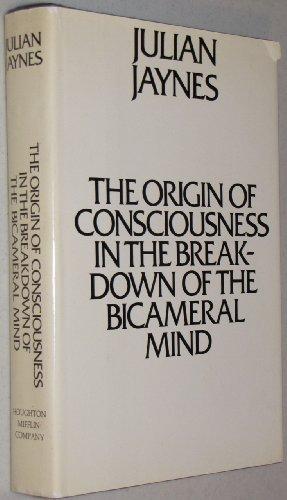

The Origin of Consciousness in the Breakdown of the Bicameral Mind Cover
Podcast Mentions

The Origin of Consciousness in the Breakdown of the Bicameral Mind

Julian Jaynes

At the heart of this book is the revolutionary idea that human consciousness did not begin far back in animal evolution. Rather, Jaynes presents consciousness as a learned process that evolved from an earlier hallucinatory mentality only three thousand years ago. The implications extend into every a...

Podcasts 5
Quotes 28
Stuff You Should Know

The podcast discussed Jaynes's controversial theory, which proposed that human consciousness emerged around 3,000 years ago, replacing a 'bicameral mind' where people followed auditory hallucinations they perceived as divine guidance.

"

Consciousness is a much smaller part of our mental life than we're conscious of because we cannot be conscious of what we are not conscious of.

— Episode: Thrill to the Stunning Bicameral Mind Hy...

Episode: Thrill to the Stunning Bicameral Mind Hypothesis

The podcast discussed Jaynes's controversial theory, which proposed that human consciousness emerged around 3,000 years ago, replacing a 'bicameral mind' where people followed auditory hallucinations they perceived as divine guidance.

"

Consciousness is a much smaller part of our mental life than we're conscious of because we cannot be conscious of what we are not conscious of.

It's like asking a flashlight in a dark room to search around for something that does not have any light shining upon it.

And his point is, is wherever your conscious mind looks, there's consciousness. But that doesn't mean that there's consciousness all over the place.

My God has forsaken me and disappeared. My goddess has failed me and keeps at a distance. The good angel who walked beside me has departed.

David Bowie loved it. He said that the origin of consciousness is the breakdown of bicameral mind.

Episode: Thrill to the Stunning Bicameral Mind Hypothesis

It was discussed as a controversial but interesting hypothesis that consciousness emerged around the first or second millennium BC, related to the development of metaphor and language.

"

Consciousness is a much smaller part of our mental life than we're conscious of because we cannot be conscious of what we are not conscious of.

It's like asking a flashlight in a dark room to search around for something that does not have any light shining upon it.

And his point is, is wherever your conscious mind looks, there's consciousness. But that doesn't mean that there's consciousness all over the place.

David Bowie loved it. He said that the origin of consciousness is the breakdown of bicameral mind.

It's a very Bowie thing.

Episode: Selects: Thrill to the Stunning Bicameral Mind Hyp...

The hosts said Jaynes presented his bicameral mind hypothesis in a 1976 book, using ancient texts such as Homer's Iliad as evidence for the transition from automatic behavior to conscious introspection.

"

I know one of the things he wrote a lot about in his book in 1976 was Homer's Iliad because he's kind of like, here's proof right here...

The Dan Bongino Show

Dan Bongino mentioned the Julian Jaynes book while mocking a CNN factchecker, noting its title in a sarcastic comment.

"

You're not going to ask him, hey, what's your feeling about the Julian Jaynes book, The Origins of Consciousness and the breakdown of the bicameral mind, Mr. Joe Clown? He may be the smartest clown in...

— Episode: The Left’s Battle Plan for Street Chaos...

Episode: The Left’s Battle Plan for Street Chaos (Ep 1346)

Dan Bongino mentioned the Julian Jaynes book while mocking a CNN factchecker, noting its title in a sarcastic comment.

"

You're not going to ask him, hey, what's your feeling about the Julian Jaynes book, The Origins of Consciousness and the breakdown of the bicameral mind, Mr. Joe Clown? He may be the smartest clown in the world, but you really don't care about his opinion.

Modern Wisdom

It was mentioned as a beautifully written popular science book that explored the hypothesis that modern consciousness only emerged during the Homeric age, where people talked about gods' commands rather than their minds.

"

Julian Jaynes wrote this classic back in 1976 called The Origin of Consciousness and the Breakdown of the Bicameral Mind and one of the things that's great about it is that it's a beautifully written...

— Episode: #663 - Erik Hoel - A Guide To The Fundam...

Episode: #663 - Erik Hoel - A Guide To The Fundamental Myst...

It was mentioned as a beautifully written popular science book that explored the hypothesis that modern consciousness only emerged during the Homeric age, where people talked about gods' commands rather than their minds.

"

Julian Jaynes wrote this classic back in 1976 called The Origin of Consciousness and the Breakdown of the Bicameral Mind and one of the things that's great about it is that it's a beautifully written book.

The Matt Walsh Show

The host described the book as one of the most interesting of all time, noting its central thesis is likely wrong but still fascinating. He explained the book's claim that human consciousness is a relatively recent development.

"

About 50 years ago, a psychologist named Julian Jaynes wrote what is, for my money, one of the most interesting books of all time. Even if the central thesis is almost certainly completely wrong, the...

— Episode: Ep. 1463 - The Party That Hates Men Is W...

Episode: Ep. 1463 - The Party That Hates Men Is Wondering W...

The host described the book as one of the most interesting of all time, noting its central thesis is likely wrong but still fascinating. He explained the book's claim that human consciousness is a relatively recent development.

"

About 50 years ago, a psychologist named Julian Jaynes wrote what is, for my money, one of the most interesting books of all time. Even if the central thesis is almost certainly completely wrong, the book was called The Origin of Consciousness in the Breakdown of the Bicameral Mind.

Consciousness, Jaynes proposes, is a developed trait and a relatively new one in the grand scheme of things. He argues that human beings only became selfaware about 2,000 to 3,000 years ago.

The mind was split between the two hemispheres, like it is now, but the two together did not create a cohesive conscious whole as they do now.

Jaynes' theory was that the right side of the brain would speak to the left side of the brain in a literal, audible sense, so that ancient people were hearing voices in their head all the time.

He argues that the left side of the brain considered the voice coming from the right side to be the voice of God, or of the gods.

Episode: Ep. 328 - Hey Guys, Stop Oppressing Women

Walsh said he read the book after a recommendation, found it weird and disagreed with most of its arguments, but still considered it fascinating and read it more like sciencefiction.

"

Someone emailed and recommended that I read Julian Jaynes, the origin of consciousness in the breakdown of the bicameral mind. And so I did. I did read it. I this is a weird book because I don't agree with almost any of it. I disagree with 98 percent of this book, but I kind of loved it because it was really fascinating. I read it almost more as a sort of science fiction than anything else.

He argues that consciousness arose in the human population very recently, about 3,000 years ago, and before that humans operated with a bicameral mind, essentially hearing voices they interpreted as gods.

StarTalk Radio

It was mentioned as a book that explored the genesis of consciousness, but was later said to have been discredited by the scientific community.

"

West world story about the genesis of consciousness is scientifically inaccurate. So it's due to the psychologist Julian Jaynes back in the 70s. I remember when his book the origin of consciousness an...

— Episode: Westworld and the Future of AI, with Jam...

Episode: Westworld and the Future of AI, with James Marsden

It was mentioned as a book that explored the genesis of consciousness, but was later said to have been discredited by the scientific community.

"

West world story about the genesis of consciousness is scientifically inaccurate. So it's due to the psychologist Julian Jaynes back in the 70s. I remember when his book the origin of consciousness and the breakdown of the bicameral.

Yeah, it was a good one. Yeah. There's a big thick bottle that we thick books. There's a big thick book.

Yeah, so that's been discredited.

Episode: Westworld and the Future of AI, with James Marsden

It was mentioned as a book that was scientifically inaccurate regarding the genesis of consciousness in the context of the show Westworld, but it was considered a good read.

"

West world story about the genesis of consciousness is scientifically inaccurate

So it's due to the psychologist Julian Jaynes back in the 70s. I remember when his book the origin of consciousness and the breakdown of the bicameral.

Yeah, what a great title. I read that book.

Yeah, it was a good one.

There's a big thick bottle that we thick books. There's a big thick book.

Note: The book recommendations on this page are discovered automatically from podcast transcripts, and may be incorrect or incomplete.