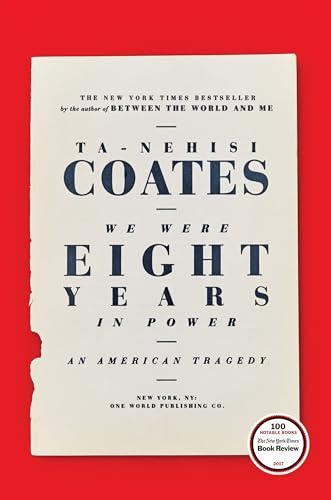
We Were Eight Years in Power: An American Tragedy Cover
Podcast Mentions

We Were Eight Years in Power An American Tragedy

Ta-Nehisi Coates

In this “urgently relevant”* collection featuring the landmark essay “The Case for Reparations,” the National Book Award–winning author of “We were eight years in power” was the lament of Reconstruction-era black politicians as the American experiment in multiracial democracy ended with the return...

Podcasts 3
Quotes 19
Pod Save America

It was discussed in detail, with the authors' insights into his conversations with Barack Obama and his perspective on race relations in America, particularly during the Obama presidency.

"

On the pod today we talked to national correspondent for The Atlantic and the author of the new book We Were Eight Years in Power, An American Tragedy, Ta-Nehisi Coates.

— Episode: “What’s your plan to stop mass shootings...

Episode: “What’s your plan to stop mass shootings?”

It was discussed in detail, with the authors' insights into his conversations with Barack Obama and his perspective on race relations in America, particularly during the Obama presidency.

"

On the pod today we talked to national correspondent for The Atlantic and the author of the new book We Were Eight Years in Power, An American Tragedy, Ta-Nehisi Coates.

Everyone, please go by. We were Eight Years in Power, an American Tragedy, outstanding collection of essays.


The Daily Show: Ears Edition

The book was explored as a deep reflection on the Obama presidency, beginning with optimism before moving into a nuanced analysis of how black leadership intersected with white supremacy. Host John Stewart and the interviewer highlighted Coates’s argument that reactions to ordinary black life reveal deeper societal contradictions. The discussion emphasized the book’s powerful, thought‑provoking perspective on race and politics, presenting it as a highly recommended read.

Highly Recommended

Episode: Ta-Nehisi Coates - Why Obama Was Different in "We...

The book reflects on Barack Obama's presidency, starting with hope and excitement and tracing a journey through the unfolding of his time in office. It explores the reactions to Obama's presidency and how those reactions relate to the concept of white supremacy.

"

You take us through each year of the Obama presidency and it's interesting how the book starts from a place of hope excitement.

You know you talk about how you went with your partner you bought food you were chasing was like oh black times baby it was good things.

And then as the presidency unfolds we go through this journey with you.

That's really powerful because you take us to a place where in many ways you argue that Obama's presidency and black leadership in any way shape or form is in some way contributing to white supremacy which is very complicated argument.

It's the reaction to that. It's always the reaction to the ordinariness to the bourgeoisness to the middle classness of you know normal everyday black people and how well that accords with what this country claims to value.

Episode: Ta-Nehisi Coates - Why Obama Was Different in "We...

Ta-Nehisi Coates's book reflects on Barack Obama's presidency, exploring the complexities of race and politics in America. It begins with hope and excitement, but as the presidency unfolds, the narrative shifts to explore more complicated themes of race, leadership, and reaction from the American people.

"

You take us through each year of the Obama presidency. And it's interesting how the book starts from a place of hope, excitement.

You know, you talk about how you went with your partner. You bought food, you were just like, oh, black times, baby. It was good thing.

It's the reaction to that. It's always the reaction to the ordinaryness, to the bushworn, the middle classness of, you know, normal everyday. Black people are how well that accords with what this country claims the value.

But this goes back to, you know, justification to slavery and black folks who present themselves, you know, in a particular way as undermining that. You know, it's always a threat to the thinking about white supremacy.

I think that's why folks were so offended by Obama. You know, like they couldn't grasp that he was actually black and so they became this whole other mythos that sprung up around them, most, you know, specifically in this birth or the reason thing.

On Being with Krista Tippett

The book was described as "fantastic" and discussed in the context of Coates' reflections on the Obama presidency and the ongoing struggle for racial justice in America. The conversation touched on themes of hope, the weight of history, and the need for critical self-reflection.

"

You wrote, I can somehow remember all that I did not allow myself to feel walking away from that unemployment office and through the Harlem streets that day, just as I remember all that I did not let...

— Episode: Ta-Nehisi Coates — Imagining a New Ameri...

Episode: Ta-Nehisi Coates — Imagining a New America

The book was described as "fantastic" and discussed in the context of Coates' reflections on the Obama presidency and the ongoing struggle for racial justice in America. The conversation touched on themes of hope, the weight of history, and the need for critical self-reflection.

"

You wrote, I can somehow remember all that I did not allow myself to feel walking away from that unemployment office and through the Harlem streets that day, just as I remember all that I did not let myself feel in those young years trapped between the schools and the street.

In America, it is traditional to destroy the black body. It is heritage.

But I also had an urge to make something new of them. This book is made in this way because I enjoyed the challenge of doing so. If I can communicate half of that joy to you, then I will have done my job.

Episode: [Unedited] Ta-Nehisi Coates with Krista Tippett

Coates' most recent novel at the time of the interview, discussed in the context of the Obama presidency and the ongoing issue of race relations in America. The author reflected on the idea of "providential progress" and its limitations in addressing historical injustices.

"

And in that same season that you were in that Harlem unemployment line, the campaign was starting for Barack Obama, who had become the first black president.

You wrote, I was from the kind of home that would have been labeled on paper pathological, six siblings born to four women, all of whom became college graduates except for you. Except me. Except for you.

You wrote, I can somehow remember you're talking about this day that you've been you're unemployed. I think you've lost three jobs in seven years.

I did. That's correct. You read three jobs and seven. You said, I can somehow remember all that I did not allow myself to feel walking away from that unemployment office and through the Harlem streets that day, just as I remember all that I did not let myself feel in those young years trapped between the schools and the street.

Note: The book recommendations on this page are discovered automatically from podcast transcripts, and may be incorrect or incomplete.