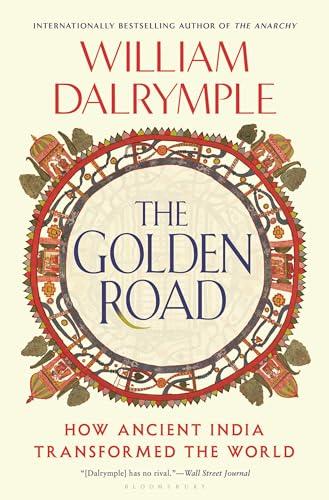
The podcast discussed William Dalrymple's new book, "The Golden Road," which delves into the spread of Buddhism from India to other parts of the world, highlighting the influence of Indian culture and ideas on Southeast Asia.
"
William Darribble is giving us a sneak peek of his fabulous new book, which is out in September called The Golden Road.
And the last episode just to recap we, we were talking about the Buddha, the origin story, the superhero story, if you like, of the Buddha, and then the spread of Buddhism. And we're going to continue in that vein.
You sort of gave us a little tease about one of the greatest acolytes of the new religion, the new Buddhism, was a man who would take it further than anyone could possibly dream. And that man was the Emperor Ashoka.
And there is this thing in Indic religions whereby you have the different stages of life. Some people call it Sanyaras, you go off and hermit yourself.
And it's about 50 miles to the north, I think, of Bangalore, but anyway, with a car drive from Bangalore. And it's still one of the major centers of the Jains. It has that fantastic statue of the naked Jane Hiro Balubali who stood so long in one place that the vines wind round and creep around his legs and you see this in the statue.
So this obviously leaves a vacancy on the throne in Paliputra, the capital, and his son, Binder Surah, takes over, continues to have good relations with the Greeks who are in Afghanistan. And Chandra Gupta's grandson, Binder Surah's son Ashoka, is the young prince who becomes initially the viceroy in Taxina at the very place that Alexander met the gymnosophis.
Well, you can't. And one of the reasons you can't is that he is the first Indian whose voice survives for us in his own words. The earliest inscriptions we have anywhere in India are those of Ashoka. And it's he who calves the first script that we can actually read.
And we actually have fragments of a report by a Greek ambassador from the salutids who is called Megasinis. And he visits just before Ashoka is born during the reign of Bindusutra or Chandra Gupta. And he says the city already covers 10 square miles and is surmounted by a 21 mile long wall broken by 64 gates and 570 towers, which means that it's about twice the size of early Rome and three times the size of Alexandria, and 11 times larger than Athens, with a population of around 200,000.
And I mean everything about these inscriptions, the oldest written first person statements in Indian history, are utterly remarkable.
And there are several classes of these edicts. The earliest ones are on rocks, often in weird places, on hilltops or at crossroads, or at places where fairs or festivities seem to have been held and often are still held. So they're sacred places that are still sacred today.
So they raise as many questions as they answer. We can now read them. Thanks to James Principe in the 19th century, reading the karoshti and the Brahmini scripts and translating them. We can read these things, but the interpretations are still being chewed over by scholars to the state.
And this is a trajectory which results ultimately in Angkor Wat.
You get two different trajectories in the sense of Indian influence at this period. You get the merchants who are often subscribing to Buddhism and there's a very simple trade-off. They give gifts to the Buddhist monasteries, which allow the Buddhists to excavate their wonderful cave monasteries and build fantastic stupas and so on. And in return, the merchants get karmic relief. They're forgiven their sins and a promise good rebirth.
So you get these great epics like the Mahabharata, suddenly are being carved up the Mekong Delta, the Ramayana is on the walls of temples in Thailand and in Laos and in Vietnam.
And so you get these great epics like the Mahabharata, suddenly are being carved up the Mekong Delta, the Ramayana is on the walls of temples in Thailand and in Laos and in Vietnam.
So it isn't just a matter of some wholly in improving moral theories going out with it, comes the whole civilization.
So what you had with the Shokha was Buddhism going to Sri Lanka and heading off towards the Middle East. But the really successful thrust is when Buddhism heads into Afghanistan. You get to see all those wonderful Gandharan sculptures, the great Buddhas of Bamiyan and so on.
And then we will eventually go as far as the Tang dynasty in China when Buddhism briefly becomes the main state religion of China, briefly replaces Confucianism. And the final and most exciting moment is when Buddhist monks from China begin to make the journey to the holy land of India to consult the great Buddhist universities of India, most famously in the Landa, which is the Oxbridge, the Harvard, the Nazar of the seventh century in Dickworld.
And until we meet again, it's goodbye from me, Anita Arnan. And goodbye from me, William Dremble.
This is available from today, and you can find a link for that in the show notes.