Podcast
Freakonomics Radio
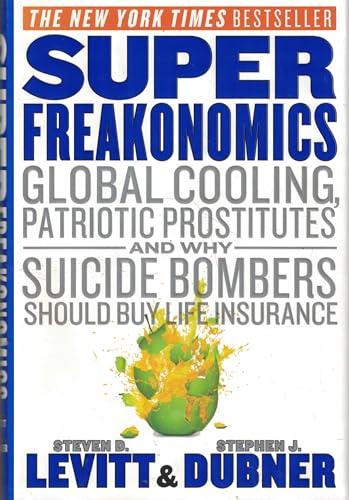
The book was repeatedly cited as a source of unconventional economic anecdotes, from a calculation about baseball lineage to a chapter on altruism and a prediction about carbon emissions that proved accurate. Hosts Stephen Dubner and Steve Levitt highlighted its mix of quirky stories and data‑driven insights, even acknowledging that one terrorist‑life‑insurance tale was a fabricated example. Overall, they treated the title as a notable reference for surprising, thought‑provoking ideas.
Episode: How to Hate Taxes a Little Bit Less (Ep. 400 Repla...
The book included a chapter called Unbelievable Stories About Apathy and Altruism, which challenged some of the initial findings about altruism in dictator game experiments.
We wrote about this in our book Superfreakonomics in a chapter called Unbelievable Stories About Apathy and Altruism.
Episode: 488. Does Death Have to Be a Death Sentence?
It was mentioned as a book co-authored with Stephen Dubner, where they predicted that controlling carbon emissions would be difficult due to private incentives, a prediction that unfortunately proved accurate.
And a prediction that I made that I wish hadn't been true, but turned out to be quite true was with Stephen Dubner in the book, Super Freakonomics. We suggested that because of private incentives, the attempts to rein in carbon emissions just weren't going to work.
Episode: 351. Here’s Why You’re Not an Elite Athlete
It was mentioned as a book that contained a calculation suggesting a son of a Major League Baseball player is significantly more likely to also play in the major leagues.
In Superfreakonomics, one of the books I wrote with the economist Steve Levitt, we performed a rough calculation showing that if a Major League Baseball player has a son, that boy is about 800 times more likely than a random boy to also make the majors.
Episode: The Dangers of Safety (Rebroadcast)
It was mentioned that the speaker writes books with Steve Levitt, one of which is SuperFreakonomics.
Steve Leavitt is the guy I write books with, freakonomics and super freakonomics
Episode: Who Runs the Internet? (Rebroadcast)
It was mentioned in passing as a book that contained a chapter about climate change, which resulted in a wave of negative online reactions. It was also described as having a chapter about climate change.
It just reminds me, I don't know why, of when Superfreak Analytics came out, and we had this stuff on climate change.
Episode: 174. What Do King Solomon and David Lee Roth Have...
The podcast discussed a story from this book about why terrorists should buy life insurance as a way to catch them via reverse psychology, though it later admitted that was a fabrication.
You remember that story we wrote in Super Freakonomics about why terrorists should buy life insurance?
And that was whether or not a given bank customer had bought life insurance from that bank.
And that was the sort of logic we threw out in the book.
And this whole thing in the Superfreeconomics book about life insurance was just a complete and total lie.
Episode: The Upside of Quitting (Rebroadcast )
It was mentioned in relation to Sudhir Venkatesh's work as a grad student in Chicago, who embedded himself with a crack gang, as well as his later work surveying street prostitutes in the book.
We wrote about him in Super Freakonomics, too. He did an extensive survey of street prostitutes.
Episode: 161. How to Make People Quit Smoking
It was mentioned that after writing this book, the authors decided to not write the same book repeatedly and tried a different approach.
And we weren't sure if we'd ever write another book.
Episode: 35. Live From St. Paul!
It was mentioned towards the end of the episode in the context of the chapter on altruism and how people behave differently when they know they're being watched.
So in Superfreak, there was a chapter on altruism. And we explored how you know when altruism is real, and how do you know whether it's sometimes just the product of scrutiny. You do nice things because you know that you're being watched.