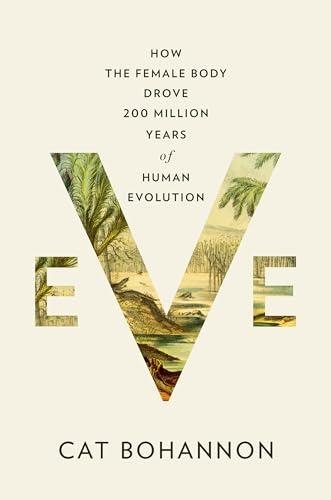
Eve: How the Female Body Drove 200 Million Years of Human Evolution Cover
Podcast Mentions

Eve How the Female Body Drove 200 Million Years of Human Evolution

Cat Bohannon

NEW YORK TIMES

Podcasts 3
Quotes 23
Freakonomics Radio

It was described as fascinating and wonderfully weird, with a fresh and surprising perspective. Steve Leavitt said he couldn't put it down and kept bringing up the stories in conversation, and that he didn't expect to like the book because he is generally not interested in events that happened a long time ago.

"

I did not expect to like this book. I'm generally just not that interested in things that happened 200 million years ago or even 10,000 years ago. I tend to be much more excited by modern events. But...

— Episode: 570. Is Gynecology the Best Innovation E...

Episode: 570. Is Gynecology the Best Innovation Ever?

It was described as fascinating and wonderfully weird, with a fresh and surprising perspective. Steve Leavitt said he couldn't put it down and kept bringing up the stories in conversation, and that he didn't expect to like the book because he is generally not interested in events that happened a long time ago.

"

I did not expect to like this book. I'm generally just not that interested in things that happened 200 million years ago or even 10,000 years ago. I tend to be much more excited by modern events. But in chapter after chapter, Kat Bohannon offers such a fresh and surprising perspective that I couldn't put the book down.

And over and over, I found myself bringing up these stories in conversation.

And I don't think as a writer, you could have hoped to do anything more than that.

I have to confess, I wasn't familiar with your work. The first description I found about you mentioned your PhD in Evolution of Narrative and Cognition. And of course, I didn't know what that meant. And then it mentioned that you'd published a wide range of essays and poems.

And it said you'd written a book about the female body. That was the sum of everything I knew when I opened your book, that it was a book by a poet about the female body.

And can I honestly say, rarely have I been caught so off guard by a book because right from the beginning, it's clear that you have deep knowledge about an enormous range of scientific subjects.

And this isn't just a repackaging of the standard popular science stories on subject after subject that I thought I knew something about. You brought forth facts and ideas that were totally new to me, that were fascinating, and that changed my view of the world.

Episode: 569. Do You Need Closure?

Kat Bohannon is the author of "Eve, How the Female Body Drove 200 Million Years of Human Evolution".

"

And you'll hear a fantastic conversation with Kat Bohannon, the author of Eve, How the Female Body Drove 200 Million Years of Human Evolution.


The Daily Show: Ears Edition

Cat Bohannon's book explores how the female body has been overlooked in scientific research and how it has driven human evolution. The author discussed the complexities of the female body and how it has adapted for survival, including pregnancy, childbirth and menstruation.

"

One of the central things I discovered was that we are garbage at making babies. Just the entire species.

— Episode: Sarah Silverman Unpacks the Realities of...

Episode: Sarah Silverman Unpacks the Realities of AI | Cat...

Cat Bohannon's book explores how the female body has been overlooked in scientific research and how it has driven human evolution. The author discussed the complexities of the female body and how it has adapted for survival, including pregnancy, childbirth and menstruation.

"

One of the central things I discovered was that we are garbage at making babies. Just the entire species.

our pregnancies and births and postpartum recoveries are harder and longer and more prone to dangerous and crippling and sometimes murdery complications than they are in most any other primate.

It's not that it is our destiny to make babies to be fulfilled or something.

It's more like it's how we do it, particularly as a species is so bad that there are many fail safes. There are many things built into kind of brace for impact.

And they're essentially the same thing for a long time. And what becomes the clitoris in a typical female... Oh, I just got a tingle when you said clitoris. My clitoris went, whoa! Shut up!

Episode: RFK Jr.'s Surprising Poll Numbers | Cat Bohannon

The book explores the female body's evolution, highlighting the challenges of reproduction and how the body has adapted for survival. It also discusses the historical underrepresentation of women in biological and medical research.

"

One of the central things I discovered was that we are garbage at making babies. Just the entire species.

It's not that it is our destiny to make babies to be fulfilled or something. It wasn't mine.

It's more like it's how we do it particularly as a species is so bad that there are many fail safes. There are many things built into kind of brace for impact, yeah?

The lack of studying endo, well that is just sexism actually, unfortunately, and we're just starting to come back around and really start to model how that's working.

And they're essentially the same thing for a long time. And what becomes the clitoris in a typical female?

What A Day

Podcast

What A Day

The book's author, Kat Bohannon, was interviewed to provide more insight into the difficulties humans face in reproducing, including the biological limitations related to our evolution and our unique placentas.

"

We evolved to walk upright, which narrowed the pelvic opening, and we simultaneously started getting bigger and bigger heads and bigger and bigger shoulders.

— Episode: The Hidden Roots of America's Baby Bust

Episode: The Hidden Roots of America's Baby Bust

The book's author, Kat Bohannon, was interviewed to provide more insight into the difficulties humans face in reproducing, including the biological limitations related to our evolution and our unique placentas.

"

We evolved to walk upright, which narrowed the pelvic opening, and we simultaneously started getting bigger and bigger heads and bigger and bigger shoulders.

And so now our situation is we're trying to squeeze a watermelon out of a lemon-sized hole.

So that's the one big reason that our birth sucks.

But the more pervasive reason, actually the even more dangerous reason, is that our placentas are really invasive.

They penetrate the mother's bloodstream.

Note: The book recommendations on this page are discovered automatically from podcast transcripts, and may be incorrect or incomplete.