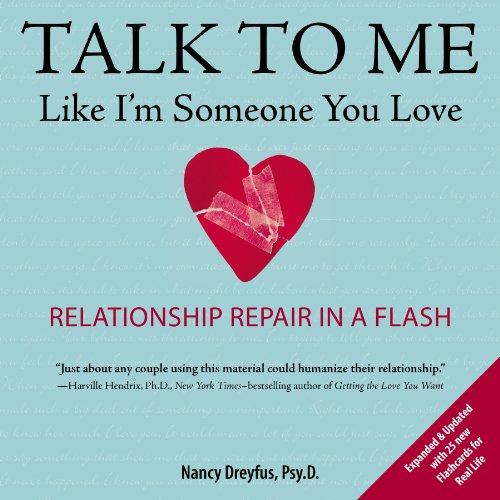

Talk to Me Like I'm Someone You Love, revised edition: Relationship Repair in a Flash Cover
Podcast Mentions

Talk to Me Like I'm Someone You Love, revised edition Relationship Repair in a Flash

Nancy Dreyfus Psy. D.

No matter our attachment style, we all crave connection with our partners. Learn how to transform your unproductive communication patterns with this helpful, practical, and sometimes magical tool from experienced couples’ therapist Nancy Dreyfus

Podcasts 2
Quotes 5
The Diary Of A CEO with Steven Bartlett

This book was discussed in relation to repair attempts in relationships, specifically how focusing on emotions during an argument is more effective than using business-like tactics.

"

I just wanted to name Nancy Dreyfus who came to my lab and she had written a book of things you can say when you started to get flooded in an argument.

— Episode: The Gottman Doctors: "Women Tend to Be M...

Episode: The Gottman Doctors: "Women Tend to Be More Unhapp...

This book was discussed in relation to repair attempts in relationships, specifically how focusing on emotions during an argument is more effective than using business-like tactics.

"

I just wanted to name Nancy Dreyfus who came to my lab and she had written a book of things you can say when you started to get flooded in an argument.

It was brilliant book, it's called Talk To Me Like I'm Someone You Love.

Call Her Daddy

It was discussed as a guide to transform unproductive arguments into moments of connection, teaching how to hold two realities at once and take ownership of reactions in relationships.

"

The title of your book, Talk To Me Like I'm Someone You Love, is a profound one.

— Episode: SOS I Keep Arguing with My Partner

Episode: SOS I Keep Arguing with My Partner

It was discussed as a guide to transform unproductive arguments into moments of connection, teaching how to hold two realities at once and take ownership of reactions in relationships.

"

The title of your book, Talk To Me Like I'm Someone You Love, is a profound one.

You say we're not usually upset for the reason that we think. You write about that in your book.

It's not the content of the argument. It's the context.

Note: The book recommendations on this page are discovered automatically from podcast transcripts, and may be incorrect or incomplete.