
Podcast
Morning Wire
The book argues that the LGBTQ movement is fundamentally different from the fight for civil rights and discusses how the LGBTQ movement has hijacked the civil rights movement.
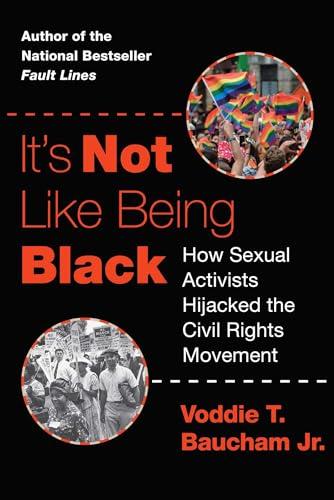
His new book, It's Not Like Being Black, How Sexual Activists Hijacked the Civil Rights Movement argues that the LGBTQ movement is fundamentally different from the fight for civil rights.
— Episode: Voddie Baucham: How Sexual Activists Hij...
Episode: Voddie Baucham: How Sexual Activists Hijacked the...
The book argues that the LGBTQ movement is fundamentally different from the fight for civil rights and discusses how the LGBTQ movement has hijacked the civil rights movement.
His new book, It's Not Like Being Black, How Sexual Activists Hijacked the Civil Rights Movement argues that the LGBTQ movement is fundamentally different from the fight for civil rights.
I actually have a whole chapter on that. And quite simply what happened with the Loving case was government was actually prohibiting people from doing something that the government doesn't have the right to prohibit.
The government didn't define marriage. The government didn't give us marriage. Marriage is a creation ordinance.
You know, you speak in your introduction about how the gay rights movement hijacked the legitimate grievances of the civil rights movement in ways that undermine the very foundations upon which Western civilization is built.
The government has now said, we get to tell you what truth is.
The government says to us, look at those two men and you must call that marriage.
The government says, look at that man and you must call him a woman and you must do it because we say so.
So Western civilization is built on and rooted in ideas of biblical Christian worldview, right? Whether people like it or not.
Bake the cake or lose your business, make the dress or lose your business.
Eventually it's going to be do the wedding or lose your church. It's declare the pronouns or lose your job. It's here already.
Anyone who believes what the Bible teaches about not just sex and marriage, but about male and female, about reality. Anyone who believes that and holds to it and is not willing to bow the knee and say, Caesar is Lord will face wrath.
There's either been no response or there's been capitulation. And the problem with the capitulation is you can't go far enough.
This is a continuation of the critical social justice movement. Social justice have often likened to a train with many boxcars.
We had the racial justice boxcar and there's the climate justice boxcar and all these other boxcars. And this whole alphabet mafia boxcar is part of that same social justice train.
And there are a lot of people who have begun to capitulate just like they did on the so-called racial justice issue.
And just like with anti-racism, you can't be anti-racist enough and the moment you slip up it's, I knew it all along. It's the same here, right?
Okay, I'll go to the wedding. Fine. You think that's going to end it? It won't. Eventually, you're going to be backed into a corner.
They're going to demand something that you can't give and you either bow the knee, confess that Caesar is Lord or you say no, and then they negate every area where you capitulated.
And unfortunately, that's been the response of many to just capitulate again and again and again until there's nothing left.
I think it's unfortunate that we don't see the play there.
And the key to understanding this is to look at the gay pride progress flag. Now the gay flag is the rainbow flag, right? Everybody's familiar with the rainbow flag, but the new flag, the pride progress flag has the chevrons over on the end of the flag coming toward the middle and these chevrons, you know, white, pink, maybe blue, bringing trans and everything else into that flag.
But pay attention to the last two chevrons. They're brown and black. Why are they brown and black?
It's a reference to brown and black people. And this flag brings everything together under the banner of the critical social justice movement.
So at the end of the day, this is cultural Marxism. This is neo-Marxism. This is the oppressor oppressed struggle manifesting itself all over again.
And the reason that they refer to themselves as sexual minorities is because they look at the cultural hegemony, which by the way, is Christian morality and Christian morality is the evil oppressor, right?
And the evil oppressor in this regard is oppressing people who don't measure up to this cis heteronormative, you know, whatever view of Christian sexual morality.
So they refer to themselves as sexual minorities based on that worldview.
And the brown and black stripes in the chevrons of the bright progress flag are the smoking gun.
And you know, something that strikes me when I think about this, and as I was reading your book was how quickly we're seeing a lot of Western countries, including the US, starting to outlaw what could be termed repentance in terms of calling it reparative therapy.
And so they're saying we're outlawing reparative therapy.
How do you confront that when you're a Christian who believes that we have to repent, but the law has now said you are not allowed to teach repentance if it looks like it could be termed reparative therapy?
Yeah, this goes back to the earlier question, right, about religious liberty and whether or not this is going to be an issue. It's already an issue.
I talk in the book about Canada's Bill C-4.
It's incredibly ironic because on the one hand, we are saying that if someone wants to identify as the opposite sex, we can mutilate them. We can give them drugs to sterilize them, to stop their bodies from going into puberty. We can cut off healthy breast tissue.
We could do all this to mutilate people's bodies. And it's okay. We call that gender affirming care.
But if somebody wants counseling because they're struggling with same-sex attraction and we step in to help them with that, well then we've crossed the line and we're doing something that is brutal and unacceptable.
I mean, it's absolutely clown world.
I've told people recently that the three most important books right now are the Bible, Animal Farm and 1984.
I mean, we're seeing this and it's not new. It's not a surprise.
We know this game.
Well, you know, and something else you kind of explored was how when we talk about approaching these issues from a question of science, the original civil rights movement was acknowledging something that was scientific, that there is no difference between people of different skin colors.
There are not actually different races.
There's just different ethnicities. And it was recognizing that whereas with the LGBTQ movement, it's become very unscientific in the sense of biology and other scientific questions.
Can you talk a little bit about that?
You know, the contradiction here is seen even in the acronym because if you think, for example, about the last generation and lesbians and gays, what were they doing? They were arguing that this issue was biological.
You need to accept us because it's biological. So you had pheromone studies and brain studies and all these things trying to prove that it was in the genes, that it was in the...
They were looking for a gay gene, right?
This is biological.
Well, then you have the T's who come along and say, biology means nothing.
And they're coexisting within the same movement in spite of this massive contradiction.
Well, the reason that they're able to coexist is because at the end of the day, this is about neo-Marxism.
This is about the oppressor-oppressed paradigm. And all you have to do is say, we're sexual minorities.
You get there in a way that's completely contradictory to the way that we get there, but it doesn't matter because this is a power play.
This is about us rebelling against the biblical order, rebelling against Western civilization because ironically, we recognize that Western civilization is built on the Bible. So we want to deny that in civics class and then we want to rebel against it in queer theory. So it's all completely contradictory.
Are you familiar with Christopher Caldwell's book, The Age of Entitlement and its argument that the Civil Rights Act created a rival constitution that is now taking precedence over our original constitution. What is your reaction to that argument?
It's brilliant. I wish that I had gotten a hold of it before I finished with this, Not Like Being Black.
I mean, it's brilliant. And the thing I love about it is he's coming from a very different perspective and worldview that you or I would be coming from.
But man, truth is truth. And I think he's made a very important argument.
And it's because of the truth of his argument that we now have a de facto constitution that overrides our de jure constitution.
It's because of that, that these people are able to exercise the kind of authority and influence that they're able to exercise because there are laws now that override all the rest of our laws.
And those are the laws that say, you got to bake the cake, or you got to make the dress, you got to do the wedding.
So yeah, I think it's a very important book right now.
So do you see a way to restore then the originalist constitutional principles that the Civil Rights Act eventually undermined without dismantling the advances that happened in the 1960s regarding issues like segregation, Jim Crow laws, that kind of thing?
That's a lot to unpack.
And the first thing I want to say is we've had advancements that go beyond civil rights legislation.
And we've had advancements that are more important than civil rights legislation.
There have been transformations in our culture in terms of the way people see one another, and the law didn't do that.
The law doesn't change hearts, and hearts have changed. And that's a good thing.
And I think it's unfortunate that we give so much credence to the law on that and not recognizing what has happened and the great blessing that we've experienced in terms of people's hearts being changed.
How do we see a transformation in the right way that we need to see it without undoing things that have been good?
And the answer to that is what we need is not a new law. What we need is changed hearts.
We need revival. We need repentance. We need awakening. We need spiritual restoration.
We have been at war with God, and we have been at war with our foundations that are rooted in biblical and godly ideologies.
And the answer to that is for us to lay down our arms and to plead with God for mercy.
I guess the obvious question then is, do you see any return to founding principle without spiritual revival?
Is there any other mechanism?
Well, yes, but is it theoretically possible to return to founding principles without the spiritual mechanism? Yes, it is.
But I don't think that's what any of us wants.
What we want is changed hearts.
We don't want just principles and laws.
Those are not enough.
What we want is to be a people.
So maybe second to last question here, in your experience, what's the broader reaction of the Black community when they hear the civil rights struggle that they went through being equated with the aims of the Rainbow Coalition?
It's really interesting.
One of the things that I talk about in the book is Proposition 8 in California.
That was back in 2008, and everybody thought that California would be the first domino to fall and that there'd be this great victory for same-sex marriage in California.
But the pro-same-sex marriage ideologues were defeated in California in 2008.
Let that sink in for a moment. You can't imagine that today.
But the other thing that was troubling to the movement was that they were defeated, especially and significantly, with Black and brown people.
They were shocked by this and kind of enraged by it.
They couldn't show too much rage because they need that group of people and then they need that, oh, gay is the new Black argument in order to move forward from 2008.
But they were shocked by it and absolutely brooding over it.
The fact of the matter is that Black Americans tend to be very conservative in a lot of ways.
And this is one of those ways.
And the other thing is, even people who tend to be more open to the pro-LGBT ideology also tend to not like the fact that they are equating themselves with the struggles of Black people.
So it's interesting.
It's fascinating how that dynamic has even worked out in light of the way that Black people have felt about it.
Okay. My next question then, what is the most important element of your book then that you think readers need to come away with for, I would say, a very pivotal moment in our nation's history with regards to how we're defining civil rights?
Yeah, that's a good question.
And you know, what I'm trying to do here, I'm not trying to start a political revolution.
I want people to be informed and equipped and striving for that.
But at the end of the day, I also want them to be prepared.
I want them to be prepared for what's ahead.
I don't think Christians are aware of the consequences of this movement.
I don't think they're aware of the price people are already paying and the price that we're going to be required to pay for standing up for biblical truth, for proclaiming the gospel in the marketplace of ideas.
And so I want people to go in this with their eyes wide open and to recognize that we're being asked to deny ourselves, take up our cross and follow Christ.
And that the price that we're being called to pay is well worth it so that Christ might indeed have the fullness of the reward for which he died.
All right. Well, it is certainly a groundbreaking book, Dr. Bachman.
We thank you so much for joining us and for giving us a sneak peek at it.
It's been my pleasure.
Thank you for having me.
And thank you for your work.