Podcast
Behind the Bastards
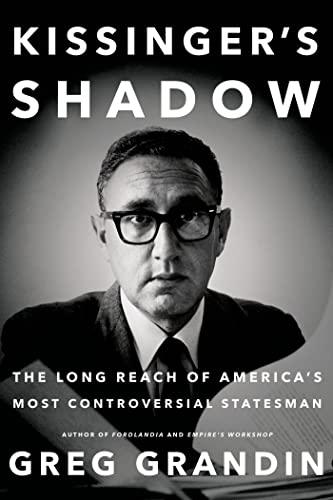
Greg Grandin's *Kissinger's Shadow* examines Kissinger's development of his political philosophy, noting that he adopted a worldview that emphasized action and power over morality and justice.
From these thinkers, Kissinger cobbled together his own view of how history operated.
— Episode: CZM Rewind: Kissinger Parts 1-3
Episode: CZM Rewind: Kissinger Parts 1-3
Greg Grandin's *Kissinger's Shadow* examines Kissinger's development of his political philosophy, noting that he adopted a worldview that emphasized action and power over morality and justice.
From these thinkers, Kissinger cobbled together his own view of how history operated.
Kissinger finds this logic intoxicating, but he did disagree with Spengler about Spengler's primary contention, which is that civilizational decay was inevitable.
Having lost a sense of purpose, civilizations lurch outward to find meaning.
Kissinger accepted Spengler's critique of past civilizations, but rejected his determinism.
The fact that Kissinger participated in an intrigue that extended the war for five pointless years, seven, if you count the fighting between the 1973 Paris Peace Accords and the 1975 fall of Saigon is undeniable.
Episode: Part Three: Kissinger
The book 'Kissinger's Shadow' by Greg Grandin was referenced in the podcast as a source for information about Henry Kissinger's involvement in secret bombing campaigns in Cambodia, including his role in the 40 Committee.
And I'm going to quote from Kissinger's shadow by Greg Grandin.
Sitton, based on recommendations he received from General Creighton Abrams, the commander of military operations in Vietnam, would work up a number of targets in Cambodia to be struck.
Then he would bring them to Kissinger and Haig in the White House for approval.
Kissinger was very hands on revising some of Sitton's work.
I don't know what he was using as his reason for varying them, Sitton later recalled.
Episode: Part Two: Kissinger
This book by Greg Grandin was referenced in the podcast to discuss Henry Kissinger's role in extending the Vietnam War and his actions during the 1968 election.
And I'm going to quote again from Kissinger's Shadow by Greg Grandin.
The activities of the Nixon team went far beyond the bounds of justifiable political combat. It constituted direct interference in the activities of the executive branch and the responsibilities of the chief executive, the only people with authority to get to negotiate on behalf of the nation.
The activities of the Nixon campaign constituted a gross, even potentially illegal interference in the security affairs of the nation by private individuals,
The fact that Kissinger participated in an intrigue that extended the war for five pointless years, seven if you count the fighting between the 1973 Paris Peace Accords and the 1975 fall of Saigon is undeniable.
Episode: Part Six: Kissinger
It was recommended as the best book to read regarding Kissinger's influence and how toxic it was on the US and its foreign policy. It was viewed as a comprehensive look into the damage he caused.
If you want an actual biography of Kissinger's whole life and time and power I recommend Walter Isaacson's 1992 book Kissinger.
I actually think Isaacson is too fair to Henry Kissinger.
But even so even though he clearly like does not wholly condemn the man I find the book utterly damning.
Episode: Part Three: Kissinger
The book 'Kissinger's Shadow' by Greg Grandin was referenced in the context of how Kissinger and Haig would approve bombing targets in Cambodia, and Kissinger's role in expanding domestic surveillance.
And I'm going to quote from Kissinger's shadow by Greg Grandin.
Kissinger's shadow.
Kissinger, according to Marvin and Bernard Kolb, knew almost instinctively that he would be able to control the bureaucracy and thus help reorder American diplomacy only to the degree that he became indistinguishable from the president and his policies.
The test had no military or scientific benefit, but was seen as something of a ritual by the right fireworks to celebrate the end of Johnson's presidency when many hawks like Curtis LeMay felt the United States had fallen behind on nuclear development.
Greg Grandin, author of Kissinger's Shadow, sees the bombing campaign in Cambodia and Laos as the terminal phase in what he calls the crack up of America's domestic consensus, which had begun under Johnson.