
Podcast
Behind the Bastards
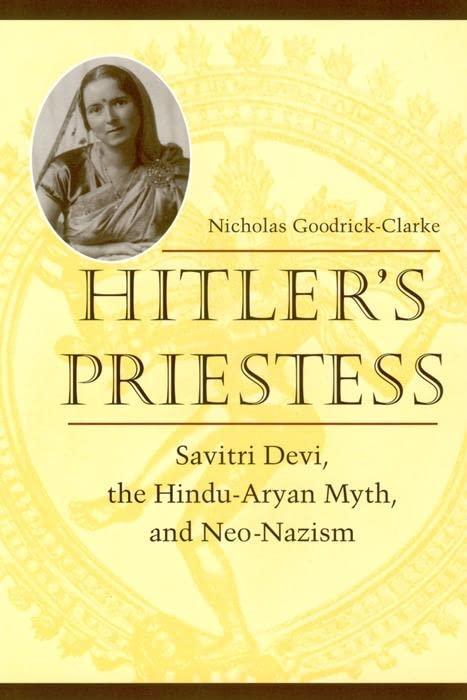
The book provided a decent, albeit flawed, biography of Savitri Devi, relying heavily on her own recollected memories of her life.
Le Conte de L'Ile's own tragic view of the universe. His romantic colors were always tinged with somber pessimism strongly appealed to Maximilani.
— Episode: CZM Rewind: Part One: Savitri Devi The W...
Episode: CZM Rewind: Part One: Savitri Devi The Woman Who T...
The book provided a decent, albeit flawed, biography of Savitri Devi, relying heavily on her own recollected memories of her life.
Le Conte de L'Ile's own tragic view of the universe. His romantic colors were always tinged with somber pessimism strongly appealed to Maximilani.
He regarded all religious symbols as fragments of a divine truth, but the profusion of faiths over time convinced him of the relative value and ultimate vanity of every doctrine.
Maximiani admits that she did not yet connect Hitler with her own dream of a new racial order based on her view of classical Greek antiquity.
Years later, she would recall that she spent such a sunlit afternoon upon the Acropolis on 9th October 1923, the fateful day of Hitler's Putsch when he and his followers had attempted to coup against the Bavarian government and staged a march to the Feldherne Hall in the center of Munich.
The police successfully broke up the march and 16 martyrs of the early Nazi movement fell beneath the hail of bullets. When the tales of the incident were published in the world press the following day, there was some discussion over lunch at the International Home Hostel, which is where she was crashing at the time.
Episode: Part One: Savitri Devi: The Woman Who Turned Nazis...
It was described as the only decent biography of Savitri Devi, which was used as a major source for the podcast, and it contained information regarding her early life and her fascination with Hinduism.
disgusted her and turned her against mankind.
Lecont de Lille's own tragic view of the universe his romantic colors were always tinged with somber pessimism strongly appealed to Maximilani.
He regarded all religious symbols as fragments of a divine truth but the profusion of faiths over time convinced him of the relative value and ultimate vanity of every doctrine.
Beset by a sense of cosmic futility Lecont de Lille rejected Christianity and evoked the stoical heroism of barbarian and exotic peoples in his famous poem, cycle poems Barberes.
He was also powerfully attracted to Hinduism following the translation of its sacred texts in the 1840s, Maximilani felt a profound sympathy with Lecont de Lille's view of life's fragility, the vanity of existence and the illusion of the world his romantic poems about the ancient Egyptians the Scandinavians, the Celts and Hindus their proud paganism and heroic action yet final resignation in the face of death and oblivion confirmed her own aversion to Christianity and helped her form her own fatalistic world view.
Episode: Part One: Savitri Devi: The Woman Who Turned Nazis...
It was described as the only decent biography of Savitri Devi, and was repeatedly mentioned throughout the podcast as a source of information about her life and ideology.
disgusted her and turned her against mankind.
Lecont de Lille's own tragic view of the universe his romantic colors were always tinged with somber pessimism strongly appealed to Maximilani. He regarded all religious symbols as fragments of a divine truth but the profusion of faiths over time convinced him of the relative value and ultimate vanity of every doctrine. Beset by a sense of cosmic futility Lecont de Lille rejected Christianity and evoked the stoical heroism of barbarian and exotic peoples in his famous poem, cycle poems Barberes. He was also powerfully attracted to Hinduism following the translation of its sacred texts in the 1840s, Maximilani felt a profound sympathy with Lecont de Lille's view of life's fragility, the vanity of existence and the illusion of the world his romantic poems about the ancient Egyptians the Scandinavians, the Celts and Hindus their proud paganism and heroic action yet final resignation in the face of death and oblivion confirmed her own aversion to Christianity and helped her form her own fatalistic world view.
years later she would recall that she spent such a sunlit afternoon upon the Acropolis on 9th October 1923 the fateful day of Hitler's Putsch when he and his followers had attempted to coup against the Bavarian government and staged a march to the Feldherne Hall in the center of Munich.
Episode: Part One: Savitri Devi: The Woman Who Turned Nazis...
It was discussed as the main source of information about Savitri Devi, and the podcast host noted it was a decent biography mainly based on Devi's own writing.
disgusted her and turned her against mankind.
Lecont de Lille's own tragic view of the universe his romantic colors were always tinged with somber pessimism strongly appealed to Maximilani.
He regarded all religious symbols as fragments of a divine truth but the profusion of faiths over time convinced him of the relative value and ultimate vanity of every doctrine.
Beset by a sense of cosmic futility Lecont de Lille rejected Christianity and evoked the stoical heroism of barbarian and exotic peoples in his famous poem, cycle poems Barberes.
He was also powerfully attracted to Hinduism following the translation of its sacred texts in the 1840s, Maximilani felt a profound sympathy with Lecont de Lille's view of life's fragility, the vanity of existence and the illusion of the world his romantic poems about the ancient Egyptians the Scandinavians, the Celts and Hindus their proud paganism and heroic action yet final resignation in the face of death and oblivion confirmed her own aversion to Christianity and helped her form her own fatalistic world view.
years later she would recall that she spent such a sunlit afternoon upon the Acropolis on 9th October 1923 the fateful day of Hitler's Putsch when he and his followers had attempted to coup against the Bavarian government and staged a march to the Feldherne Hall in the center of Munich.
Episode: Part One: Savitri Devi: The Woman Who Turned Nazis...
It was mentioned as the only decent biography of Savitri Devi, it was referenced several times as a source for information on her life and views. This is a paperback book.
disgusted her and turned her against mankind.
Lecont de Lille's own tragic view of the universe his romantic colors were always tinged with somber pessimism strongly appealed to Maximilani.
He regarded all religious symbols as fragments of a divine truth but the profusion of faiths over time convinced him of the relative value and ultimate vanity of every doctrine.
Beset by a sense of cosmic futility Lecont de Lille rejected Christianity and evoked the stoical heroism of barbarian and exotic peoples in his famous poem, cycle poems Barberes.
Maximilani felt a profound sympathy with Lecont de Lille's view of life's fragility, the vanity of existence and the illusion of the world his romantic poems about the ancient Egyptians the Scandinavians, the Celts and Hindus their proud paganism and heroic action yet final resignation in the face of death and oblivion confirmed her own aversion to Christianity and helped her form her own fatalistic world view.