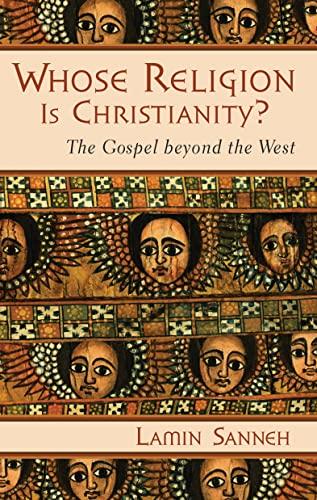
It was described as a new book and a short, readable book by an African scholar. The book discussed how Christianity has grown rapidly in Africa, from nine million Christians in 1900 to 380 million in 2000. The book also discussed how Christianity didn't destroy African culture, but rather completed and resolved it.
There's a book I've been reading recently and I can recommend it to you. It's a new book and it's short and it's readable. It's by an African scholar, Laman Sanay, who teaches at Yale. He's written a...
— Episode: Converted by the Cross
Episode: Converted by the Cross
It was described as a new book and a short, readable book by an African scholar. The book discussed how Christianity has grown rapidly in Africa, from nine million Christians in 1900 to 380 million in 2000. The book also discussed how Christianity didn't destroy African culture, but rather completed and resolved it.
There's a book I've been reading recently and I can recommend it to you. It's a new book and it's short and it's readable. It's by an African scholar, Laman Sanay, who teaches at Yale. He's written a book called Whose Religion is Christianity?
He says, the African old religions provided the rules rewarding good conduct and punishing wrong but they had only a limited ethical range. Christianity answered this historical challenge by a reorientation which means conversion. People sensed in their hearts that Jesus did not mock their respect for the sacred nor their clamor for an invincible savior. So they beat their sacred drums for him until the stars skipped and danced in the skies and after that dance the stars weren't little anymore. Christianity helped Africans to become renewed Africans not remade Europeans.
He says, Africans have always believed in a world of supernatural forces. They have always believed that they were good and evil spirits, they were supernatural forces everywhere. But Africans also sensed that so many of them sensed that they were powerless against the evil forces. They saw the evil forces in their lives, they saw the evil forces in their society, they saw the evil forces in their family and they didn't know what to do about it. And they realized, well what are our alternatives? The first alternative is Western secularism. Western secularism says there is no supernatural. Everything has a natural cause. Western secularism and the Africans, this is what Laman Sane says, this is not my opinion. Laman Sane says the Africans realized that if we became modern western people that would destroy our Africanness. They would destroy our belief in the sacredness of everything.
We came to realize that being coming western modern people would replace and destroy our Africanness and other religions would destroy our Africanness but Christianity converted our Africanness. Christianity completed, resolved our Africanness and that when we became Christians we became not Europeans. It didn't destroy our culture. When you become a Christian, you become a Christian first and you're an African or you're an Asian or you're an Anglo-Second. But he said Christianity did not turn us into something else. It didn't destroy our culture. It didn't. When we became Christians it didn't destroy our culture. He says don't talk like that. Christianity is as much ours as yours. It's not a European religion. It's our religion now, he said.
Christianity is not the product of any Western culture or any particular culture, it's the product of the Holy Spirit that recreates Christianity in each and every culture of the world.