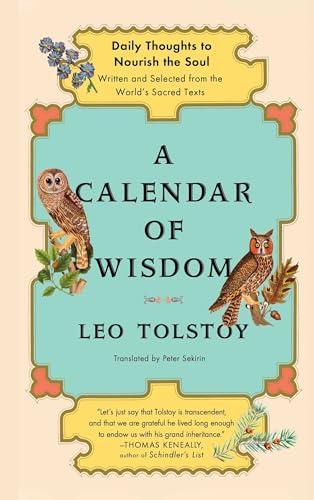
A Calendar of Wisdom
Daily Thoughts to Nourish the Soul, Written and Selected from the World's Sacred Texts
Leo Tolstoy
This collection of daily thoughts to nourish the soul from the world’s sacred texts by Leo Tolstoy feature gems of inspiration and wisdom—author Thomas Keneally calls this book “transcendent, and that we are grateful he lived long enough to endow us with his grand inheritance.”
This is the first-ev...
It was mentioned as a daily devotional that the speaker was reading, where a significant portion of quotes were about not eating meat, and that Tolstoy himself became a vegetarian.
"
You know I've been thinking about this recently for two reasons. One is I've been reading this book by Tolstoy called A Calendar of Days and it is kind of like this daily devotional. So he apparently...
— Episode: 51. What Separates Humans From Other Ani...
Episode: 51. What Separates Humans From Other Animals?
It was mentioned as a daily devotional that the speaker was reading, where a significant portion of quotes were about not eating meat, and that Tolstoy himself became a vegetarian.
"
You know I've been thinking about this recently for two reasons. One is I've been reading this book by Tolstoy called A Calendar of Days and it is kind of like this daily devotional. So he apparently for the last 15 or more years of his life created this journal where he kept all his favorite quotes from Blaise Pascal and from the Bible and from other sources and I have to say something like a fourth of these quotes are about not eating meat.
Here's a Leo Tolstoy quote his own, a man can live and be healthy without killing animals for food therefore if he eats meat he participates in taking animal life merely for the sake of his appetite and to act so is immoral.
So one reason I've been thinking about vegetarianism is that every day I wake up and I read the new Tolstoy missive and a lot of the time it's about being vegetarian.
Tolstoy's book is a collection of quotes and commentary that he compiled towards the end of his life, and was rediscovered in the 1980s. It is a spiritual text with a focus on Christianity.
"
Have you read Tolstoy's A Calendar of Wisdom?
— Episode: Paper Trails: How Notebooks Changed The...
Episode: Paper Trails: How Notebooks Changed The World | Ro...
Tolstoy's book is a collection of quotes and commentary that he compiled towards the end of his life, and was rediscovered in the 1980s. It is a spiritual text with a focus on Christianity.
"
Have you read Tolstoy's A Calendar of Wisdom?
It's incredible. So, so Tolstoy towards the end of his life, just become sort of this spiritual seeker, not doesn't see himself as a novelist anymore.
And he writes this collection called The Calendar of Wisdom, which is also a page a day book of like his favourite quotes, and some riffing and commentary on those quotes.
And he puts it together shortly before he dies. It's the thing he's most proud of, then he does die.
And then only a few, it's only a few years later that the Russian Revolution happens.
Episode: You Aren’t Killing Time. Time Is Killing You | Rya...
A book of quotes compiled by Tolstoy, which the speaker attempts to read a page from daily. It was described as a collection of quotes accumulated over Tolstoy's lifetime.
"
There's a book I try to read every day by Tolstoy called A Calendar of Wisdom.
It's one page a day of quotes that this great wise novelist accumulated over the course of his life and I try to read a page of that every day.
Episode: It’s Not A Bad Experience | Living Like A Stoic Fo...
This book of daily readings was mentioned as one the podcast host reads every morning. It's cited as part of his regular reading routine.
"
one of the books I read every morning is Tolstoy's a calendar of wisdom
Episode: Ramachandra Guha on Gandhi’s Extraordinary Life an...
This book, read daily by the podcast host, is a collection of Tolstoy's favorite quotes and his reflections on them. It was described as one of the host's absolute favorite books, offering daily wisdom.
"
one of my favorite books I read it every morning is Tolstoy's a calendar of wisdom I don't know if you've read this but but towards the end of his life Tolstoy put together a collection of his favorite influences in what shaped him and along with the road etc in here is you know Marcus Aurelius is in here Epochitis is in here a Confucius is in here Kant is in here but people that I didn't see Gandhi referencing much
I am going to order it so if you finish up on the season yeah it sounds like what you're saying is you're talking about college students and a lot of them listen to this podcast it sounds like what Gandhi didn't get was a liberal arts education he didn't have an undergrad degree I mean he was educated shall we say about the University of life yes but and that probably in some ways allowed him to by not having the same philosophical upbringing as many of his adversaries would have been because they all would have been elite educated British men for the most power is that it also allowed him to see and form a new paradigm because he wasn't boxed in by there he understood sort of British Western thought because he was educated in their legal system but he was not as indoctrinated with all of the same ideas and this allows him to to come up with a radical new way of how human should interact
Episode: Jack Weatherford on Genghis Khan and Learning From...
This book, written at the end of Tolstoy's life, was mentioned as having been suppressed by communists for nearly a century. Its rediscovery highlights the potential for ideas to be lost and then later rediscovered.
"
One of my similar books since we were talking about recommending books. I don't know if you ever read Tolstoy as a calendar of wisdom. But at the end of Tolstoy's life, Tolstoy wrote this book, A Calendar of Wisdom that was also suppressed by the communists for almost 100 years.
Episode: 10 Timeless Meditations From Stoic Philosophy
It was mentioned as a page-a-day book that the speaker keeps on their desk and tries to read daily.
"
I have Tolstoy's calendar of wisdom here on my desk. I was lucky enough to work on Robert Green's The Daily Laws. These are two books I try to read on a daily basis.
Episode: Coach Bob Bowman on Balancing Stillness and Excell...
Bob Bowman reads this book daily as part of his morning routine. It includes quotes and ideas from various sources, including the Bible and Stoics.
"
I read a daily book that you might like called a calendar of wisdom by Leo Tolstoy he you know of a warm piece and all his famous books but he he collected like what he thought were his favorite quotes or ideas sometimes their Bible passages sometimes their passages from the Stoics it's not it's it's a little less like put together it's not like quote story quote story or something but I like to flip through that every day and it's it's part of my morning routine
Episode: Venture Capitalist Brad Feld on How Nietzsche Empo...
This book was mentioned as a daily read the host enjoys.
"
I love A Calendar of Wisdom.
Episode: Allie Esiri On the Power of Poetry and Daily Reads
This was described as a daily book containing Tolstoy's favorite quotes and sayings, considered by Tolstoy to be his most important work. It was mentioned that the book was rediscovered in the late 1980s after being repressed following the Russian Revolution.
"
Have you read Tolstoy as a calendar of wisdom?
So so I didn't know about this book until maybe a year or two years ago. But Tolstoy did a sort of a daily book. It was his collection of favorite quotes and sayings and little bits of wisdom with some commentary from him. But he actually thought it was his most important work.
Episode: If You Only Read a Few Books This Year, Read These
Tolstoy considered this book his best work, even over his classic novels, intending it as a daily study guide for self-improvement composed of wise thoughts from philosophers like Epictetus and Buddha. The speaker noted that the book, which took 17 years to publish and nearly 100 years to appear in English, is meant to provide inner calmness and happiness by communing with great thinkers one page at a time.
"
One of the most famous writers of all time, who many consider to be one of the greatest writers of all time. He didn't think that his classic novels were his best work. He thought this was his best work.
I'm talking about Tolstoy's A Calendar of Wisdom, which, as I said, he thought was more important and a better work even than war and peace.
The purpose of the book, he said, was to give you like a great inner force, a kind of calmness and happiness. And that communing with these great thinkers, whether it's Socrates or Epictetus or Matthew Arnold, it helps you understand humanity and helps you understand the human condition and helps you understand yourself.
Note: The book recommendations on this page are discovered automatically from podcast transcripts, and may be incorrect or incomplete.