
Podcast Mentions
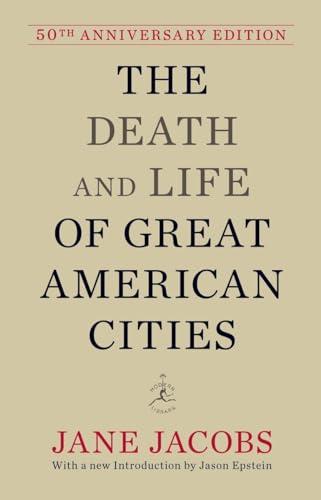
The Death and Life of Great American Cities 50th Anniversary Edition (Modern Library)
Jane Jacobs
Published to coincide with the 50th anniversary of its initial publication, this special edition of Jane Jacobs’s masterpiece,
Podcasts
5
Quotes
9

Podcast
Today, Explained
This book, written in 1961, was referenced to support the idea that safety in public spaces comes from informal networks of people using and enjoying the city streets, rather than just the presence of police.
"
I mean, Jane Jacobs talks about this in The Death and Life of Great American Cities, which was written in 1961. Safety on the streets by surveillance and mutual policing of one another sounds grim, bu...
— Episode: City Limits: Crime vibes
Episode: City Limits: Crime vibes
This book, written in 1961, was referenced to support the idea that safety in public spaces comes from informal networks of people using and enjoying the city streets, rather than just the presence of police.
"
I mean, Jane Jacobs talks about this in The Death and Life of Great American Cities, which was written in 1961. Safety on the streets by surveillance and mutual policing of one another sounds grim, but in real life it is not grim.
What contributes to a feeling and perhaps a reality of safety in public is not the presence of policemen, but the kind of informal network of what she called eyes on the street, which is just to say various neighborhood actors, whether they are merchants who have a shop or a bus driver who takes his coffee break here or a neighbor who is looking out after a kid playing on the sidewalk.

Podcast
99% Invisible
The host highlighted the book as a seminal collection of Jacobs' observations that championed pedestrian‑friendly, community‑based planning and critiqued mid‑20th‑century slum clearance. He described it as hugely popular and influential, calling it the "Bible for urbanists" and a love letter to what thriving cities already did right. In a later episode it was referenced as a modern example of mixed‑use, neighborhood‑focused planning contrasted with top‑down approaches.
Episode: The Power Broker #8: Shiloh Frederick
The book Death and Life of Great American Cities by Jane Jacobs was mentioned as an example of modern thinking about city planning, emphasizing community needs and mixed-use spaces. This approach contrasted with Robert Moses's more rigid, top-down approach to urban development.
"
Yeah, Death and Life of Great American Cities is sort of a city is a neighborhood is a living unit
Episode: U Is for Urbanism
This book was a compilation of observations Jacobs made about urban life, championing pedestrian-friendly cities and community-based planning over slum clearance. It was described as hugely popular, influential, and the 'Bible for urbanists,' containing principles seen playing out in Sesame Street's design.
"
In 1961, Jacobs compiled these observations and released a book called The Death and Life of Great American Cities.
It is hugely popular, hugely influential. The same way the concepts from The Feminine Mystique are in the air, the concepts from this book are also in the air. It's like the Bible for urbanists.
The Death and Life of Great American Cities was almost a love letter to what the city was already doing right.
Episode: U Is for Urbanism
This book was a compilation of Jane Jacobs' observations on urban life, directly challenging slum clearance and revitalization efforts of the 1950s. It was considered hugely popular and influential, often cited as the Bible for urbanists, detailing the conditions Jacobs believed were essential for a thriving city.
"
In 1961, Jacobs compiled these observations and released a book called The Death and Life of Great American Cities.
It's just one of those books that becomes part of the zeitgeist. It is hugely popular, hugely influential. The same way the concepts from The Feminine Mystique are in the air, the concepts from this book are also in the air. It's like the Bible for urbanists.
The Death and Life of Great American Cities was almost a love letter to what the city was already doing right. And in it, she identified a set of conditions that she observed every thriving city was built on.
Note: The book recommendations on this page are discovered automatically from podcast transcripts, and may be incorrect or incomplete.