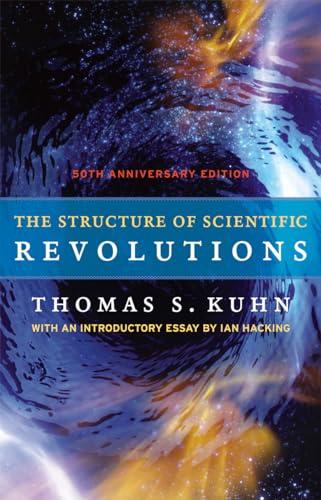

The Structure of Scientific Revolutions: 50th Anniversary Edition Cover
Podcast Mentions

The Structure of Scientific Revolutions 50th Anniversary Edition

Thomas S. Kuhn

A good book may have the power to change the way we see the world, but a great book actually becomes part of our daily consciousness, pervading our thinking to the point that we take it for granted, and we forget how provocative and challenging its ideas once were—and still are.

Podcasts 7
Quotes 12
On Purpose with Jay Shetty

It was discussed as a book that Jim Kwik and Elon Musk bonded over, which details how innovation across various industries often comes from outside perspectives.

"

I read this book, we were bonding over this book called the structure of scientific revolution and it, and, um, and by the other way, the other thing you get from reading fiction is not only creativit...

— Episode: Jim Kwik: ON How To Learn Faster, Rememb...

Episode: Jim Kwik: ON How To Learn Faster, Remember More &...

It was discussed as a book that Jim Kwik and Elon Musk bonded over, which details how innovation across various industries often comes from outside perspectives.

"

I read this book, we were bonding over this book called the structure of scientific revolution and it, and, um, and by the other way, the other thing you get from reading fiction is not only creativity and imagination, um, but also empathy.


Young and Profiting with Hala Taha

In the episode, the host referenced the book to illustrate that most innovation originates from individuals outside a given industry, noting that while the book was considered somewhat boring, it provided a useful perspective on this idea. The mention was brief and served mainly as a supporting point rather than a strong endorsement.

Episode: Jim Kwik: Is AI Destroying Your Brain Health? What...

This book was referenced to support the idea that most innovation comes from people outside of an industry who bring a different point of view.

"

There's a book called The Structure of Scientific Revolution, and I think it's kind of boring. But what I got out of it is most innovation comes from people outside your industry.

Timcast IRL

The speaker mentions "The Structure of Scientific Revolutions" in the context of discussing the concept of paradigms and how they can shift over time, suggesting that the current paradigm of progressivism is leading to a breakdown of social order and a loss of faith in traditional values.

"

I like the idea of Chester Tins when you find a fence figure out what it was for before you tear it down and sometimes you know maybe that fence is for something bad and it's okay to tear it down I'm...

— Episode: Timcast IRL #820 Trump Expects ARREST In...

Episode: Timcast IRL #820 Trump Expects ARREST In Connectio...

The speaker mentions "The Structure of Scientific Revolutions" in the context of discussing the concept of paradigms and how they can shift over time, suggesting that the current paradigm of progressivism is leading to a breakdown of social order and a loss of faith in traditional values.

"

I like the idea of Chester Tins when you find a fence figure out what it was for before you tear it down and sometimes you know maybe that fence is for something bad and it's okay to tear it down I'm not saying no one should ever defy expectation but what I am saying is when someone is defying expectations when they are tearing down fences that very clearly have a person of course there's a sense of entitlement there.

Philosophize This!

The podcast referenced the book in two episodes, highlighting its analysis of paradigm shifts and the non‑linear nature of scientific progress. The hosts explained how Kuhn argued that scientific breakthroughs are driven by social context and revolutions rather than steady rational accumulation, presenting it as a key work for understanding changes in scientific assumptions.

Highly Recommended

Episode: Episode #120 ... Logical Positivism

This book was discussed at length, focusing on the argument that scientific progress is not linear, but rather a series of revolutions, shifting perspectives and paradigms. It was said that Kuhn's argument challenged the idea that science is guided by rationality and that it's actually influenced by social context, as well as a desire to start over.

"

The Structure of Scientific Revolutions

The Structure of Scientific Revolutions.

The Structure of Scientific Revolutions

The Daily Stoic

The book was mentioned in a discussion about how people's understanding of themselves and their financial situations can change over time, similar to paradigm shifts in science. It was used to illustrate the idea that major life changes often occur gradually, not as sudden epiphanies.

"

have you have you read a structure of scientific revolutions by Thomas yeah you know he taught we think science is this like brilliant genius has a breakthrough that turns the world upside down but as...

— Episode: Ramit Sethi on How to Generate Wealth

Episode: Ramit Sethi on How to Generate Wealth

The book was mentioned in a discussion about how people's understanding of themselves and their financial situations can change over time, similar to paradigm shifts in science. It was used to illustrate the idea that major life changes often occur gradually, not as sudden epiphanies.

"

have you have you read a structure of scientific revolutions by Thomas yeah you know he taught we think science is this like brilliant genius has a breakthrough that turns the world upside down but as you know it's it's this slow accumulation of things not adding up the old theory not holding true anymore that eventually encourages someone to come up with something new and then that's what they call a paradigm shift and I think uh you know we think that's an epiphany but actually it's this kind of slow slumbering updating of of how you see yourself

Timothy Keller Sermons Podcast by Gospel in Life

The book discusses the concept of value neutrality, stating that it's impossible to be completely objective. Thomas Kuhn argued that all observations are based on some form of faith commitment, even in the scientific realm.

"

Now this was something brought out about 30 years ago. A guy named Thomas Kuhn wrote this in a book called The Structure of Scientific Revolutions.

— Episode: The Search for Certainty

Episode: The Search for Certainty

The book discusses the concept of value neutrality, stating that it's impossible to be completely objective. Thomas Kuhn argued that all observations are based on some form of faith commitment, even in the scientific realm.

"

Now this was something brought out about 30 years ago. A guy named Thomas Kuhn wrote this in a book called The Structure of Scientific Revolutions.

In it he put that the fact that there's no such thing as value neutrality.

You know, 20 years ago, before Thomas Kuhn began to sort of sink down into modern thinking, he used to read... When I came out of college, the counseling textbooks always said, if you're going to counsel somebody, you must do it value neutral. You must never impose your values on anybody. Never. If somebody sits in front of you and gives you a problem, you must be value neutral.

You must not tell that person what's right or wrong, but let them work it out for themselves. But you see, in light of just experience, the most recent counseling textbooks insist and admit that that's impossible.

There is no way, Thomas Kuhn said 30 years ago, to be value neutral. Everything that you see, everything that you question is on the basis of some kind of faith commitment.

Note: The book recommendations on this page are discovered automatically from podcast transcripts, and may be incorrect or incomplete.